h1

The Reflective Gaze

April 19, 2015

William Forrestall / Stephen Scott
The Reflective Gaze
Saint John Arts Centre
20 Peel Plaza
Saint John, New Brunswick
7 November – 23 December 2014

Originally published in Vie des Arts, #238 Printemps 2015, pgs 90-91

There is a vast difference in the subject matter and technique of Will Forrestall and Stephen Scott, but they share a common bond in their dedication to realism. They share other things as well. Both live in Fredericton, New Brunswick; they both attended the same art school, Mount Allison University. They are both senior artists and, most important, they are friends who talk to each other about their art and have done so for years.

Will works almost exclusively in egg tempera while Stephen paints in oil and watercolour. Will’s paintings are worked up from preparatory drawings while the majority of Stephen’s paintings, in this exhibition, are plein-air (painted directly from nature). The observation of the natural world is a quality that these two artists have in common. They use the loaded word ‘gaze’ in the title of their exhibition. Gaze is often equated today in a negative sense as in the male gaze, but their meaning is more traditional, referring to a fixed or intent look. Their paintings do reflect their deeply felt philosophy on the nature and meaning of contemporary art.

I have talked to Forrestall and Scott many times about their art, but it is their paintings that speak to me most directly. James Joyce says in his, the Portrait of the Artist: “The artist, like the God of creation, remains within or behind or beyond or above his handiwork, invisible, refined out of existence, indifferent, paring his fingernails.” In other words, that art can be viewed apart from the artist who created it. This is not to say that the artist’s ideas and thoughts, are not important but rather, that a good art work must stand on its own merits. Forrestall’s lilies and coffee pots take on an importance that belies their mundaneness and Scott’s paintings are more than pictures of New Brunswick or Nova Scotia landscapes. Both artists’s work speaks to the world of universal values.
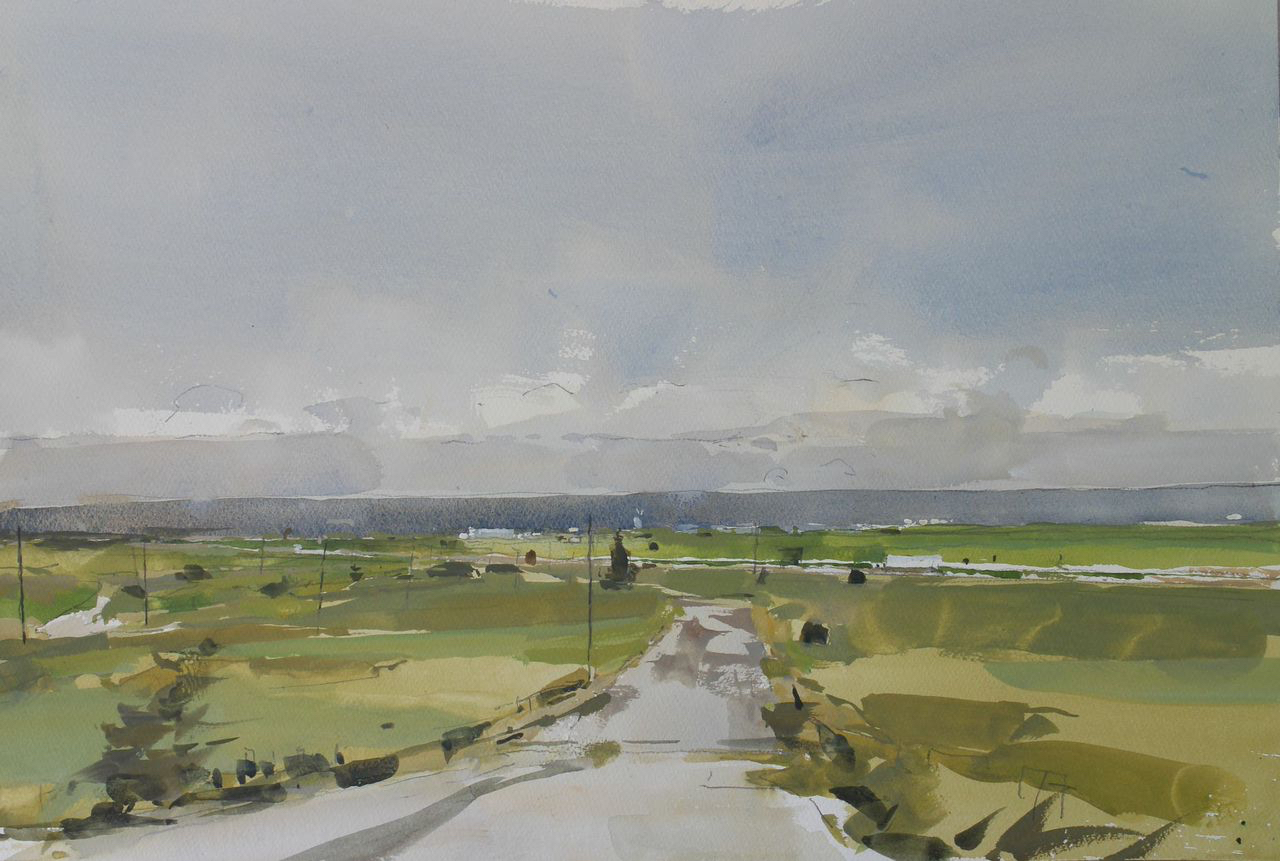
Image: Stephen Scott

Image: Stephen Scott

I was at this exhibition with two friends, neither one an artists, but they certainly understood the paintings and knew that they represented more than pictures of realistic things. Good art’s parlour trick is to stop viewers in their tracks and give them cause to think about what they are seeing. Realistic painting is a bit of smoke and mirrors. It is an illusion of reality. Will’s flowers and coffee pots are more than they seem and Stephen’s landscape are about more than about place. Painting is a chance for reflection.

3 Lilies 2 coffee makers -green

Image:  William Forestall


Will’s, Coffee and Flowers, 20”x40” (2012), offers a chance to reflect on the nature of objects; the coffee pots permanence versus the transience of the lilies. It is a 21st century take on the 16th century Dutch idea of nature morte transcending common still life with an often hidden comment on the fleeting quality of life. Stephen also owes a debt to Dutch and Flemish painters of the same period who brought bourgeois and secular values to landscape painting. Both his painting Storm Front, 14”x21” (2014), and his watercolour Study for Storm Front, 18.5”x25” (2014), are examples of landscape painting that bring universal human values to the genre. The study was done on site and the painting, from the watercolour, in the studio. The location, the Bay of Fundy, is not as important as the image of a coming storm and the change that it will bring. It is something that most viewers will understand independent of the painting’s geographic location.
Forrestall uses egg tempera in a very precise fashion building the painting surface to completion through minute cross hatching, but the detail is united as you stand back from the pictures. His paintings possess a quiet contemplative quality that draws you in and holds your attention. The works in the exhibition, with one exception, are generally larger works than those of Scott’s. While Will’s paintings are realistic they are also abstract.  The lilies in Coffee and Flowers and in Three in Blue, 33”x22” (2011) are in a very different space and scale from their backgrounds, but they are visually logical.

Many of Scott’s paintings in the exhibition are very small at some five by seven inches no more than sketches, really, but they offer an eyeful. They remind me of the best small oil sketches of the Group of Seven. He is able in a few well- delivered brush strokes to capture the essence of a situation. When viewed closely his paintings are totally abstract, but, like Forrestall’s work, when viewed from a proper distance, fall together beautifully. He uses paint as a musician uses notes to build a melody. In music, it’s what’s not there—the silence between notes—that is important. Similarly in Scott’s paintings, it’s what we think we see that’s important. He makes our eyes, and our brains, work to complete the picture.

As artists, Forrestall and Scott have worked for a very long time—between thirty and forty years—dedicated to a continued commitment to realism. Their work is different, but they share a constant belief in realism. Isolation from artistic centres like Toronto and Montreal might be a reason for their devotion to their respective visions. They are certainly aware of what is going in both Canada and the rest of world, but they choose to work near to where they were born and received their artistic training. It’s good to see art that is about quality and craftsmanship and not just about keeping up with fashion.

© Virgil Hammock, Sackville NB, Canada, Sunday, February 15, 2015.

h1

Paring my Nails

February 25, 2015

The other day I was paring my nails and I had a Proustian moment, my very own madeleine. My mind went back to 1962 when I first read James Joyce’s words in the Portrait of the Artist describing his epiphany: “The artist, like the God of creation, remains within or behind or beyond or above his handiwork, invisible, refined out of existence, indifferent, paring his fingernails.” Those words of Aristotelian/Thomistic logic struck me like a thunderbolt then and they still ring true. An art work, while the product of the artist, stands apart from its creator. One cannot exist without the other, but once the artist releases, gives birth, to the work of art, it exists on its own merits.

I have been thinking about this separation of art from the artist for over a half of a century. Certainly the genesis of a work of art exists in the mind of the artist and its execution is by the hand of the artist. However, once it’s done, it stands on its own. Anonymous art works are no less valuable those by a known artist. Art works by a scoundrel, Caravaggio, are no less valuable than those by a saint, Fra Angelico. The history of art is filled with very good art done by very bad people.

Valuable is a funny concept in regard to works of visual art. Is a Gauguin worth hundreds of millions of dollars? No, it isn’t, it is priceless and if priceless, then it is also valueless. The worth of a painting comes when it is seen by a viewer. There is something obscene about the current art market with its ever increasing prices at auctions for art works both good and bad. Of course, art has always been a hobby horse for the rich. People without taste trying to prove otherwise are nothing new, but we appear to have reached a new high (or is that low?) in money chasing art. That is too simplistic as many high end art purchases are investments pure and simple. Investment in art has outstripped other investments many times over. It’s simply buying and selling art like pork bellies only more profitable.

What’s to be gained by the forces of triumphal commodity capitalism in having someone like me go into a museum and look at a painting. Where is the money in that? Actually, the price of looking has gone up since I was young with most art museums requiring hefty admission fees plus even more money for so-called ‘blockbuster’ exhibitions. I’ve been to exhibitions recently that ended up costing thirty-five bucks to join the herds in a jam-packed gallery. Lucky me, I have a press card that gets me in free and often to private views of exhibitions, but as a child and young man art museums were generally free. My grandfather would take me to San Francisco’s deYoung and Legion of Honor from about the time I was ten. It was there that I fell in love with paintings. As a teenager, I lived in England and went to public art galleries and museums there and in Paris. Later, as an art student, I went to museums in San Francisco and New York. All without paying a cent.

You are the product of your experiences and I doubt if my life would have followed the course it did had I not gone repeatedly to museums when I was young. It is interesting that fifty years ago, and more, the galleries were often quite empty and I had whole rooms to myself. It’s a paradox that even with high admission charges the museums are more crowded now than then. This seemingly blows my theory that museums are more elitist now, but it’s who doesn’t go rather than who does that matters regardless of the attendance figures that is important. What is more, those that should, don’t and their numbers are increasing. Yes, museums have free days and school tours, but it begs the point that museums are seen by many as elite. That’s a shame.

meaning_meaningWhat drives people to become artists? Why did Joyce’s Stephen Dedalus, the young artist in question, want to be an artist and not a plumber? Even then a plumber would make a better living than a poet, but a poet’s life was a whole lot better than a plumber’s at least in Stephen’s eyes. Joyce’s hero wanted romance; to be a romantic. I think romance is still a good idea a century after Joyce’s book. Certainly, art offered me a way out boredom and on to a path that I hoped would end in adventure. When I was twenty, I didn’t think of making a living or about saving for a pension plan. I wanted to be an art hero and that’s why I read Portrait of the Artist. If Stephen could do it, I reasoned, so could I. I don’t think I ever became the hero I wanted to be, but my life has been filled with wonders and it wasn’t boring. I’m slowing down a bit now. It is the winter of my life, however, I’m hoping for a couple more springs before the curtain drops.

© Virgil Hammock, Sackville NB, Canada, Monday, February 23, 2015.

h1

Dead White Male Philosophers

January 29, 2015

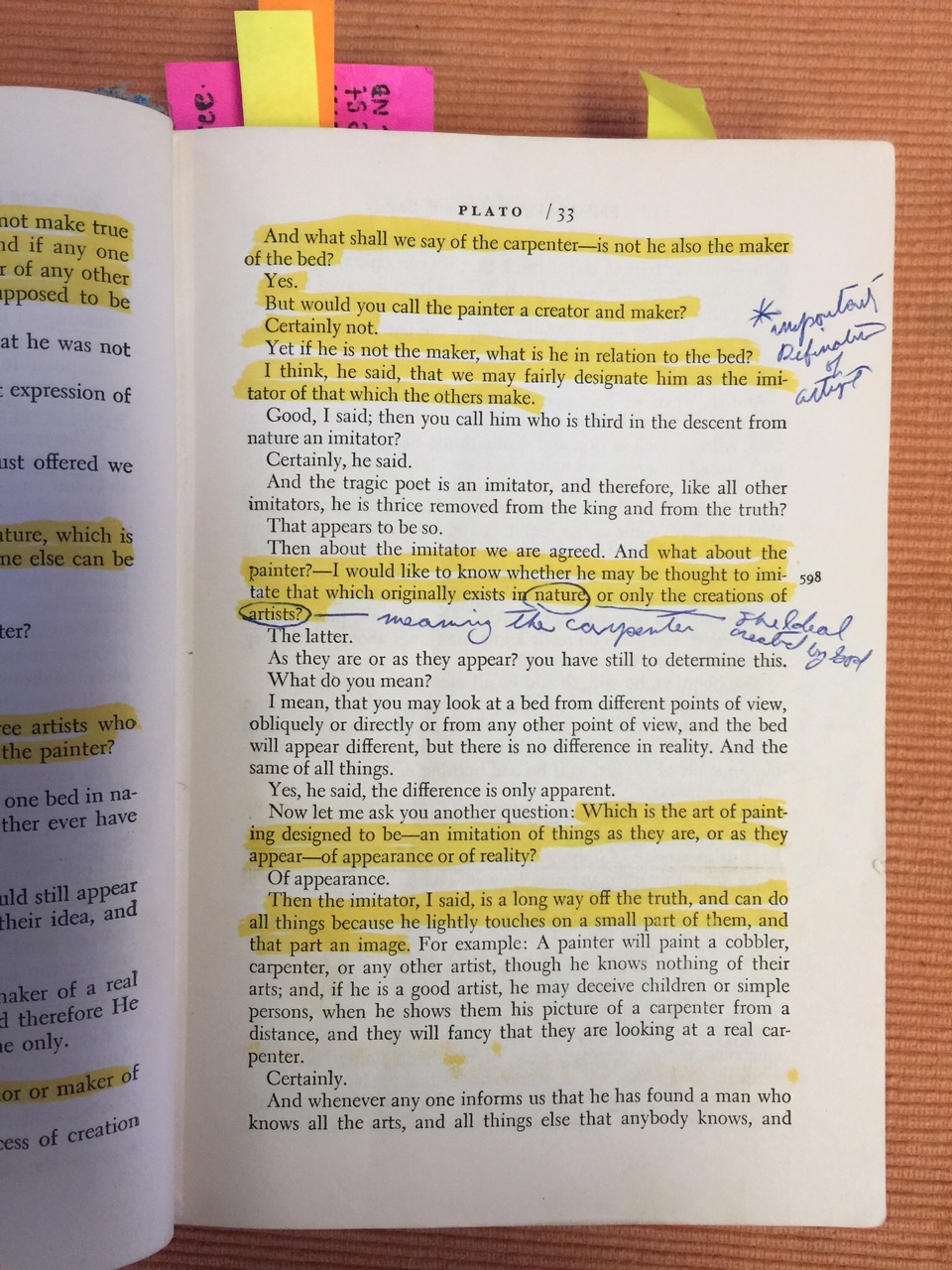
I had a second look at the image that accompanied my last post which was a page out of the Modern Library’s edition of the Philosophies of Art and Beauty edited, in 1964, by Hofstadter and Kuhns from their chapter on Aristotle’s Nicomachean Ethics concerning what is art. I find what Aristotle had to say about art still holds water. It was written sometime before 322 BC or, to be politically correct, BCE; a long time ago. I first read this text in 1966, forty-nine years ago. I’m not sure which came first, the high-lined or underlined text or why I did either. It’s likely that I underlined the text while I was using the book in a course on art theory I took from Albert Elsen in 1966 at Indiana University while at graduate school and the high-lining was when I used the book as a text in my own course on art criticism that I taught many times during my teaching career. But that’s beside the point. What is important is what Aristotle had to say around two thousand four hundred years ago and how our understanding of the problems of art remains pretty much the same. So much for progress.

Aristotle tells us that all is art: “…whose origin is in the maker and not the thing made; for art is concerned neither with things that are, or come into being, by necessity, nor with things that are so in accordance with nature…” Makes sense to me. You can’t really have art without the artist. Of course, once you have a work of art, it can pretty much stand on its own without the artist. It’s a chicken and egg thing. The big deal is the idea. Mind you, this is where Plato and Aristotle part company. Is the idea in God’s hands or the artist’s mind? I’ll stick with the artist, thank you very much, and leave God wherever he, she, or it may reside. I really don’t believe that art is several times removed from the ideal. I don’t like the idea (Plato’s in The Republic) of art, and the artist, coming in third place after the idea of a bed.  Art is it’s own thing and certainly not an imitation of the real. And art can be an improvement over nature.

Ideas, even good ideas, are, of course, a dime a dozen or twelve cents Canadian and good ideas that result in good art are rarer still. In Metaphysics, Book IX, 25, Aristotle states the obvious: “…for he who does a thing well must also do it, but he who does it merely need not also do it well.” Therein lies my problem; most of my good ideas, intentions, have gone undone. Which leads up to the last sentence on the illustrated page from his Nicomachean Ethics: “Art, then, as has been said, is a state concerned with the making, involving a true course of reasoning, and lack of art on the contrary is a state concerned with making, involving a false course of reasoning; both are concerned with the variable.” Ah, the variable, but that’s the subject of another whole post. I’ll stick for the moment with the ‘making’.

plato

Aristotle also states in his Nicomachean Ethics, this time in Book II, that: “…we often say of good works of art that it is not possible either to take away or to add anything, implying that excess and defect destroy the goodness of works of art, while the mean preserves it; and good artists, as we say, look to this in their work.” Yes, too much is too much and too little is too little. What is needed in a work of art is balance. Finding that balance is the difficult part. In my life drawing classes I often had my students erase as much as they could from what they thought was a finished drawing and still have it hold together. The result was almost always a better drawing. The reverse was telling them that they had a certain amount of time to produce a finished drawing, say ten minutes, and then when the time came, tell them to continue drawing. The result of this exercise was mixed. Sometimes the drawings got better and sometimes worse. Believe it or not, my idea for these exercises did come from my reading of Aristotle. Talk about applied philosophy.

If dead white ancient Greek and Roman male philosophers teach us anything it is that the problems surrounding the making of art have changed very little since the fifth century BCE. We, or at least I, have failed to find any solutions. Yes, times and media have changed. I don’t want to debate here about the sex or race of who makes art; only what it is art and what it is that drives human beings to make it. Whether people picked up sticks and drew animals on a wall or whether they make videos, some do it, or did it, better. They made art. Many thousands of years ago or yesterday doesn’t seem to make a difference. The why and what questions remain. I think that art is more than shadows on the wall. There is something in human nature that gives us the will, as Aristotle thought, to do something well. I just wish that I knew more about that something that does gives us the will to make art. It’s all questions and few answers. Damn.

© Virgil Hammock, Sackville NB, Canada, Tuesday, January 27, 2015.

h1

Marginalia: Life on the Edges

January 21, 2015

I am attempting to move my library office from the basement of my house to the first floor. It’s not because I’m getting too old to go up and down the stairs, but because I’m returning the office back to what it was, a guest apartment. The challenge is that the guest room upstairs that will become my office is much smaller and already full of books.

Books, you see, are my problem. I have been collecting books for over a half century. They’re easy to come by and very difficult to get rid of. I don’t seem to be able to throw them away. Can I be sure that my copy of Wordperfect for Windows for Dummies won’t come in handy sometime? Actually I’m just dropping that tome into a blue recycling bag as I write this. There it goes. Painful. Now for rest and it’s a lot. Books to the right of me, books to the left of me, books everywhere and the problem is that rest of the house is already full of books.

My friends, who are keen on technology, tell me I don’t need books anymore as everything is available online. Just throw them out, they say, you’ll be a better man for it and, besides, they add, we might be able to find a place to sit down when we visit your house. They might as well tell me that I could do without sex too. Which may be good advice. At my age too much excitement could kill me. Of course, there is the online sex too, but that leaves much to be desired despite the daily stream of young women who have read my Facebook profile and are dying to meet me.

Every book I own, you see, has a story to tell me. It’s not necessarily the content; it’s more about how I acquired the book. Did I buy it, was it a gift or did I borrow it and forget to return it? Yes, I did buy that copy of the Selected Poems of Ezra Pound at City Lights in San Francisco in December of 1965 when I was home for Christmas from studying for my MFA at Indiana University. How about a copy of Cézanne, a tiny Fontana Pocket Library of Great Art edition, that given to me by a certain Mrs. Lund during a trip on a freighter from Hull, in England, to San Francisco in 1954? We had become friends on the month long trip and we talked about art the whole time. I was fifteen and she was in her thirties. I was in love with her and, besides, it among my first books on art. Throw these two out? Not on your life.

Then there’s the copy of Ogden and Richards’s The Meaning of Meaning that I should have returned to the University of Manitoba’s library by December 28, 1971. I’ve yet to finish the book. Some books take longer to read than others. On the subject of marginalia, there’s my copy of the Modern Library edition of the Philosophies of Art and Beauty edited by Hofstadter and Kuhns that I bought in February 1966 for a class in art criticism taught by Albert Elsen at Indiana. I used the book, the same book, to teach a similar course for over thirty years. I couldn’t say the course was as good as Albert’s, and I did keep in touch with him, but it was my best shot. The book is held together with duct tape and every chapter is underlined or marked with a highliner with my ‘brilliant’ remarks on the margins. It’s a history of my teaching career and my friendship with Elsen.

There’s the heavily annotated The Norton Anthology of English Literature, Volume 2, also from the 1960s, once owned by my late second wife, Candice. I can’t pick it up without thinking of her. She was a brilliant woman. The book is hardly a page-turner, but I often use the book as reference. Now, it shouldn’t take me all that long to go through the thousand or so books in the basement if I continue at this rate.

Visitors often ask me if I’ve read all the books I own. Actually, I have at least attempted to read them all like the before mentioned The Meaning of Meaning. It’s just that some are easier reads than others. My dog and cat are lending their noses as I go through this hopeless task of culling my library. I think their advice is about as good as I would get from any of my friends. My excuse is that we all need history, if we are going to avoid the mistakes of the past, to paraphrase Santayana, and my books are my history. If I stop reading, stop writing, senility will surely step in the fill the gap or, at least, that’s how I view my race to the end of time, my time.

Let’s see, there are first editions, signed editions, rare books, books by friends and hundreds of exhibition catalogues going back over fifty years. I pity my children trying to make heads or tails of my library after I’ve ‘passed’ to that big archive in the sky. They’ll likely give them to the Sally Ann or throw them away. At least, that’s the advice I would give them. On second thought, why not burn my body on a big stack of books or, better still, throw a match into my library with my body sitting at the desk. It would be a Viking literary funeral—dust to dust, rubbish to rubbish.

aristotle

© Virgil Hammock, Sackville NB, Canada, Monday, January 19, 2015.

h1

We are all Charlie or in my Case: I am Mike

January 14, 2015

I was trained by the US Army to be a combat photographer. It was considered to be a very dangerous job. I volunteered. I was seventeen at the time and none too bright. Fortunately, the only time I spent in a combat zone was for sixteen months in Korea in 1957 and 1958. The real war had ended in 1953. I subsequently spent nearly forty years of my life teaching art at university and, in particular, teaching drawing. I was following my post army credo, make love not war with an emphasis on the love. I thought that art would not be a dangerous job for me or my students. The recent events in Paris have proven me wrong.

A former student of mine, Michael de Adder, is one of Canada’s best known political artists. In fact, I’m in the process of organizing a major retrospective of his work at the Beaverbrook Art Gallery in Fredericton, New Brunswick for next year. We had spoken, before the shooting in Paris, about cartoons he had drawn that proved too hot to be published and others that when published that got him and his publishers in trouble for being too provocative. These were, of course, the kind of materials that I wanted to include in the exhibition.
Political cartoonists work within a very short time line. They need to know what is going on and what’s going to be of interest to the paper’s readers. They need to be provocative. Who wants boring cartoons. They need to have an opinion. Nothing should be sacred; yet if it’s too far off the wall, then the paper won’t likely publish it. Mike does everything a good political cartoonist ought to do. The one thing he should not have to worry about is getting killed in the process.

by Micheal de Adder (used with permission)

by Micheal de Adder (used with permission)

There’s been a lot of ink spilt in the last little while over the Charlie Hebdo shootings some of it very good and some, too much, lamentable. Salman Rushdie, who does have some real experience with extremism, vented his frustration, during a TV interview, over what he calls the buts. These are the people who say, yes, the events in Paris were terrible, an attack on free speech, blab, blab, but if Hebdo had been more sensitive to people’s feelings, none of this would have happened. This begs the point of what Charlie Hebdo was, and is, a slightly off-kilter, satire magazine. The old Mad magazine or the National Lampoon on steroids. Charlie Hebdo is not in the business of being sensitive. Rushdie said that you are either against an outright attack on freedom or you’re not; there is no middle ground. He is right.

I’m able to avoid what Mike must confront. I’ve told the magazine, that I’m still writing for, that I’m going to only write about exhibitions and subjects that I like. I figure that there’s a lot of bad art and why, at my advanced age, should I get my knickers in a knot venting about stuff I don’t care about. I guess I’m back to my make love stand of the 1960s. Mike, on the other hand, has to deal, on a day to day basis, with a lot of awful stuff and be funny at the same time. People do get offended and write letters to the editor. If they didn’t, Mike would likely be looking for another job. I do know that he believes in what he draws and is passionate about his work.

The danger of an event like the Hebdo shootings is that cartoonists, consciously or sub-consciously, will self censor themselves or be censored by their publishers. It’s easy to understand why. Getting yourself killed over your art is an option to be avoided. The main problem that faces most North American cartoonists is running afoul of the politically correct. This is a quagmire that I am all too aware of after a lifetime in academia. Seldom does a day pass that there isn’t a letter to the editor in the newspapers that I read where someone is offended by an editorial cartoon. Fortunately objections normally stop there and the next day all is forgotten.

Political cartoonists are like the court jesters of old. The jester had the difficult job of telling the king the truth and had to be skillful to keep his head. One assumes that even temperamental kings had a sense of humour or they would have had a hard time finding jesters. The people who murdered the staff at Charlie Hebdo had no sense of humour. Truth often needs humour to make us see the absurdity that surrounds us.

These are dangerous times and we need windows to truth more than ever. I doubt that if I were living in Paris today, that I would have been a regular reader of Charlie Hebdo, and I did briefly live in Paris, but I sure as hell would be buying a copy now. I’m proud that Mike was my student. I might have helped him learn to draw, but his talent, and bravery, are his own. So, I am Mike as well as Je suis Charlie.

© Virgil Hammock, Sackville NB, Canada, Monday, January 12, 2015.

h1

Stephen Paints a Picture: Part Thirty-Two

December 3, 2014

26 May 2014

It was a Monday, the day after Lord Beaverbrook Day, and the gallery was closed as it is every Monday, but Stephen Scott and I were at Beaverbrook Art Gallery around eleven in the morning to try and finish his portrait of me.

“This should work out OK for us,” I said, “as there will be nobody around and we can concentrate on the painting.”

“Well, it certainly needs some work,” Stephen told me, Where’s the style? It’s boring.”

“You’re beating yourself up again. I think that it’s fine. It just needs the finishing touches.”

“I think that it’s a day for big brushes. Too much finicky detail. I’ve got to pull the whole fucking thing together,” he replied.

“I rather like the combination of detail and broad brushwork. It reminds me of Dutch and Flemish 17th century painting—Rembrandt, Halls, Rubens and the like,” I told him.

“But where’s the style, my style?”

“You got loads of style just don’t screw it up.”

“It’s hard to copy old master techniques. They’re just so natural and too good.”

“I think that you’re doing a pretty good job. A lot of contemporary artists have done a homage to past masters like Freud’s admitted homage to Watteau,” I said.

By this time Stephen was going in earnest with a very large brush on the canvas. Because I was posing I couldn’t see what he was doing, but seemed to be having a good time.

“It’s a good thing for painters to look back at art history to find inspiration. There’s some damn fine painters not that far back like Sargent and he, sure as hell, was looking at Rubens,” he said.

“It sure goes back to that old chestnut that art is about art,” I replied, “but I’ve been accused of being an old fart, sort of a neo-con critic and that was by friends.”

“They seem to have you pegged. Mind you, I’m not exactly a progressive.”

“You know I do like abstract painting, Abstract Expressionism, in particular, but that too is now history,” I added.
“But a lot of those guys,” he said, “could paint. They had solid education and it shows.”

“Where I have problem is with an artist like Jeff Koons who draws on Popeye and ballon dogs for inspiration and then farms out the work to a factory to do,” I said, “I think the work is shit, but then, again, he wildly successful and I’m not. One of the stupid dogs just sold for millions.”

“I’m not exactly swimming in money myself, but if you say artists like Koons or Hirst are shit, people will say you are reactionary or worse. Art is what it is today and that’s that.”

“Much of it is just bullshit, bad art, but then I’m a self identified old fart and what do I know about this brave new world of today’s art?” I said.

“Now, you’re beating yourself up. You’ve got a pretty solid base of art history. I’d say that there is a general disrespect for tradition in much of today’s art world.”

“I think that it’s more a lack of education than disrespect. When I talk to many students and younger artists, I’m amazed by what they don’t know about the history of art and, not only that, they don’t seem to care. They think history begins with them and, perhaps, they’re right.”

“Don’t forget the part,” he added, “that if you don’t know history, you’re doomed to repeat it.”

“You’ve got that right. I’ve been looking at the same bloody installation works, all by different artists who think they’re being original, for the past fifty years and these have been shows in North and South America, Asia and Europe. It’s depressing the number of circles of rocks, tree branches and empty galleries passing as a statement that I’ve seen.”

“There are good contemporary artists and good exhibitions of contemporary art,” he said.

“You’re right, but I just have trouble naming them off the top of my head. How’s my painting coming along?”

“It’s getting there. Are there any of those coffee cartridges we bought left in the staff room.”

“I think so. Let’s take a break and I’ll go make us a cup.”

Back with the coffee, I had a look at what Stephen was doing with the painting, he was trying to bring everything together. He was adding details like my wrist watch and pen and, at the same time, working on unifying the background with the figure. The problem with painting is knowing when it is done, when to quit. It’s a problem that we had talked about many times during this project. I was familiar with the problem, when I painted as I, more often than not, had screwed it up at the last minute and had gone too far with a painting. Stephen had confessed that he did the same thing, but I think that he was a better judge about his own work than I was about mine and I felt a majority of his paintings looked ‘right’.

“Look, we’re getting there,” I said, “what do you think?”

“It’s close, but there’s the difference between making a painting and not making a painting”

“That’s cryptic. Who’s going to be the judge with this painting? You or me?”

“Perhaps the rest of the world.”

“You may have reached the point where you don’t need me to finish the painting. The painting takes on its own life and I just get in the way, but I’ll sit down and you have at it.”

“Sounds like a plan. There’s still things I can do.”

“I keep going back to the idea of music and painting,” I told him as I resumed posing, “In music it’s the space between the notes that’s important and in painting, it is often, what not there that makes it art. One’s imagination makes an art work, be it music or painting, complete.”

“Yes, you’re right a work of art is always more than the sum total of its parts.”

“That’s often the problem with Photo Realism, it tries too hard to look like a photo and misses the whole point of painting which is to make the eye and imagination work,” I said.

“There are times when photographs are useful as tools to an end in painting, but only as one tool among many,” he replied.

“Granted, but we’ve gone through this whole project without using photography and I think that the painting is the better for it.”

“It has taken us a long time, though, since last summer nearly a whole year. When did we start?”

Sketch 18 July 2013

Sketch 18 July 2013

“The 18th of July of last year to be exact. I looked it up last night.”

“Glad, I’m not being paid by the hour.”

“Actually, you not getting paid at all.”

“Don’t remind me.”

We worked, or rather, he painted and I sat, for the next hour or so, continuing our conversation, until it was time for the gallery to close. Terry Graff came in to watch us finish as did Sophie, his wife.

“So, is it done?” Terry asked.

“Close,” Stephen said.

“Hey, let me get up and see the last stroke,” I said, “I’ve waited a long time for this,” Stephen hit a high light on my wrist and watch and that was that, “I think that we should all go out for a drink, right now. Can Stephen clean up tomorrow, Terry? This is cause for a celebration.”

“Sure, I’ll even spring for the drinks.”

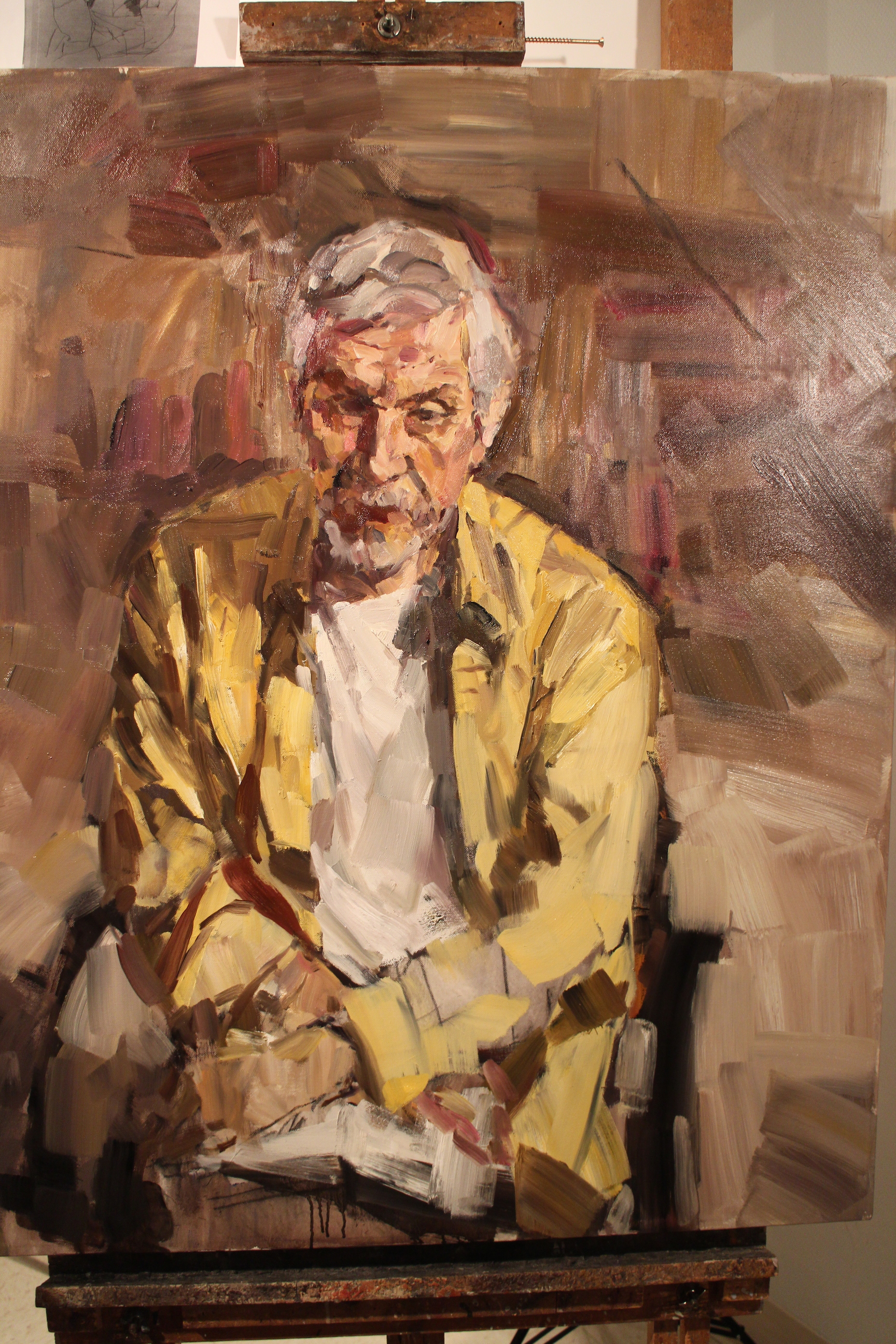
Final Portrait

Final Portrait 26 May 2014

© Virgil Hammock, Sackville NB, Canada, Saturday, November 29, 2014.

h1

Stephen Paints a Picture: Part Thirty-One

November 26, 2014

25 May 2014

It was, at last, Lord Beaverbrook Day at the Beaverbrook Art Gallery. The gallery annually puts on an open house for the event and regularly draws its largest attendance of the year. Stephen Scott and I were scheduled to finish my portrait during the day. We had planned to work at the gallery from eleven in the morning until two in the afternoon, but we got to the gallery early and decided to work until the gallery closed at five, but, even then, we figured that we might need an extra day to finish.

As Terry Graff, the gallery’s director, promised the place was packed. The staff had roped off our work space so that it resembled an accident scene.

“I’m not sure I like this,” I told Stephen, “It cuts us off from the public and rather puts us on display like an exhibit.”

“Yeah, I agree, but let’s leave it be for the moment and see how it works.”

By the time we really started working the place was crawling with kids and their parents. The little girls outnumbered the boys by a wide margin, but that seems to be the way it is. The boys were likely out with their dads doing manly stuff leaving the culture to the girls.

beaverbrook basement

Speaking of girls, one who appeared to be seven or eight, and for some reason dressed in a tutu told me, “When I grow up, I want to be an artist,” which was a statement that we had heard a few times over the week and almost always from girls. “OK, it seems like a good idea to me. What do you think, mom?” I asked her mother.

“If that’s what she wants, it’s OK with me.”

“Well, keep her interested. We need all the artists we can get.”

Stephen May, another Fredericton artist, who had been visiting us several times over the week, showed up once again.

“What do you think about Lucian Freud, Stephen?” he asked.

“I like him a lot. What’s not to like. Virgil and I talk about him often. How about you?” Scott replied.

“I like him too. He so painterly. Throws the stuff around really well.”

“If I can get my ten cents in,” I said, “I think that he was one of the best painters of the last century.”

“He doesn’t over romanticize his subjects. He can be brutal,” Scott said.

“I agree, but despite that, I find him to be a romantic,” I replied.

“I think Freud’s Romanticism is in his attitude,” May said.

“He sure as hell knew how to live his life to the fullest,” Scott said.

“God save us from boring artists,” I added.

We had quite an audience by that time, all of whom were listening intently to our three way conversation, but I doubt if many of them had any idea who Lucian Freud was. The seriousness of our talk was broken by one little boy in a Boy Scout uniform, looking at one of Stephen’s nudes in the exhibition, who announced to his mother in a loud voice, “Look, mom, another naked woman.” That statement broke everybody up and brought an end to our talk about Freud. Truth does come out of the mouths of babes.

“What do you say we take these barriers down,” I suggested.

“They’re in the way. Why not? This way people can get behind me,” Stephen aid.

“Good, want to do it, Max?” I said. Max Ackerson, a young art student, who had been helping us over the last few days, had been with us since eleven in the morning. He pulled the ropes aside, sat down again and continued to draw the scene in his sketchbook. He turned out to be a big help with our project.

“You know we should start our art school in Sackville,” I suggested to Stephen.

“Yeah, we have talked about that, haven’t we?”

“Meredith has got the space. The carriage house on Rectory Lane. It would at least in the summer or when it’s warm,” I added.

“We could do painting, drawing, history, criticism, the whole nine yards,” he said.

“Yes, and the nice thing, it’s nearly right across the street from the new fine arts building.”

“I really like the idea, Virgil, of a really traditional programme. Something most art schools and departments aren’t doing.”

“No shit. There’s a lot of art students out there that can’t draw and fair number who would like to know how to.”

“The trick,” he said, “is how do we do it? There’s startup costs and figuring out what in the hell to charge much less where the students are going to come from.”

“We can have a good look at the space this summer. I know that Meredith would be interested.”

“How many students do you think the space, and we, could handle?” he asked.

“Somewhere around ten to dozen. Needs to be a pilot project.”

“Sounds like a good way to go broke, but still interesting. What do you think Max? Would you go?”

“Maybe,” Max replied, “but it wouldn’t be like a regular art school.”

“Ah, but that’s the point,” I said, “It could be like how artists learned in the Renaissance and before. Working with an established artist and working from the ground up. Learning by doing. Less bull shit and more work.”

“Sounds better and better,” Stephen said, “but it would be a lot of work to get it going.”

“Granted, but there is a market out there. People want to learn traditional skills. There is a school of figurative art in New York which charges a lot of money and they have all the students they can handle.

“First things first. I still have to finish this painting and then maybe we can save the art world.”

“Speaking of first things, I could use a cup of coffee and a couple of cookies, how about you? Let’s take a break.”

“Good plan.”

“I can go into the kitchen and get it,” Max said.

“An even better plan,” I said.

During the break, I was able to get up and take a look at the painting. “It’s going OK, if you ask me,” I told Stephen. “Who’s asking you?” he replied. Stephen is a hard man to please. He’s very critical of his work and I’m always worrying that he is going to wipe out the portrait and start again which would not be good because we were scheduled to finish the project today or tomorrow at the latest. The gallery was really packed by now and there was no shortage of rubberneckers, but that was the whole point of the day and they, and we, were actually having a good time. It was odd as it was rather like the act of painting as a concert and I was looking for applause to break out after a particularly good brush stroke by Stephen. Historically the only precedent that came to mind was Gustave Courbet’s The Studio, but then we would have to have a real naked woman standing next to Stephen as he painted at the Beaverbrook which might have raised a problem for family day at the gallery.

Courbet_LAtelier_du_peintre

Finishing our coffee, I sat down and Stephen resumed painting. We talked about another project that we could do after finishing the portrait that might be easier than starting our own art school.

“I do like the idea of us going to art galleries around the Maritimes and the northeast of the States and looking at pictures together,” I said.

“It does have legs,” I think he said, “Picking one painting from each collection and talking about it.

“We could video as well and put it on YouTube. It’s too bad that we didn’t video this project, but it’s too late now,” I replied.

“Well, let’s do it, but I’m not going to finish this picture by five. We’re going to have to come back tomorrow.”

“Suits me and the gallery will be closed to the public. Should make it easier.”

“I feel like lobster and fiddleheads. How about you?” Stephen told me and I couldn’t argue.

© Virgil Hammock, Sackville NB, Canada, Tuesday, November 25, 2014.

h1

Stephen Paints a Picture: Part Thirty

October 20, 2014

24 May 2014

Stephen Scott and I went to Fredericton, from his Nashwaak Village home, early Saturday morning to meet two friends, Harold Jarche and Chris Mackay, from Sackville for brunch at Isaac’s Way which is just two doors up from the gallery. They were both in on the project from its beginning the year before and they wanted to see the large painting being completed. All last summer the four of us would meet every Wednesday night at my place for wine and cheese and to shoot the breeze about art and technology. Chris and Harold were the techies and Stephen and me provided the art part. Anyway, they became very keen about Stephen’s art and we managed to plough our way through a great deal of wine in the process.

After a long brunch and conversation, we all went next door to the Beaverbrook Art Gallery and the exhibition. Chris and Harold had only seen the larger portrait in its very early stages and were impressed with the nearly completed painting.

“It’s pretty neat,” Harold said, “How long have you been working on it?

“I don’t know, thirty, forty hours, maybe more. What would you say, Virgil?”

“About that. I haven’t really counted. Should though.”

Stephen was transferring his paint from the water bath to his palette. “Hey, that’s a new palette. It’s square. Why?” I asked.

“It’s larger that’s all. I haven’t a fucking clue about the background colour. What do you think?”

“You’re painting, not me. If I were, I’d opt for something dark to contrast with the yellow shirt—dark brown or green.

“Speaking of the yellow shirt. I can’t seem to be able to find the right yellow.” He looked through the tubes of paint in his paint box. Picking one up, he said, “Think I’ll try yellow lake.”

basement sittingChris and Harold were walking around looking at the rest of the exhibition. They couldn’t figure what they liked best. It seemed like toss-up between the swimming pictures of Sophie or the painting of the dogs. “all things being said,” I told them, “I like the series better, but Echo and Bailey art pretty cute.”

“What do you mean by cute!” Stephen interjected, “I don’t paint cute.”

“Dog pictures are everybody’s favourite. Just watch the people as them come into the gallery. I’ll bet three quarters of them gravitate to the dog picture,” I answered.

“Perhaps, I should paint you as a dog.”

“Might be an improvement. It would certainly be better than painting me nude.”

“that’s an awful thought.”

“Yeah, my body is gone. Can my mind be far behind?”

Just about then Max, the art student we had met yesterday, came in. We had invited him to help us with the project.

“Good to see you Max. Ready to give us a hand?” I said.

“Sure, what can I do?”

“Not much right now. We need your eye more than anything else. What do you think? Have a look,” I told him.

“It looks pretty good to me.”

“What would you do?” Stephen asked him.

“I don’t know.”

“Here, have a go,” Stephen handed him his brush.

This took Max, and I must say, me, by surprise. I wouldn’t think that Stephen would ever let anyone touch one of his paintings. Max took the brush and dabbled a couple of strokes on the canvas. Mainly, it turns out, on the background and quickly returned the brush to Stephen.

“I think that was an improvement,” Stephen said.

Stephen never ceases to amaze me. He often puts on a grouchy persona, but, in reality, he is a bit of a softy. During our time painting at the Beaverbrook, he was always polite and friendly in answering everyone’s questions particularly those from children and students. I, on the other hand, have no problem being constantly grumpy. I put it to lower back pain.

“Max,” I offered, “Why don’t you go in the staff room and make us all, yourself included, a cup of coffee and I think I left some cookies from yesterday.”

While Max was gone, I asked Stephen why he let him work on the painting.

“Look, he isn’t going to any harm and the painting still got a long way to go. What’s here today might be gone tomorrow and besides, it’s good for his ego.”

“You got a point, I guess. It’s interesting that you keep referring to the drawings, and even the photographs of the drawings, while I’m sitting right in front of you.”

“The drawings are a different thing. They are the product of non-thinking. Drawing is almost automatic.”

“I would call it creative non-thinking,” I replied.

“I guess that’s a good way of putting it.”

“In order for drawing to be automatic,” I said, “You’ve got to master it and here I mean technique.”

“You learn drawing by doing it over and over again until it becomes second nature,” he said.

“Learning to draw is sort of like learning to play the piano. Lots of practice makes perfect. Mind you, it still doesn’t explain great drawing which comes down to talent,” I countered.

“I’m pretty sure that talent is over rated,” he said, “I think we should hold this conversation until Max returns.”

“Ok, you paint and I’ll sit.”

Presently Max returned with the coffee and cookies and we took a break. “Max, Stephen and I were just talking about the importance of drawing. What do you think?” I said.

“I guess, it’s pretty important. I actually brought my sketchbook. Mind if I draw?”

“Well, you guessed right. If you can’t draw, you’re not an artist. As far as drawing here; I don’t see a problem. Do you, Stephen?”

“Sure, I would be interested in what you come up with, Max.”

“How were your drawing courses at the craft school?” I asked.

“They were Ok, but I wish that we had more drawing.”

“I think the problem with many contemporary artists is that they can’t draw,” Stephen said.

“Many of them took drawing courses from professors who couldn’t draw. We’re three or four decades into teaching drawing poorly,” I replied.

“It’s likely that they were trying to teach them art with a capital A rather than the craft of drawing,” Stephen said.

“Yeah, I’ve had discussions with a lot of teachers over the years who tell me that they’re not interested in teaching technique. They want to teach art.”

“I’ll bet that most of them had very little technique themselves.”

“You’re right, that’s the ticket.”

“Let’s get back to work,” Stephen said.

Back in place, Stephen had a hard look at me. “Move your head a little bit to the left and look up a tad. That’s better.”

“For you maybe, but I still have to write my notes.”

“You figure it out. I’m sure you can get back into position.”

“Look, no notes, no book.”

“I should really cost this painting out.”

“Do you mean in time or materials?”

“Both.”

“Don’t it would be too scary.”

“Yeah, the paint alone is costing me a fortune and, as for the time, even at minimum wage it’s running into the thousands.”

“It’s interesting that wealthy people want to nickel and dime you for a portrait. They just don’t get it. Look it’s going to work out to well over a hundred hours of painting to finish the project. You got three oil sketches, lots of drawings all leading up to this big sucker,” I said.

“Stop. You’re depressing me.”

“Perhaps, we can con some collector into buying the painting for the Beaverbrook.”

“Fat chance,” he said.

“Just keep focused,” I told him, “and we’ll be finished before you know.”

“Focus is a good point. How do you keep focused throughout your life? Some great artists seem to have figured it out; Picasso, Cézanne and Courbet for example.”

“It was French food and wine,” I suggested.

“No, I’m serious. It’s hard to be true to your own vision throughout your life.”

“Look, it’s all about liking yourself and your work.”

“Are you listening to this, Max?” Stephen asked.

Max who was drawing in his sketchbook, looked up and replied, “Yes, it’s interesting.”

“Remember, Max you’re listening to two old farts complaining,” I said.

“Actually, it’s more to my point,” Stephen said, “follow your dreams, Max, and be true to yourself.”

Stephen painted for a couple more hours before Sophie returned to the gallery and told us the gallery was about to close and that we should quit. “Take a few photos before we do,” I asked.

grumpy old men

Photo by Christopher Mackay


© Virgil Hammock, Sackville, NB Canada, 20 October 2014.

h1

Stephen Paints a Picture: Part Twenty Nine

October 7, 2014

23 May 2014

Stephen Scott and I arrived at the Beaverbrook around noon in time for a BBQ that director Terry Graff was throwing for his staff who were getting ready for Sunday’s Lord Beaverbrook Day at the gallery. We had stopped on the way in to pick up some copies of the Saint John Telegraph Journal which placed an interview of Stephen and me by Michael Landry about our exhibition on its front page. “It must have been a slow news day,” I told Terry, “but it’s good publicity, nonetheless.”

“I sure as hell hope that I can finish the painting by Sunday,” Stephen said.

“Don’t worry, I’m sure that Terry will give us extra time if we need it, right Terry?”

“Sure and the gallery is closed to the public on Monday and you work in private,” Terry said.

Stephen, Sophie, his wife, and I ate a couple of hot dogs and a hamburger before going into the gallery to continue the painting. The first thing we had to do was to fix the makeshift table that he was using to support his palette. “It’s up to you, man,” I told him, “If there is one thing that I’m not, it’s handyman. I couldn’t drive a nail straight if my life depended on it. That’s why I’m a critic, I can only talk or write about things, not actually do anything.”

“Yesterday I couldn’t touch the head,” Stephen said looking at the painting.

“Well, there’s always today. Sometimes things look better after a good night’s sleep,” I countered.

“And sometimes worse.”

“Don’t beat yourself up. We still have a few days to finish this thing and I, for one, think that it’s coming along swimmingly.”

“So do I,” chimed in Sophie.

“Go ahead and sit down while I adjust the lights,” Stephen said.

“I don’t think that anybody moved them,” I answered. We had put tape on the floor to mark the location of my chair and the lights.

Once he was satisfied with the setup, he started to paint. “I really need to do something with the highlight on left side of your face.” He picked up a brush and dabbed it with a little yellow.

“It’s pretty much about light and dark, isn’t it,” I asked.

“Without changes in value paintings become boring pretty quickly,” he said.

“You know what I used to do?” I said

“No, what?”

“I used a yellow filter to look at painting while I was doing. It changed everything to a mono-chrome and you could see the true values of the colours. It’s something the old masters did.”

“Yeah, colour differences are one thing, but people fail to see value differences.”

“It was certainly something that I had a hard time teaching,” I said.

“Colour theory is hardly taught at all these days. It’s all about content,” Stephen added.

“It all comes back to what you can teach and what you cannot teach,” I said, “Technique is teachable, talent is not.”

virgil 23 MayAround this time there were a few people in the gallery including three students from the Fredericton College of Arts and Crafts who were very interested in what we were doing. They had just finished the term and were keen to see Stephen paint.

“Do you like it?” Stephen asked them.

They all said yes and that they wished that they could paint as well as he did.

“It’s all about practice and hard work,” he told, “nothing comes easy.”

“How long have you been painting?” one of them, the woman— the other two were men—asked.

“Thirty-seven years. That’s since I graduated art school at Mount Allison.”

“That’s a long time,” she said.

“Do you guys like the Craft College? I used to teach there. This is Virgil,” he said, pointing to me, “He taught me. At Mount A.”

They looked at me and then back to him. We must have appeared to be very old to them, but they were too polite to say so. They did say that they did like going to the College.

“Why are you going to Arts and Crafts rather than a university programme like Mount Allison or NSCAD?” I asked them.

“I figure that it would be better learning something practical like illustration rather than fine arts. I could get a job,” one of the men answered.

“I bet it was your parents that told you that,” I said.

“Yes,” he replied.

“You should always go with your heart,” Stephen chimed in.

“He’s right you know,” I said, “You’ve only one life.”

“You know jobs are disappearing. Illustration can be done offshore and more of it is being done by computer programmes,” Stephen added.

“Look,” I continued, “if you’re going to be unemployed it is a lot better to be an unemployed artist—a painter or poet—then, if anything else, at least, it’s romantic.”

I was pretty sure that our hints to students on their futures would not be appreciated by their parents, but the next generation of artists has to come from somewhere. Of course, there are certainly more art schools than needed turning more artists than we need, something both Stephen and I agree on, but there are never enough really good artists and who knows one of these three students might just have the talent to become a great artist.

“I think I might go to art school after college,” the other young man said.

“What’s your name,” I asked.

“Max, Max Ackerson.”

“Well, Max what are you doing for the next couple of days? Would you like to help Stephen and me?”

“Doing what?”

“Just hang around. You can pick up some pointers from Stephen. Isn’t that right Stephen?”

“Sure, I can always use some help and a second set of eyes.”

“That will be great,” he said.

“Well, we’re here tomorrow at the same. Around one,” I said.

The three students hung around for awhile asking questions of Stephen. They left, I would like to think, happy with their afternoon.

“Stuff like that makes it all worthwhile. It’s good to find kids that are interested in art,” I said.

“Yeah, but I’m not sure that it’s not a good career move on their part.”

Actually there were quite a few people in the gallery over the afternoon. It might have had something to do with the Telegraph Journal article or people were at the Beaverbrook because they had nothing better to do. In any case, they were there and asking intelligent questions. They were very keen to watch Stephen paint from life. Most people equate realistic painting, particularly portraits, with skill and their preconceptions were confirmed watching Stephen paint.

“You know,” I told Stephen, “people looking at old masters, and high realism, in general, just don’t understand that they were painted by mortals, human beings and not by magic. That’s why it’s good for them to see you at work.”

‘Yeah, a lot of people seem to think that old masterpieces were done with some secret formula that’s been lost to the ages.”

“Actually, artists, before the modern age, apprenticed for at least seven years before they got into a guild and they had to present them with a master work as well before they were accepted.”

“Hence, the term masterpiece.”

“You got it,” I said, “most art schools today are all about talk and nothing else. A lot of graduates today couldn’t paint their way out of a paper bag.”

“Who would want to be in paper bag in the first place?”

“It’s not my point. It’s just that a lot of contemporary painters haven’t any idea what they’re doing.”

“You’re the guy that taught art for thirty-seven years, so it must be your fault.”

Touché, mea culpa.

Sophie, who had been visiting her sister and mother while we worked, returned to the gallery with coffee. “What do you think, Sophie?” I asked, “still look like me?”

“I think so,” she said.

“Why don’t you take some pictures with my camera?” I said, “We’re pretty much done here for the day. It’s pushing five.”

“No Shit?”

“Time flies when you’re having fun,” I said.

“Never going to get this done by Sunday.”

“Don’t sweat it, man. Remember what Terry said; I’m sure he’ll give us all the time we need and I’ll stay until you finish. Let’s get something to eat and drink. After all it’s Friday night.”

Virgil Hammock, Sackville NB, Canada, Tuesday, September 30, 2014.

h1

Stephen Paints a Picture: Part Twenty Eight

August 24, 2014

22 May 2014

Stephen Scott and I were back and working right on schedule at 1pm at the Beaverbrook Art Gallery. Everything was as we left it the day before. It’s rather amazing that we could leave paint, brushes and a painting in progress in a public art gallery and nobody touched a thing even though it was a downstairs gallery with periodic security. It does say something about Canada and Canadians. After we had turned on the lights and I sat down, Stephen decided that he needed a viewer to frame me while he painted. He cut a rectangle the same proportion as the canvas out of a piece of cardboard and held it up to look at me as he painted. This was a device that the old masters used: simple, but effective.

“There,” he said, “I can cut out the stuff around you that I don’t need.”

“You’re the very picture of an old fashioned painter—maul stick, long brushes, the lot,” I said.

“Yeah, painters figured all this stuff out centuries ago. Not much need for improvement,” he replied.

“Except perhaps photography,” I said.

“Oh, the old masters had their own devices.”

“You mean like a camera obscura?”

“Yes.”

“I’m not sure that it was as widespread as David Hockney believes. I think most artists just eyeballed it, like you’re doing now.”

“I would agree with that, but, in general artists will use whatever it takes to make a good painting.”

“You know about that Albrecht Dürer print with the nude on the table with the artist using a framing device?” I asked.

“Sure, it was a frame with a string grid and vertical sight.”

“The best sixteenth century technology,” I added.

By this time there were two or three people in the gallery watching Stephen paint and listening to our conversation, but they, like most of the people yesterday, were remaining silent. I tried to engage them with the usual, “What do you think?” The usual answer was, “I like it. It looks like you.” As far as Stephen and I thought, that answer was just fine. They were watching Stephen develop the painting and seemed to enjoy the process. The vast majority of the people had never seen a professional artist work and that was the idea of what we wanted to do by painting in the gallery—demystify art.
stephens palette

When we were alone again, Stephen said, “This is really a performance piece.”

“You’re right and it’s better than most so-called performance works.”

“At least,” he said, “it has a product, a finished painting.”

“The good thing about most performance pieces is once they are done they vanish without a trace,” I said.

“Many live on in documentation,” he added.

“And, usually, the documentation is as shitty as the performance,” I chipped in.

“Don’t get your drawers in a knot. It’s not worth it.”

“Well, the only thing that makes this performance work is that we’re both good looking.”

“Surely, you’re putting me on,” Stephen said.

“Perhaps, but in this performance there is cause and effect. I’m the cause and your painting is the effect and most, if not all, people watching can see that. A lot of performance works leaves a majority of people scratching their heads.”

Stephen May about this time showed up again. “Can’t you get enough of this floor show,” I asked him.

“I’m enjoying myself,” he answered, “Stephen, I’ve got a question. Do you behave differently here in the gallery than you would in your studio?”

“Of course. normally painting is a solitary thing. Painting in public is a very different thing. People don’t see your mistakes when you’re working in the studio. Normally you just release the finished produce for public view. Then there is the quiet, the silence in the studio. The only dialogue is between you and the picture. Here people are looking over my shoulder and sometimes asking questions.”

“I don’t know if I’d want to do it,” May said, “I like the studio.”

“Me too. This is a one-off thing that came by chance more than anything else,” Scott replied.

“Ah, chance is the mother of invention,” I added.
“I’m not sure about mothers or invention, but I certainly wanted to have a finished painting to go along with the studies and drawings. After all the title of the exhibition is Stephen Paints a Picture and we needed the picture,” Scott said.

“Deadlines have their virtues,” I said, “They keep your nose to the grindstone.”

“In my case it was my jaw and cancer and not my nose that screwed things up,” Scott said.

The two Stephens were standing together looking at the painting on the easel, I joined them, “Well, boys what do you think?” I asked.

“Maybe, I should start over,” Scott said.

“Are you out of your mind? I think that it’s coming along just fine and you’ve got too much fucking time invested in it,” I told him.

“I tend to agree with Virgil. It’s looking good, Stephen,” May said.

“I don’t know about the right side of the face,” Scott said, “Perhaps some highlights.”

“You can do those without me posing. There is a time when the painting takes over. I’m going to make us some coffee in the staff room. Stephen (May) do you want a cup?”

“No thanks, I’d better get back to my own work. I’ll see you guys tomorrow.”

virgil complete

Virgil, almost finished

When I returned with the coffee, Stephen was working on the right side of my face, “See,” I said, “it looks better already. Take a break, here’s your coffee.”

“I’m not sure it’s better, I may have just fucked it up.”

“You’re too hard on yourself. Think, I’m the critic, you’re the artist. Let me be the judge. That’s my job.”

“Bullshit, I have to satisfy myself most of all.”

“Suit yourself, but I know you and you’re never satisfied.”

“If I was ever satisfied with a painting, I’d quit and get another job.”

“I know that and that’s why it’s important to part with your work, to sell it. Let it have a life out of your hands.”

“Easy for you to say, but people aren’t falling all over themselves to buy my pictures.”

“Time will correct that, my friend. You’re a damn fine artist. The public just hasn’t caught up to you yet or perhaps we haven’t found the right public.”

“Speaking of finding the right public, it’s time we got off our asses and did something about The New Guild. Like, it’s now or never. There’s got to be a better way to get your art out to the world,” he said.

“You’re right, it’s pretty much all talk and not much else on our part.”

“I think that the technology is already there, but it’s just finding the right way to use it,” Stephen added.

“We need a little help from our friends like Harold (Jarche), Chris (MacKay) and Steve (Scott). They’ve forgotten more of the new technology than we know put together,” I said.

“The point is that we have a product, really good art, that people want. We just have to find a way to get it to them. I’m not just talking about my art, but lots of good art that’s made right here in the Maritimes,” he said.

“The world should be our oyster. The money, and the interest, is just not here. Most people here want to buy stuff for a couple hundred bucks that matches their sofas. The locals with real money buy their art in Toronto or New York. Tom (Forrestall) sells his work to Maritimers in Toronto who then bring it back here,” I said.

“True enough, but there’s a world beyond Toronto and that’s where our market should be.”

We took another break and walked around the exhibition. “It looks pretty good, if I say so myself,” I told him.

“Yeah, I’ve never seen my work quite like this. It’s good to see a series like the swimming pictures all together.”

“I think the show works as group. There is continuity with the work. It’s too bad that we weren’t able to do a catalogue as I would have liked to have linked the other work with the portrait”

“Well, there are certainly a lot words about the portrait in your blog and we’ve already got the start of an e-book on the project.”

“I’ve just got to finish the posts and God knows how long that will take.”

“First things first, I have to finish the portrait,” he said, “I don’t know if I’ll be able to do so by Sunday.”

“Look, we started a day late and I’m sure that Terry (Graff) will let us work until we’re finished. I’ll ask him.”

We went back to work for another hour and a few more spectators dropped by to watch including Stephanie (Weirathmuller) once again who said, like Stephen May, that she was going to come every day until we finished. “I’m beginning to like this,” Scott said, “It’s fun.”

“Well, I think that our fun is about over for the day. It’s close to five and I could use a drink and perhaps something to eat. Isn’t there a bar nearby where we could do both?” I asked Stephanie.

“I know just the place,” she replied.

© Virgil Hammock, Sackville NB, Canada, Sunday, August 17, 2014.