h1

Stephen Paints a Picture: Part Nine

October 16, 2013

15 August 2013

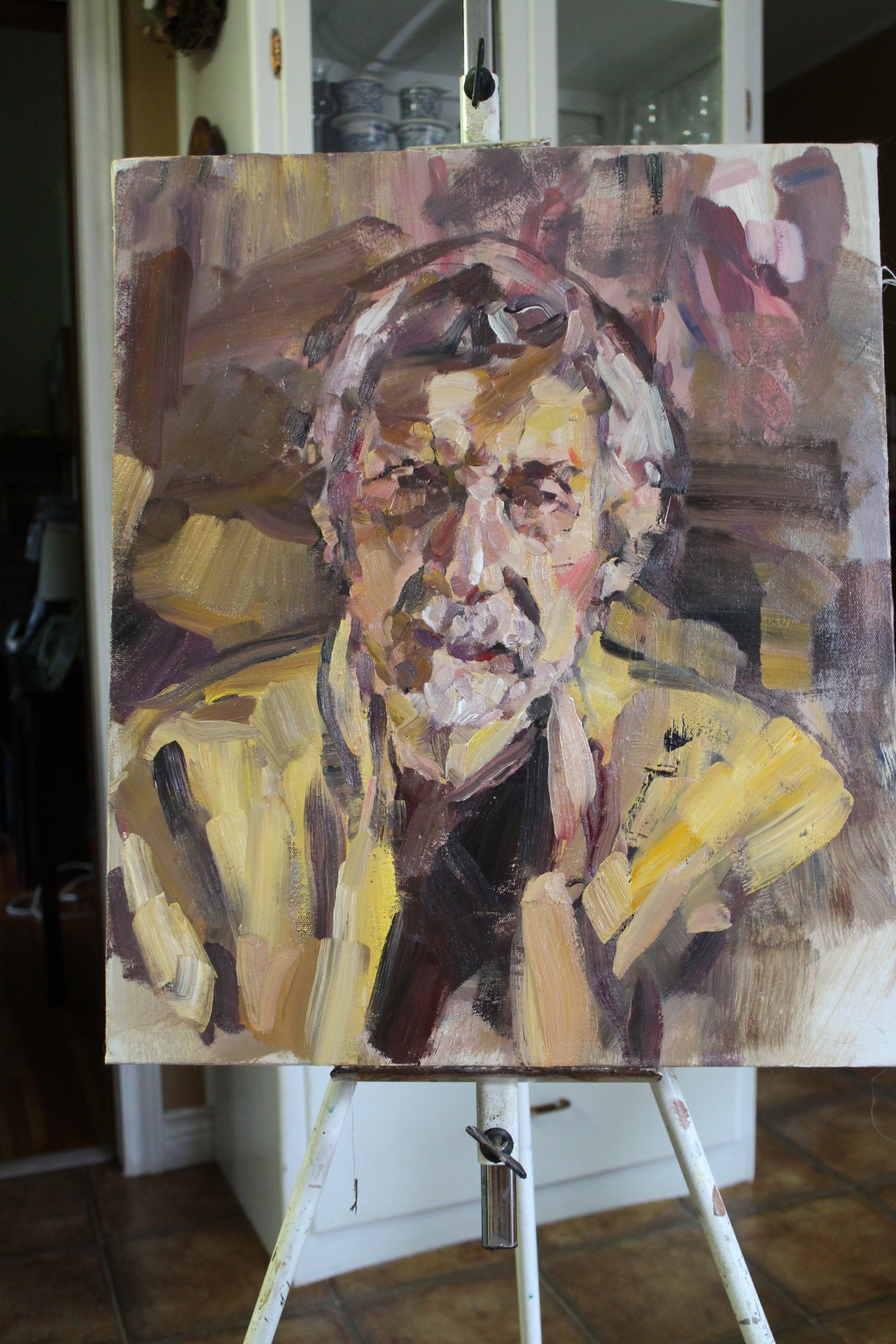
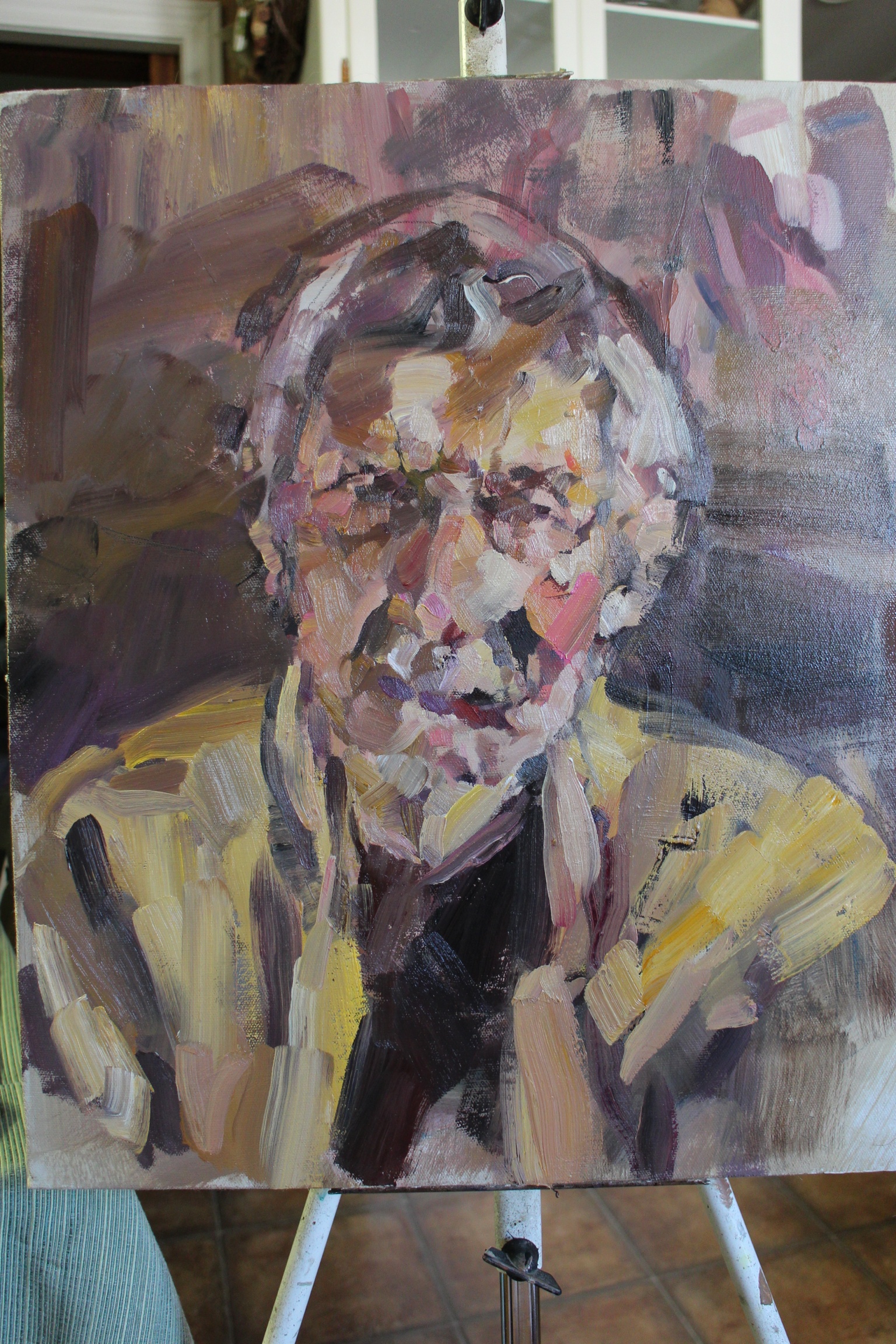
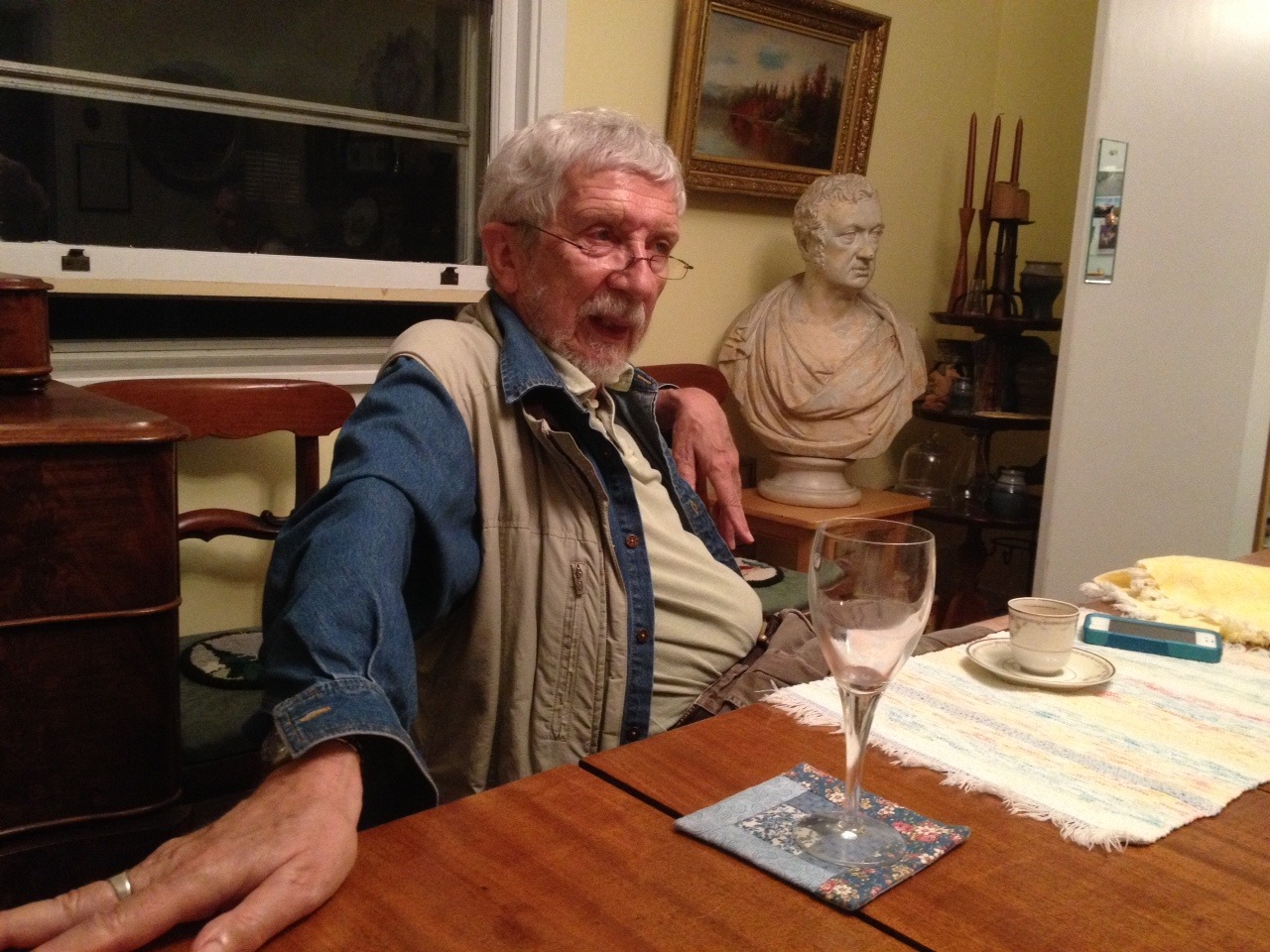
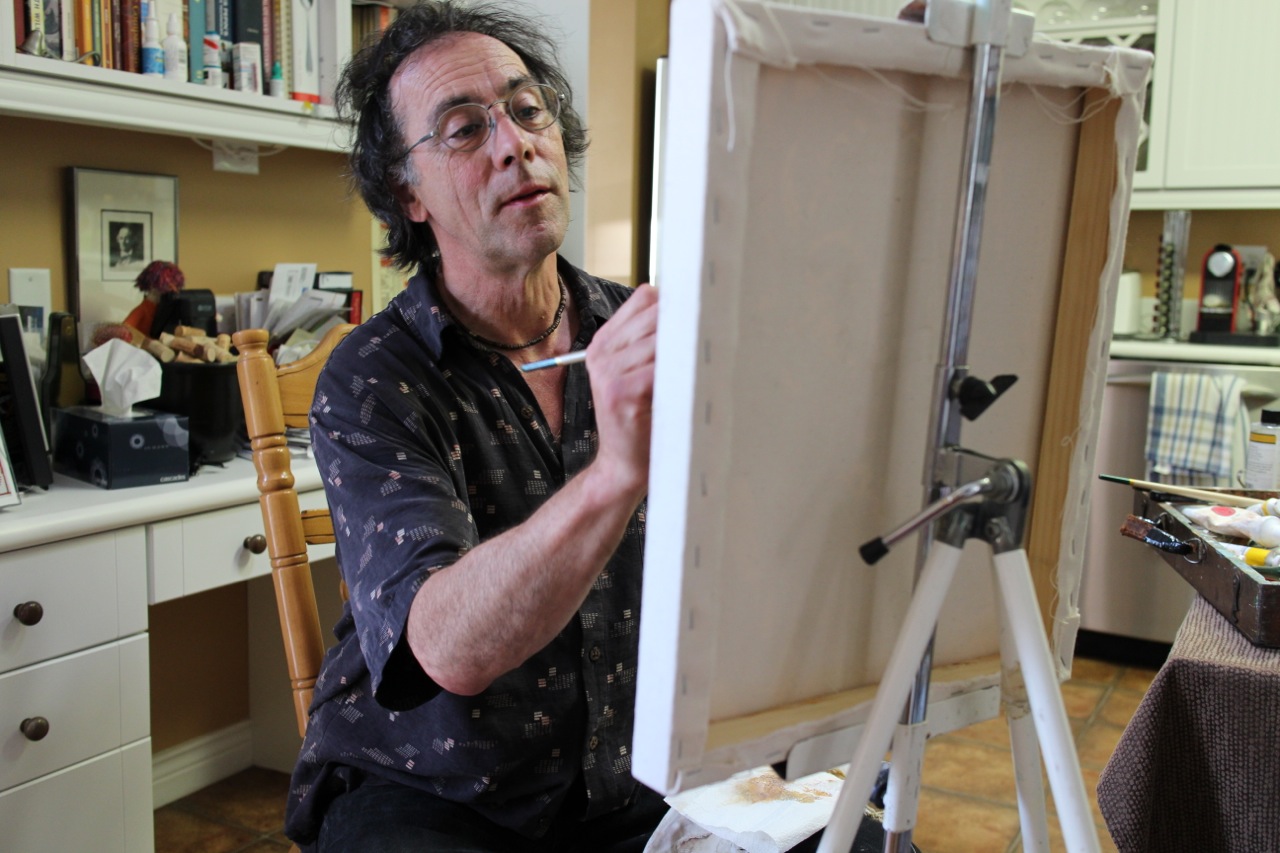
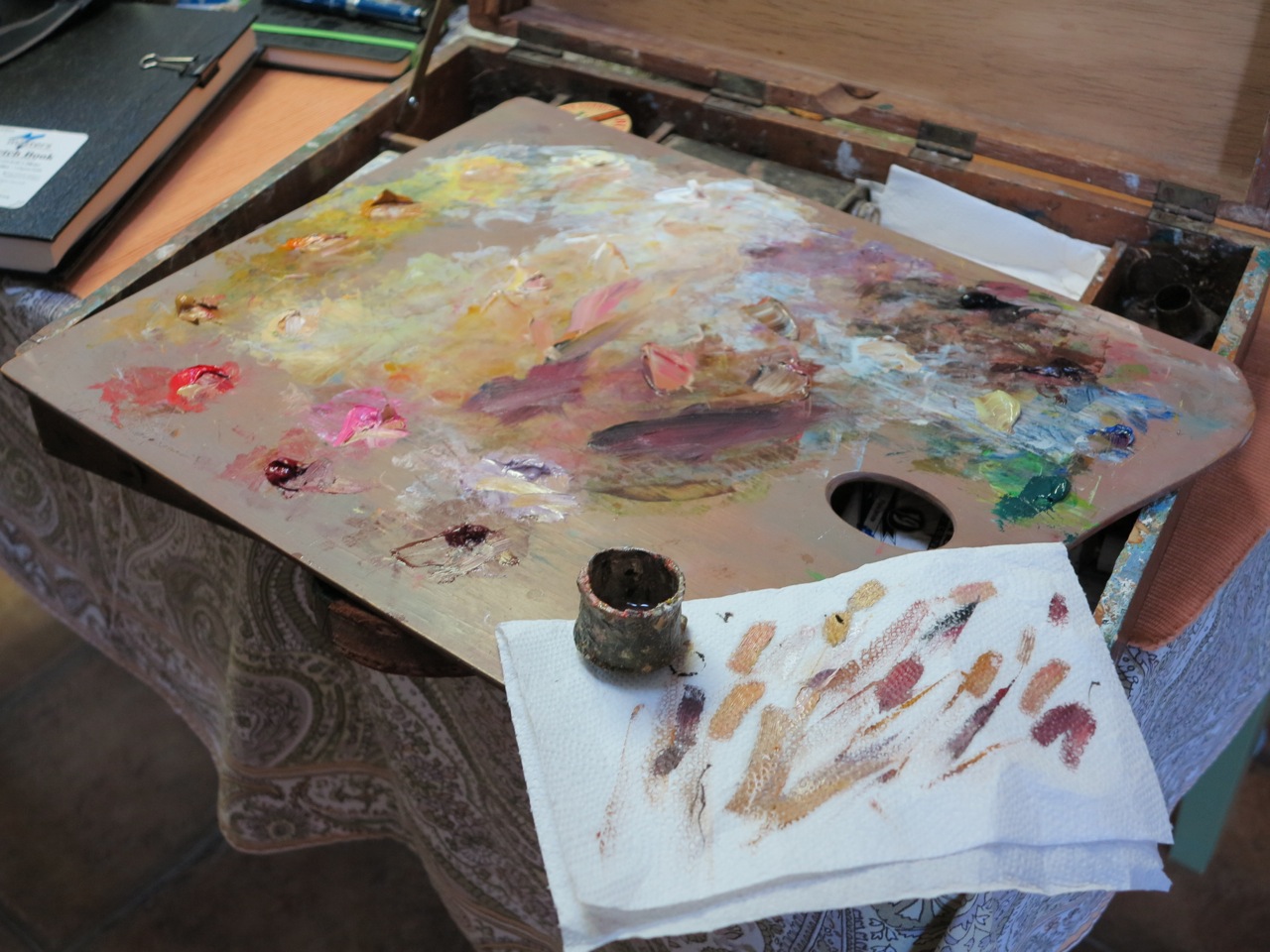
pallette 15Aug“You’re right,” Stephen Scott, told me as he came into the house, “Sophie (his wife), is my muse. She is always there when I need her.” Muse and Musae were a major subject of our last sitting of three days ago. “Of course, who else would it be?” I said. Without telling him, I thought how lucky he was to have his own muse. Someone whose very presence gives him reason to work. Changing the subject, I asked, “Where do you think (Lucian) Freud would start each session.” “He picked up where he had left off.” “And, in your case, where would that be?” By this time he had started to sit down and paint my portrait, once again. “With the bridge of the nose,” he said. “Why there?” “It’s sort of the closest point of the picture; if you think about it spatially.” It is interesting that painters think about their paintings in three dimensions while they are reducing them to two dimensions. Of course, if a painter is working from a photograph, the reduction has already been done.

I brought this point up with Stephen and it was a subject we had been talking about for weeks. “I have never liked photo realism. They look like painted photographs,” he said. “And, so they are,” I replied. “You are speaking against some sacred cows in Canadian art like Mary Pratt. People like her work,” I continued. “Yes, I know, but I find the photo realist stuff, just too slick,” he said. “Part of the problem, in working from life, is that your subjects just don’t cooperate. Like me, I move and the light is always changing,” I said. “That’s what makes it interesting. It goes back to the struggle thing,” he said. Making a good painting is a fight and Stephen is a fighter. He held the brush in front of him to get a good handle on the angle of my face. “Bring your chin up a bit and tilt your head a bit to the left,” he said. “You know, I still have to write while you are painting.” I said. “Yes, I know, I just want to get the pose in my head.” That’s the way it works, I thought; you have to have an idea what you want the painting to look like as compared to the reality that you are faced with. “The painting is starting to come to life,” Stephen said.

“I am stuck in the middle of a never, never land. A fully aware romantic realist painter left out of the mainstream,” he said.
“Do you mean Toronto?”
“Not really, there is a mainstream everywhere and I am not in it.”
“Even Fredericton?” I said.
“There is no critical analysis in Fredericton,” Stephen said.
“Do you mean press? As far as I know, the only arts stuff in the province in the press is the Salon section in the Telegraph Journal in Saint John.”
“No, it is more than that. There is just not the critical mass of people in a place like New Brunswick for an active art scene,” he said.
“Then why do you stay here? I said.
“As I have said before, there is a sense of place and even though I travel a lot, I feel I belong here,” he said. This I understand. I grew up in large cities, in different countries, yet I feel comfortable in a small Maritime town even though it lacks many features I crave. It is, as Stephen said, a never, never land.

“You did go to Montreal for a couple of years to take that art therapy course at Concordia,” I said. “Yes, I figured that I needed a way to make a living as I wasn’t making much money from painting.” “What happened?” “When I finished I found out that I could not do both, art therapy and painting. So, in the end, I returned to full time painting. I guess painting is in my blood,” he said. It is a fact of life that many art students who leave school with dreams of being a full time artist eventually give up and do something else.

Stephen had been painting for nearly twenty years before the Montreal episode and I am glad that, in the end, he stuck to painting. “Montreal was not a total bust,” he said, “I learned a lot about myself and the power of art to heal.” “I have always seen my art as therapy, both painting and writing. It seems to work for me,” I said. “The people I worked with were not artists, but art helped them nonetheless,” he said.

paint 15Aug“There is the thing about art’s ability to transform, isn’t there?” I asked Stephen as he continued to paint. “It is beautiful when it works. Humans, at least some of them, are better for the power of art,” he said. “I find what you are doing to be quite relaxing.” “That could be because I am doing all the work and you are just sitting,” he said. “That’s not fair. It takes two to have a conversation and I am trying to take notes while not looking at my notebook.” “All is forgiven, if you will crank up your Nespresso machine and make as both a cup of coffee. I need to step back and take a look at what I am doing.” I wanted to see what he was doing as well, so I complied.

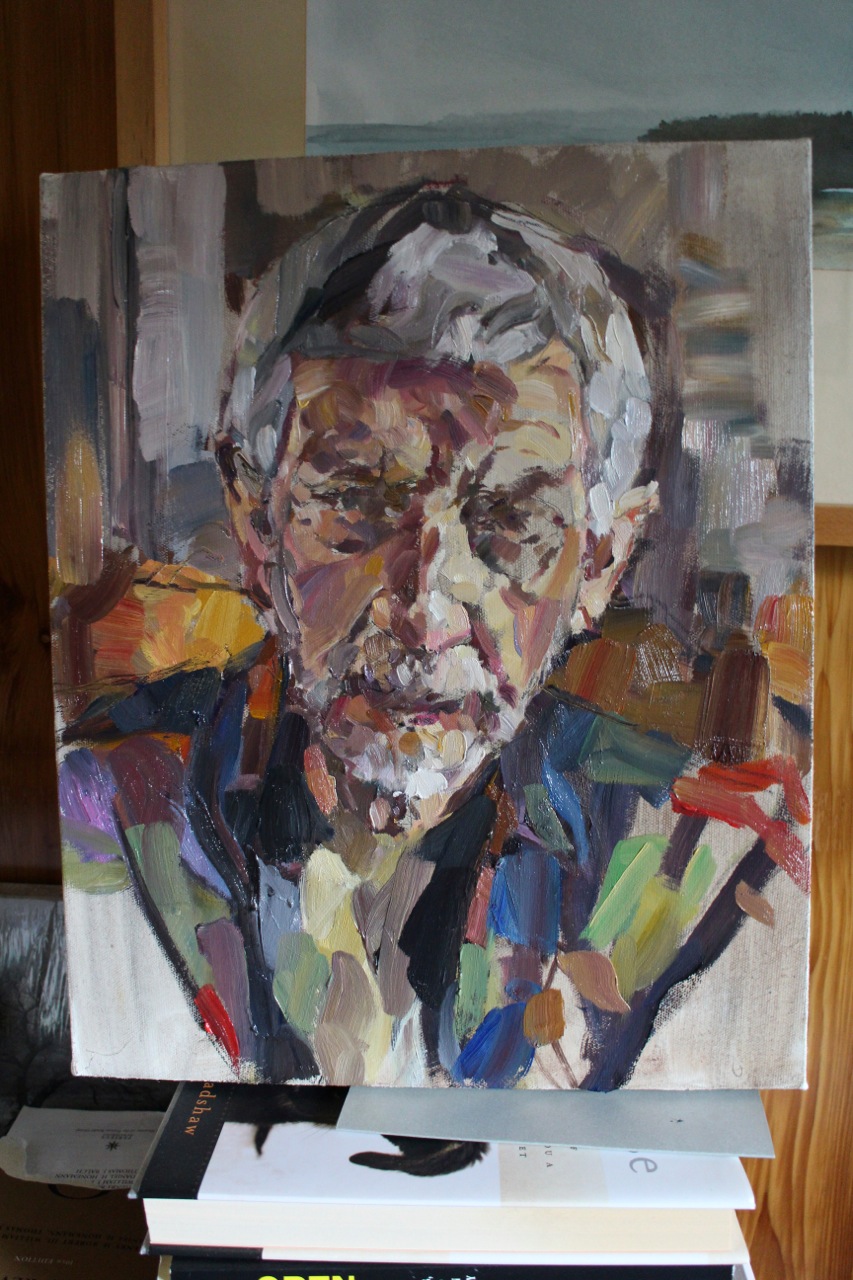
“It does look like me,” I said sticking my nose close to the painting. “It is supposed to. That is the point,” he said. “One artist that we haven’t kicked around is Klimt, Gustav Klimt,” I said. “Ya, you know what I like are his landscapes. Most people don’t know about them,” Stephen said. “There are couple of great ones in New York,” I replied. “Yes, I have seen them.” “I saw a really great show of his drawings in Vienna. They were on butcher paper in red Conté. Drop dead beautiful line drawings of nude women some of them seemingly masturbating,” I said. “Rather like that strange Titian painting. Do you know the one I mean?” he said. “Yes, the Venus of Urbino. Really odd. God knows what’s going on in the background.” “Nice dog in the painting, though and Manet used the Venus as the basis for his Olympia,” he said. “But, he put a cat in place of the dog,” I added. “Art is all about quotes, isn’t?” he said.

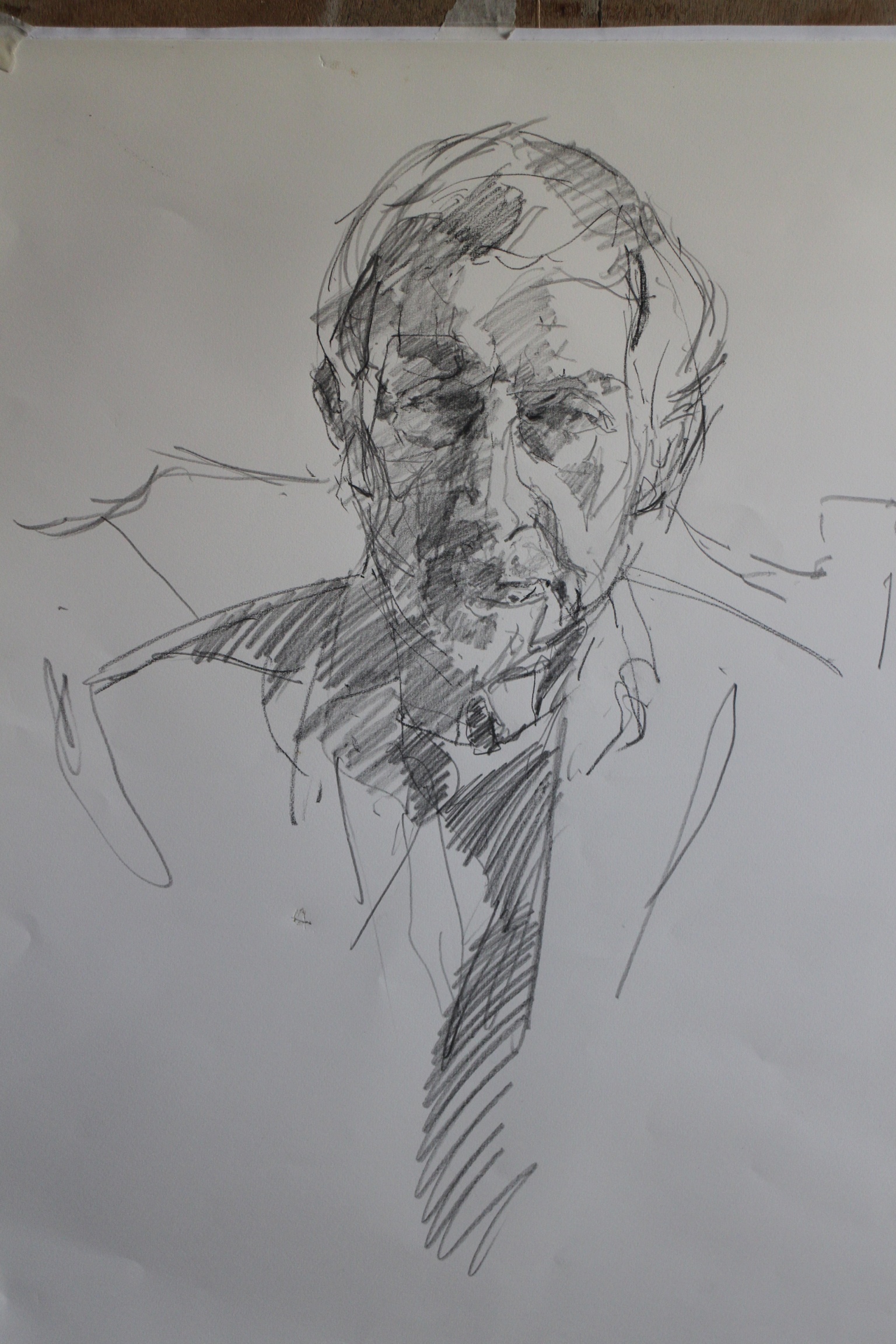
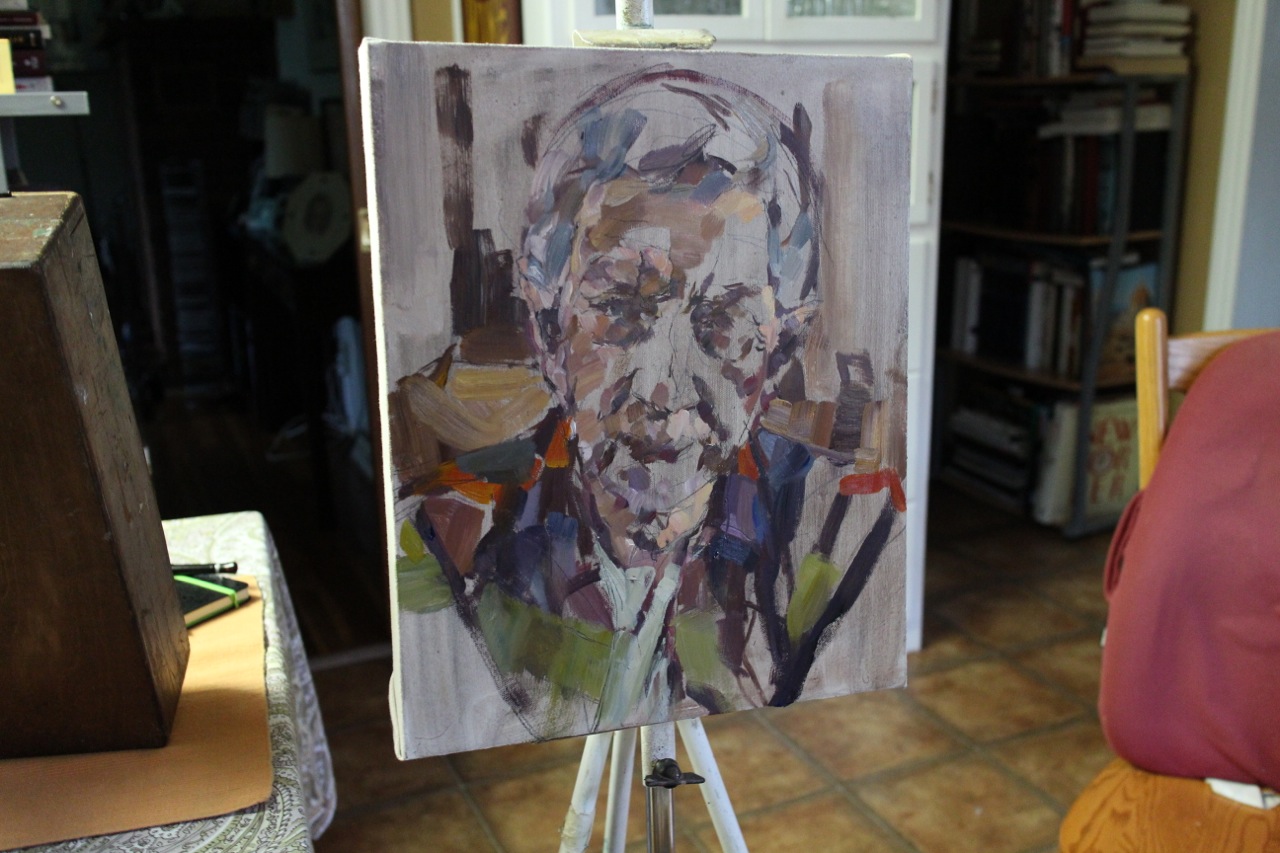
When we got back to painting, Stephen said, “You know what helped, was the drawing. This is a better painting.” I thought so too. “Do you think that you can go back to the other painting and make it better?” I said. “It is a possibility, but I still don’t have a clear idea where this whole project is going, but I am having fun,” he said. “It is a strange way for us to spend the summer. Sitting in my kitchen and you painting my portrait,” I said. “I feel things in my body. The more you work, the better it gets,” he said. “I know what you mean. When the words come while I am writing, it is like magic, but usually the magic only happens when I work real hard at it. You were talking about being in the ‘zone’, were you not?” I said. “Yes, the zone is a magic place.”

VH 15AugMagic places, art for art’s sake, all in all, the afternoon was turning out fine. “There is a place in this world for old men,” I mused. “But we got to keep working on it. It is the simple case of use it or lose it,” He said. “I think that there is a good case for me breaking out a really good bottle of wine, throwing together something to eat, and having a great evening here with you and Sophie,” I said. “Now, that sounds like a plan, but just give me a few more minutes to paint.”

© Virgil Hammock, Sackville NB Canada, Sunday, 13 October, 2013.

h1

Stephen Paints a Picture: Part Eight

October 9, 2013

12 August 2013

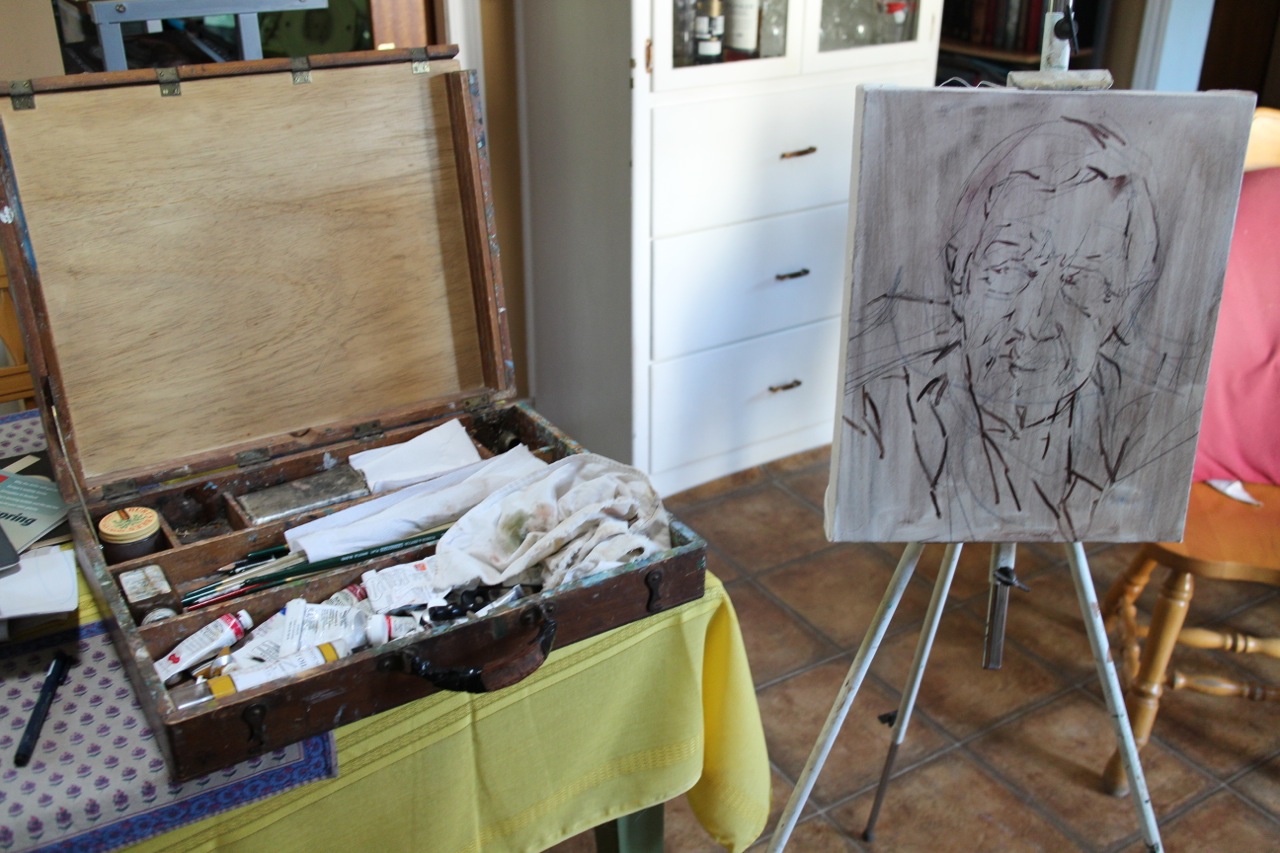
Stephen Scott came into the house carrying a small blank canvas and said, “It’s time to start a new oil sketch.” This followed on the heels of our last session which was limited to him drawing studies for my portrait. “OK,” I said, “Maybe I can change my shirt so that we can keep track of which picture is which.” So I found a yellow shirt to replace the blue and red one that I was wearing for the first oil sketch. “So, what are your thoughts on your drawings of the other day?” “You know, I think I am rediscovering drawing as a tool for my painting. Even brief drawings carry a lot of information that I can use,” he said. Stephen taped the two large drawings he had done two days before on the wall so he could see them while he worked. “I don’t think that your photographs of you, look like you, my pictures look like you,” he said. He was referring to my project where I try to take a self-portrait of myself every day to test my morbid fascination with the aging process. “You have a point,” I conceded.

paletteHe seated himself in front of the new canvas, prepared his palette and started to paint. “I just cannot get good quality (art) materials in this province; paper, paint and not even a decent pencil. I even had to put an additional white ground on this prepared canvas to get a surface I can work with.” “There is just not the market for the good stuff,” I said. “I have been thinking more about German painting since our last session,” he said, “I forgot about Max Beckmann. He was a really good painter.” “Strange you should bring him up. When I was in grad school (Indiana University) the head of school (Henry Hope) had a large painting of him and his family by Beckmann in his dining room. Henry was very rich, family money, and could afford such things. Nice man helped me through school,” I said. “Wild,” Stephen said. “You know,” I added, “Beckmann taught for a number of years in St. Louis and was a big influence on Midwestern painting.” “He was a very good portrait painter, but a bit edgy,” Stephen said. “Scary, might be a better word,” I said, “Those were troubled times when he worked in Europe. Even the Hope family portrait was a bit strange.”

I noted that Stephen had a photograph of one of the drawings on his iPhone that was on the wall in his hand while he was painting my picture. “That’s odd, Stephen. I am sitting here, the drawings are on the wall and you are looking at a photograph of a drawing that is staring you in the face.” “It is just different. It gives me another viewpoint,” he said. Whatever his methods, they seemed to be working very well and who am I to question success? “I have to compete with artists using photography and I guess this is a way of doing that.” I guess one can never have too many sources and it was interesting to watch him move his eyes from me, to one of the drawings on the wall, to the photograph on his phone in his left hand and repeat the process, all along painting on the canvas with swift brush strokes.

paints and portrait“You know, I can not think of a single male muse,” Stephen said. “What do you mean? A muse who is actual a male? The female muses all served male masters. At least, that was supposed to be the idea until women artists showed up,” I said. “No, a male muse. Let’s see if I can name the traditional muses?” he said. Good luck with that and besides the plural of muse is musae, I thought. “Let’s see, Calliope, Erato, Terpsichore, Clio, Urania. Who am I missing?” He said. “Damned, if I know, but I have a book in the bedroom that will tells us.” Why I keep a dictionary of classical mythology in the bedroom is anybody’s guess, but I haven’t impressed any women guests with it, yet. Back with the book, I quickly added: Euterpe, Melpomene, Polyhymnia and Thalia. “And, you know, none of these fine ladies are the muse of painting much less being a man,” I said. “Something we’ll have to fix,” Stephen said. “If I had my rathers, I would prefer my muse for painting to be a woman, but I like the company of women,” I added. “I knew that,” he said. As usual, our conversation was all over the map and I suggest we stop for a coffee break.

“The reason there wasn’t a muse for painting in the classical world was that painters were thought to be, at best, craftsman and not artists,” Stephen said has he stared into his Americano. “Yes, Plato treated us particularly rough,” I said. “We need to invent a muse,” he said, “Any ideas?” “We are a couple of thousand years too late,” I said, “perhaps we could add painting on to the list duties of one the traditional nine. I sort of like Polyhymnia. Nobody talks about her much.” “What does she do?” Stephen asked. Looking into the book, I told him that she was the muse for sacred song, oratory, lyric, singing and rhetoric. “Besides poly means many, so what’s another duty to her list?” I said. “I still think that we need our own muse,” he said. “I will see if I can take it up with Zeus, but Mnemosyne (his wife) has already had nine daughters and might be tired,” I said. “She might get lucky and the tenth time, it might be a son and our muse,” he said.”Better late, than never,” I added.

VH 8Back at painting, Stephen said, “My job is to be critical, a perfectionist.” Laudable sentiments, but difficult to accomplish, I thought, “What do you mean by that?” “You need the vision and the drive to get a painting where you want it to be,” he answered. “I agree, but perfection is pretty hard to come by,” I said. “Perhaps, what I mean is to seek perfection,” he said. “I usually find more perfection in the work of other people than I do in my own,” I said, “particularly in my writing.” “Yes, it is easy to find fault in your own work,” he said. “The reason I mainly gave up on painting and photography and resorted to writing was that I never could get them to the point where I was satisfied with the work. How come you never went there?” I asked. “I have had plenty of low points, but I was always able to battle my way back. I guess it was through hard work,” he said. “It has always been a battle between my mind and I eye,” I countered. “They never reconciled. I knew what I wanted my pictures to look like, but never matched my mind’s image. I still think that I can draw well and I like to think that I still have the eye and that’s why I am trying photography again,” I said. “You give up too easy. Art is always a fight,” Stephen said.

As usual, Stephen had a point and common sense on his side and that’s what makes him a good artist and me a wannabe. Those of us who delve into intellectual issues often find ourselves sidelined by inaction brought on by too much thinking and not enough doing. Stephen’s perfection was sought through his painting while mine way was in my mind. “Painting is a thing, an object, a direct experience,” he said which only added to my discomfort. “Let’s have a look at what you are doing,” I said and perhaps, we could call it day.” I was learning a lot from my afternoons with him. Yes, he had a gift, but he knew how to use it. He was teaching me that I had ventured off the track of my own creativity by being too lazy. I had some catching up to do and, perhaps, only another month of Stephen painting my picture.

© Virgil Hammock, Sackville NB Canada, Saturday, 5 October, 2013.

h1

Stephen Paints a Picture: Part Seven

October 2, 2013

10 August 2013

Six days had passed since our last sitting although Stephen and I had seen each other and talked every day. We generally had dinner together along with Sophie, his wife; he was at my usual Wednesday night gathering over wine and cheese and there was the matter of the big blowout for my seventy-fifth birthday on the 5th of August. The other issue that held us up was the weather. We need sunshine and it had rained for days on end.

VH drawing 2“I just want to draw today,” Stephen said. He had brought a large sheet of paper taped to a drawing board. “I like to work from drawings,” he said, “They tell me more than photographs.” We had talked about this before and we had agreed not to use photographs for my portrait just as I had agreed to work from notes and not record our conversations. We wanted to keep it old school out of a sense of plain curmudgeonliness. “The secret of drawing is not to think about it,” he said as he started to work. “Yes, I know,” I said, “it has got to be second nature, automatic.” I went on my usual bit about the lack of drawing skill being taught in art schools which is a favourite hobbyhorse of mine. Stephen agreed, “A lot of today’s artists couldn’t draw their way out of a box.” He was looking at me very intently as he drew. “I need the luxury of time. I need to take my fucking time.” I asked him about old master drawings, which we both admire. “How can you tell the difference between genius and competence?” “You can tell. There is an ease to genius that the only competent lack,” he replied. “Mind you, many competent old master artists were pretty good,” I said, “they did a lot of drawing and were well trained.”

“There is plenty of confusion between the terms modern and contemporary art,” I said. “Yes, I agree, modern art goes back a long time and a lot of modern artists were well trained and could draw well.” “Where do you think we lost it, the ability to draw well?” I said. “I think that we lost skill when art schools started putting more emphasis on theory than practice.” “It goes back two or three generations of teachers many of whom never learned much skill, like drawing, themselves and hence are hard pressed to teach it,” I said. “We both know that art is more than skill,” Stephen said, “but knowing how to do something well sure makes it easier.” We have often engaged in this chicken and egg argument over the summer, even if we were both on the same side, the question always boiled down to what was more important, content or technique? The truth is there will always be good art being done and there has always plenty of bad art to go around. Defining the good stuff is the big question.

“You know, I would rather talk about being a painter rather than an artist,” I said, “The term ‘artist‘ is used too easily.” “You are right. Every second year art student thinks they are an artist when clearly they aren’t,” Stephen replied. “It’s the bigger world that makes someone as artist, the public, the critics, and the galleries,” I said. “And they aren’t always right,” he said. “History, is about the only judge and I am not sure about that,” I said. “I would be happy if we just got rid of the term art,” he said. “You are not the first to think along those terms.” We continued along this line for some time talking about how the term art has been debased where everything is art; the art of cooking, driving, fashion and any other noun that can be prefaced with an additive. “This is getting depressing. Let’s have a coffee and talk about something else,” Stephen said.

With coffee in hand, I said, “How about Germany? How long where you there?” “Six months, the first time in 03 and five months more in total in three other trips in 05, 07 and 11. It certainly changed my life.” “It was mostly in Berlin, wasn’t it?” “Yes, a very exciting place, but it’s changing now.” I asked what impressed him most. “German art both past and present,” he said. “It’s a very different place which results in a very different art which effected my art,” he continued. I told him that I would have thought that German Romantic landscape painting along the lines of Casper David Friedrich must have impressed him. It did me when I first had the chance to see it in Germany many years ago. “Of course, it was impressive. Totally different from the landscape painting in New Brunswick that I was used to. There is a drama in his paintings that is lacking here,” he said, “but there is lots of other German and northern painting that is impressive.”

“Give me some examples,” I said. “Somebody, I really like is Zorn (Anders Zorn 1860-1920), strictly speaking, he is not German, but Swedish. Great portrait artist rather like Sargent,” Stephen said. This was an artist I liked as well, but not well known outside of Sweden although there are good examples of his work in Boston and he did portrait of three US presidents. “Of course, there are the German Expressionists like Der Blaue Reiter and Die Brülke,” he said. “I could go to the museums every day and learn something new.” “Seeing stuff in the flesh certainly makes a difference,” I said. “And you are seeing it in its own social context which is a big difference,” he added. “Berlin must have been one hell of a place during the hay days of the Weimar Republic,” I said. “Yes, and a great place to read about it is Christopher Isherwood’s novel Goodby to Berlin.” “I think we missed something by not being able to be in Berlin or Paris in the run up to World War II,” I added. “Always knew I was born at the wrong time,” he said. “I would have loved to have been Hemingway in Paris at that time. Short sentences, long drinks and hot and cold running romances,” I said.

It was back to reality, as we started the sitting again. “Where were we?” Stephen asked. “About to make me immortal, I hope.” “I go with what I got,” was his less than hopeful response. “I hope I can use these drawings in the end to help me with a larger painting,” he said. It was our idea that this project would end with a large portrait, but there was a doubt that it could be done over the summer. So the idea transpired that Stephen would do a number of oil sketches, some drawings and using them make a cartoon that would be transferred to a larger canvas before he left Sackville at the beginning of September, but even that was a tall order given the slow nature of the work. I also thought that I could go to Fredericton a couple of times during the fall to sit for the finished product.

VH drawing1He had started another drawing. Again the idea was to establish lights and darks. “Do you think the history of art is linear or chaotic,” I asked. “Linear,” he answered. “That’s not what you said the other day.” “I feel free to contradict myself,” Stephen said. Of course, I am full of contradictions myself, but I wasn’t about to tell Stephen that. “I think that it is circular edging on chaos. Actually, it’s more like a Möbius strip, going around forever turning back on itself,” I said. “That’s an interesting idea,” he said, “rather like a trap that we can’t get out of.” “Exactly. Think about it. In time and space everything that has existed, still exists and everything that will exist, exists,” I said. “So what goes around, comes around,” he said. I felt that, perhaps, we were solving the mystery of the Universe and that it might be good time to stop and get ourselves a stiff drink. “I am taking myself too seriously. Let’s go to Ducky’s (our local bar),” I said.

© Virgil Hammock, Sackville NB Canada, Tuesday, 1 October, 2013.

h1

Stephen Paints a Picture: Part Six

September 25, 2013

4 August 2013

We were now in our sixth sitting of my portrait and getting into a routine; move the kitchen table, find where to place my chair, put up the easel and start the painting along with the conversation. “Stephen, where do you usually paint?” I asked “I have a studio in Fredericton and I go there every day to work,” he said, “and I take Echo (his dog) with me.” “I thought that you worked in your house (in Nashwaak Village, a very small town a few kilometres from Fredericton),” I said. “I have, but I need to get out of the house.” “I thought you were a hermit?” “Yes and no, but I like painting in my Fredericton studio. I need a lot of variety in my life.”

artist toolsStephen paints, seated, with his palette in his lap for the small oil sketch he is doing now, and quite close to me. The paints are arranged on the edge of the palette in a circle from lights to darks and he mixes his colours in the middle of the palette. His medium, walnut oil, is in a small jar or tin cup. “I do love the smell of the paint. It brings back the smell of my studio and the classroom,” I said. “I think that it is only a smell that painters can appreciate,” he said. Painting is a very tactile experience for the artist–the feel of the brush against the canvas, the flow of the paint and, of course, the smell. I can tell that Stephen enjoys the act of painting, through his eyes, looking at both me and the painting, and the way that he uses his hands. There is a magic that only the artist can feel as they work. It is a different kind of magic that a viewer gets from a painting, or any art of work, but magic nonetheless.

“I wish that I had more skill,” Stephen said. “I think you have skill in spades, so why do you say that?” I said. “You can never have enough skill and sometimes I wish I just had more of it. It would make life a whole lot easier,” he said. “There is more to art than skill,” I added. “Like what?” “I know it when I see it. It is what makes art, art.” That less than helpful comment just added to the confusion. We had been talking for weeks about what makes something art much less great art. “It really boils down to content,” Stephen said. “Really?, And what do you mean by content?” “Content, in the end, dictates form,” he answered. “I think that we are talking about different things. You can paint a picture of a flower or a person, they are both content,”I said. “I am talking more about reading content,” he said. “And how does one read content?” “I am looking for the intention of the artist. Two paintings can have the same subject yet one can be great art and the other banal. It’s all in the intention,” he said. “Are you talking about brush work?” “It’s more than that. It’s everything and nothing. It’s is where the end is more than the sum totals of the parts.”

“You know, there are high points and low points to painting and I am not sure where I am now,” he said remarking on my portrait. “How about the middle?” I asked. “I know what I am doing is valid,” he said. “I have no doubt about your validity, but I have problems with some things which pass themselves off as art,” I said. “Yes,” he said, “most of my art heroes are from the 19th. Century and before.” “I don’t think that it all goes back to realism. There are some 20th. Century artists I like. It is about, as you said, intention,” I said, “Good painting is timeless. Good painting has been done, is being done and will, in the future, be done.” “Sometimes the first stroke of the brush on the canvas leads to the divine path,” Stephen said, “but, mostly painting is just hard work.” I got his point as I have often watched him work up a sweat over the past two weeks as he painted my portrait.VH 4 Aug

Art is hard work and I get annoyed when people dismiss art, particularly realism, as mere skill or the result of some God given talent. The good artists I know, of all stripes, work their butts offs and most have spent years getting to a point where they occasionally produce something fine. This I know from my own failures. It is a revelation to sit for Stephen and watch art come about, come alive. He starts with a blank canvas, a blank piece of paper and, foremost, an idea. I sit and provide the subject. Mine is the far easier task. Composition is a task for an artist looking at a blank canvas. Where to start, where to put the first mark. When, as an artist, I looked at a blank canvas, I saw the painting before I picked up my brush and started to paint. The painting was there, it was just a matter of putting it down. In reality it wasn’t that simple and the finished painting was always quite different than the one I had in my head at the outset. My vision was, of course, always better than the finished product. It is the same with Stephen; he has some idea what the painting will look like before he starts. “The problem is a matter of scale,” he said, “how it’s going to fit.” His painting of me was coming to life somewhat like a photograph in a tray of developer (for those of you who can remember that process), from a blank sheet to a completed image, only much slower. “I need to stop, have a cup of coffee and regroup,” he said.

“I need to do another drawing or two,” he said, as we were drinking our coffee, “and think about another oil sketch.” I could see how deeply Stephen was immersing himself in this project. He really wanted to capture me in paint and I certainly wanted to see my image played out. It’s all about time, I thought. I have been doing self-portraits over the years starting with drawings and paintings and now digital photographs not because I am in love with myself, but to gage the aging process which scares the Hell out of me. Stephen’s painting, or paintings, of me are very different than the daily digital photograph I take of myself. Mine are 1/60th of a second snapshots and his are observations of me over many hours and days. His is art, mine is record keeping. There is much more of me in his painting than in my photographs.

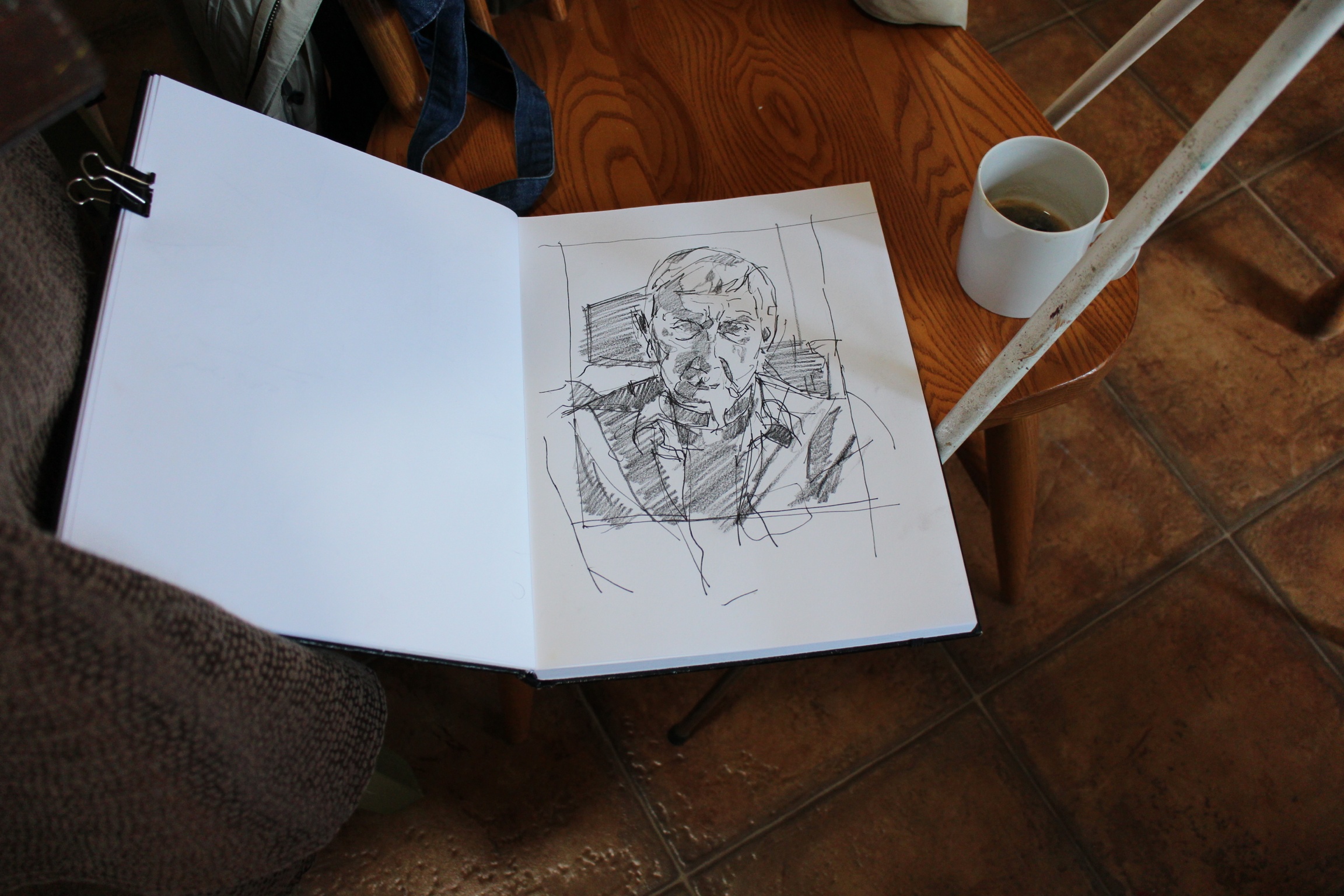
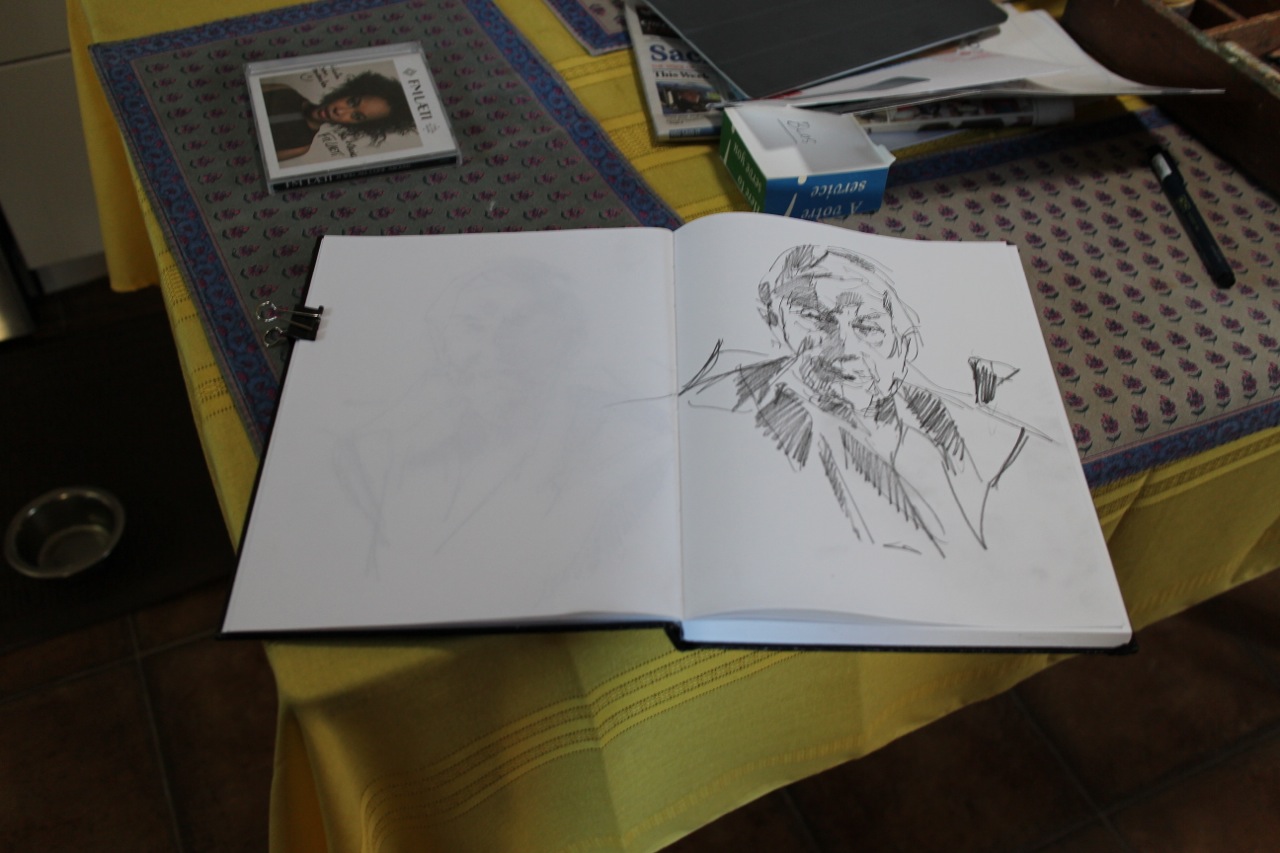
VH sketchBack in position, Stephen takes up his sketchbook and pencil and proceed rapidly to draw my face. “It’s all in the drawing,” he said. “I like to work from drawings as it gives me different information than painting from life.” I understand where he is coming from as black and white drawings reduces things, images, to values of light and dark. It can also simplify the image into visual essentials. His drawings of me contain basic information that can be transferred to the paintings. “I should draw more,” he says, “I really like drawing.” I remarked that old master drawings really turned my crank, “Look at Leonardo, Michelangelo, Rubens, Rembrandt–their drawings say it all,” I said. “Yes, it really reveals their hand, doesn’t?” he said.

“Do you have any idea where all of this going?” I said. “What are we shooting for? One big honking picture?” I continued. “I haven’t a clue. Good art, I hope,” Stephen said. At the start, I had hoped to record the painting of a portrait with words and photographs, but it was becoming something much more, a record of the artistic process at work. A painting is, in the end, the product of a process in time that becomes a moment in time. Stephen’s portraits of me will be a record of both of us over the summer of 2013. “Why do you paint Stephen?” I said. A dumb question, but I asked it nevertheless. “There is nothing else I can do,” was his obvious answer, but what he does do, is something that very few us of can do, and that is create out of imagination and talent, art.

© Virgil Hammock, Sackville NB Canada, Monday, 23 September, 2013.

h1

Stephen Paints a Picture: Part Five

September 18, 2013

1 August 2013

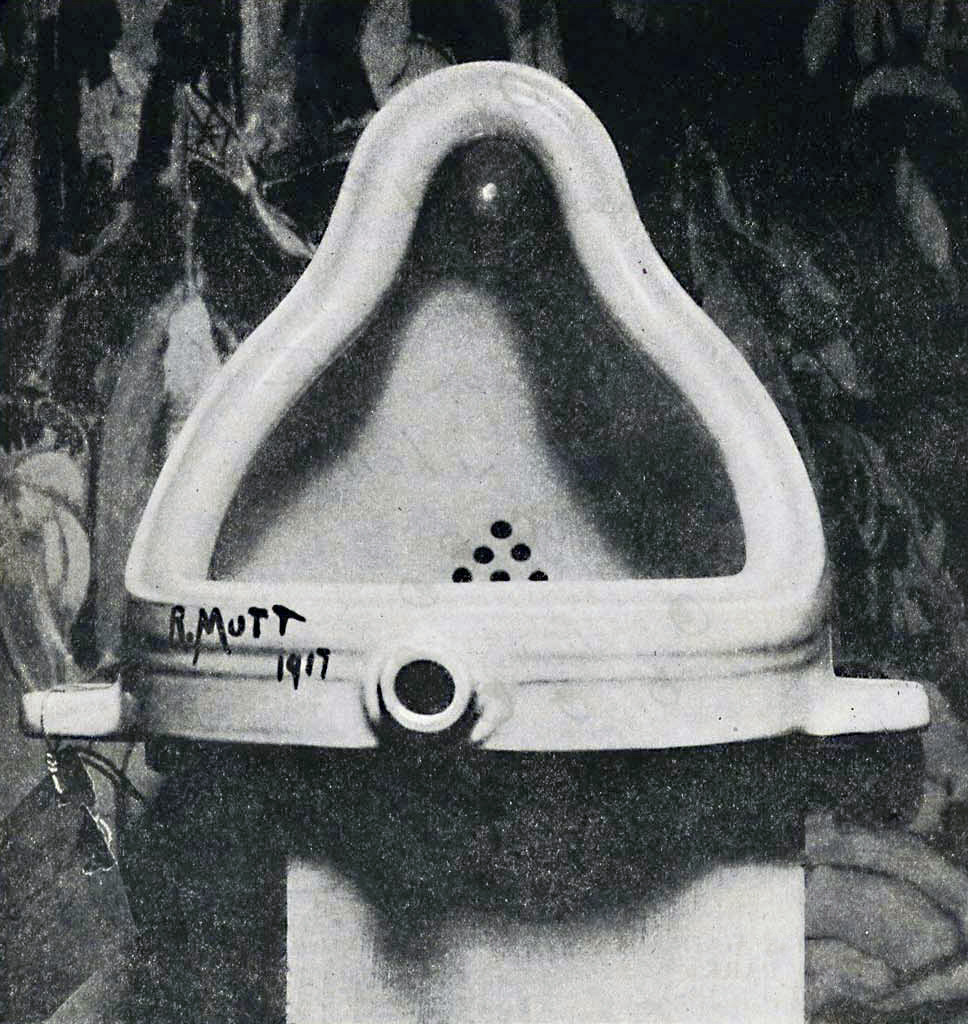
VH_01AUG2013“My summer is not going to plan,” Stephen said, “I was going to do drawings and small paintings of the marsh, but now I am doing this”, referring to painting my portrait. “Actually, aren’t you doing both,” I said. “I am, but I am spending a lot of time painting you; not that I am complaining.” Stephen was looking at me while he was putting paint on his palette and figuring out which brushes he was going to use. “You know, I really didn’t know anything about art history until I came to Mount A (Mount Allison University),” he said. “I hope that we set you straight. What did you learn?” “Well, I figured out that I didn’t like (Marcel) Duchamp very much.” “You are in good company, Ad Reinhard (American Minimalist painter) famously said: ‘I have never approved or liked anything about Marcel Duchamp. You have to choose between Duchamp and Mondrian’,” I said. ( Lucy R. Lippard, Ad Reinhard, Harry N Abrams, New York, 1981, p.195,) I doubt that Stephen would have chosen Mondrian, but he clearly did not like Duchamp’s attempt to throw a monkey wrench into the values of traditional art.

“Easel painting has survived Duchamp, you know,” I continued, “and he certainly knew how to have fun and make a name for himself.” By this time, Stephen was painting and paying attention to what he was doing. “Let me repeat myself, art is all about intention,” he said. “And by intention you mean serious, don’t you?” “Yes, art is serious stuff.” “It may be, but art is all over the board these days and has been for some time,” I said. “But, much of it is not very good,” He said and I would have a hard time arguing his point. “Good and bad are rather subjective, but I would like to think I bring at least some objectivity to the table. To my mind, there is the beautiful and that is a quality that can be observed,” I said. “Yes, I like your idea of the separation of art (beauty) from life,” he said. Now we were into a subject that could occupy the rest of the afternoon.

Duchamp_Fountaine_wikipedia“The idea of anti-art goes back at least a hundred years. Duchamp’s Bicycle Wheel was done in 1913 and the urinal (Fountain) in 1917. Things haven’t been the same since,” I said, “and in between those dates you had Dada.” Clearly, Stephen wasn’t cheered by my art history lesson. “Why?” he said. “There was the little matter of World War I, which screwed up everything including art,” I answered. “There was still beautiful and wonderful art being done after the war. Matisse for instance,” he said. “Granted,” I said, “everything did not go down the tubes but, art was changed forever.” Stephen was painting while he pondered the idea of anti-art. “History is a real pain in the ass. It seems to repeat itself with some regularity like some never ending circle,” I said and I was beginning to depress myself. “Art reflects it’s own time, it cannot help it. There can be no real Futurism. It is just that most people live in the past. It’s more comfortable,” I added. “And these are dangerous times,” Stephen said, “with the world at our fingertips via the Internet. It makes it difficult for reflection.” “Good God, yes, I have thousands of books I have collected over the past half a century and now everything is a click away,” I said. “I still like books,” he said. “And real paintings,” I added.

Surely, I thought we were two old guys too technologically savvy for our own good. Here I was sitting for a traditional oil portrait by first rate figurative artist and we both had iPhones at our sides, indeed, we would use them to settle arguments we had about artists and dates. It was too damn easy. “I have artists friends in Fredericton who don’t use this stuff at all and seem to be happy about it,” he said. “Yes, me too and just isn’t an age thing. There are people a lot younger than me who get by just fine without all this stuff. Hell, I am seventy-five and I keep running out and buying new toys.” The discussion was somewhat idiotic as we were using my blog and all sorts of social media to record this project and our conversation, but I have never claimed to rational.

“The more I am into this project the more I see how difficult it is going to be,” Stephen said. “It’s going to take more than one oil sketch.” I didn’t know if the difficulty was my ugly puss or the act of painting. I was hoping that it was the later. “What’s the problem?” I asked. “Just getting it right,” he replied. When I looked at what he had completed thus far, I thought that he had done a good job of catching my likeness. “I am going to have to do some more drawing as well,” he said. “What do you mean by right?” I said. “I know it when I see it,” he said. I told him that I know when a painting that was done by someone other than myself was ‘right‘ and that I was surer about that than I was about my own art. “Right is when everything comes together,” he said. “Surely, everything cannot be together. Is there not always something more that can be done?” I said. “Of course, nothing is ever perfect,” he said, “but close is pretty good.” “I knew a painter, John Hultberg, who was a teacher of mine, whose dealer would go to his studio and take his paintings away from him, right from the easel still wet, because he never thought that his paintings were finished,” I said. “I can identify with that. Maybe, I need somebody to tell when something is finished.”

The question of the completion of an art work is something that has haunted artists for centuries. Painting, particularly oil painting, is too bloody fluid. The paint dries slow and invites messing about. X-rays of old masters show all sorts of changes under progressive layers of paint. I had been talking to Stephen since he came to Sackville and about how a painting always calls for another painting. After all, if an artist ever did complete the perfect art work, why would want to do another one and risk failure? John Ruskin, in The Stones of Venice, says something to the effect that every great work of art has an element of imperfection. I think it is that imperfection that drives artists, including Stephen, to keep banging away in the studio.

“I am certainly glad that you have good coffee here,” he said, “it keeps me going.” I took that as a hint to brew us each an Americano and that a short break was in order. “This painting is really hard work,” he said taking the cup in hand. “If you think it is hard for you, think of me, I have to stay awake and ask semi-intelligent questions,” I said. “All those years that I taught figure drawing and painting, I never thought how hard it was for models to hold a pose and they were naked, to boot.” I asked him how he thought the painting was going. “Not bad, but there is still quite away to go,” he replied. “I can always tell you when I think it is finished,” I said. “I don’t think so, but let’s do another bit before it gets too dark to paint.”

stephen scott artist“We should think what we are going to do with all this stuff (the drawings and paintings) when we are done. I think that it might make a nice little exhibition,” I said, back in position for the painting. “Where?” Stephen said. “I would like something in a civic gallery, but a high quality commercial gallery would work as well,” I said. “Look we will have a finished large portrait along with the drawings and oil sketches that proceed it and all of the conversation about the process along the way,” I continued. “You are assuming that everything is going to work out. What happens if the painting is a flop?” he said. “That’s not going to happen. You are really good painter and the world needs a good picture of me.” We left it at that for the afternoon.

© Virgil Hammock, Sackville NB Canada, Sunday, 15 September, 2013.

h1

Stephen Paints a Picture: Part Four

September 11, 2013

25 July 2013

We are at it again on a warm summer Thursday afternoon trying to find a way into the oil sketch Stephen had started a week ago. “ I am always on the edge of disaster,” he said picking a up a brush, then discarding it for a larger one. I continue to be amazed by the large size of brushes he uses in working on such a small canvas. “Where do you start when coming back to a partially completed painting?” He tells me that he is looking for some light areas. “The nose has some highlights,” he said dabbing some white on the canvas to what I assumed was my nose, as I was sitting facing the back of painting. I try to sit still, but I am taking notes and trying to engage in conversation.

“I have been looking at your book Surface Reflections and it is pretty interesting,” I said. “Yes, it was written by my friend Robert Barriault,” Stephen replied, “and I think he did a good job summing up what me and my art are about.” “It has taken you a long time to get to where you are now,” I said. “You talk, in the book, about a moment of truth at beach at Agadir in Morocco when you were twenty years old.” “Yes, it was then and there that I decided to be a painter,” he said. A fine decision, I thought, to myself. Often some of us don’t follow our hearts and regret it for the rest of our lives. How many would be poets end up as accountants? Deciding to be an artist is a romantic choice and sticking to it can be viewed as foolhardy by those that want a practical and financially successful life. Thank God, for people like Stephen who looking at the sea, saw his future.

“The hard thing,” he said, looking rather intently at the canvas, “is getting into the zone.” The ‘zone’ is that magic place where things appear to go right as you are doing them. I know the zone myself from writing when the words start coming from somewhere within your consciousness and, more often, when they don’t. “Sometimes everything seems to fall together, but it is hard to get there,” he said. Painting is a struggle, each brushstroke a fight. I enjoy watching Stephen look at me, take a stab at the painting, sit back and look at what he has done and then repeat the process. It’s likely more fun for me than him, but I do know that he enjoys the act of painting even if it is often a fight.

In realistic painting, directly from the subject, like the portrait Stephen is doing now, there are times when the painting takes over from the subject matter. This is when you find that you are painting without looking at the subject. In the end, a painting is its own thing–an object, and to use Harold Rosenberg’s term, an ‘anxious object’ and not, as Plato would have us believe, a pale imitation of reality. We have talked a fair bit about what is real in realism. Friends, who have seen this sketch even its early stages, have remarked how Stephen has nailed me. It looks more like me than I do, they remark, but this is no slick photo realist portrait. It is boldly painted in broad marks and, I know, by the time it is finished it will be thickly encrusted with paint.

Last night at my regular Wednesday night salon, if you want to call drinking and eating with a bunch of friends, a salon, somebody remarked that the painting made me look like The Smoking Man in The X-Files. I don’t know if Stephen, who was there, took that as a complement, but I did. I like the idea of a man of mystery even if I stopped smoking fifty years ago. “Nothing interests me more than art. The rest is boring,” Stephen said just before he suggested a coffee break. He needed coffee to have the energy to paint and I needed to stay awake. It’s not that I was bored, but, being an old guy, I usually take an afternoon nap and if I sit too long I start to nod off. A break also gives me chance to see what Stephen has been up to.

VH 25 july 13The picture seemed to be taking shape, the result of more paint and looking on his part. I did like what I saw. I had painted some self-portraits in the past, but, in addition to being mirror images (backwards because of the use of mirrors) that were nowhere as good as Stephen’s painting. What is the idea of portraiture? Flatter the sitter? Record what someone looks like for history? Stop a moment in time both for the sitter and viewer? Perhaps all of these things, but great portraiture is something more. I brought the subject up while we were still drinking our coffee. “ What do you think of Goya’s portraits,” I asked, “The funny ones of the royal family?” “He was a good enough painter to get away it,” he answered, “ They are honest pictures of real people even if they were the King and Queen.” “Not at all like Velazquez’s paintings of Philip IV,” I said, “In reality, Philip was drop dead ugly.” “But, they were nonetheless beautiful paintings,” he countered. Hard to argue that. So portraits can be truthful or flattering and still be great art. It is the artist who makes the difference and not the subject. “How about Lucian Freud’s portrait of the Queen?” Stephen said. I had to agree that it is an official painting of the Queen that I am sure most of her loyal subjects hate, but it would be interesting to know what she thinks.

virgil himselfBack sitting for my sitting my ‘official’ portrait and thinking what future generations might think: “Now there is an ugly man.” or “The painter did best he could having what he had to contend with.” I really hope that young women would say: “Now, there is a handsome fellow, if he were not dead, I would fall in love with him.” I guess that I will have to leave the results to Stephen as love after you are dead is a moot point. “Stephen, you must be careful. I have got my vanity to think about,” I said, not wanting to be like the subject of a Freud portrait where it is a great painting, but the subject is to be pitied. “Not to worry,” he said, “I paint them the way I see them.” Not sure that was the answer that I wanted, we continued with our conversation about painting and, in particular, portraiture. “You know someone else I like is Graham Sutherland. There are a bunch of his portraits in the Beaverbrook (Gallery in Fredericton, New Brunswick),” he said, “I first saw them when I was very young on school outing to the gallery.” “Yes, there are are a lot of studies for his portraits as well. I really like the drawings of hands,” I said. “Me too,” he said, “ Sutherland got into a lot of trouble for his portrait of Churchill. Winnie did like the painting very much. I think that he destroyed it.” “ Rather like Freud’s painting of the queen, but, at least, it still in one piece. I think some of studies for the Churchill painting are at the Beaverbrook,” I added.

“There is certainly the question of control when it comes to portraiture–the sitter or the painter,” I said, “ Conventional thinking might say, he who pays the piper calls the tune.” I told Stephen that I was thinking in terms of commissions like those for university presidents and C.E.O.s. rather than the kind of thing that we were doing now. “I know I would have a hard time with something like that,” he said, “I am likely too set in my ways.” “I think if you are good enough and, I believe that you are, that sitter will let you do what needs to be done,” I said, “The Queen didn’t tell Freud what to do and, for that matter, neither did Churchill tell Sutherland how he should paint. Mind you, he did trash the work.” “Of course, Churchill was an amateur painter and likely thought himself an amateur art critic as well,” Stephen said. “But, so was Hitler,” I added. On that note, we decided to call it day. “How about Ducky’s for beer?” he said. “Sounds like a plan,” I replied.

© Virgil Hammock, Sackville NB Canada, Monday, 9 September, 2013.

h1

Stephen Paints a Picture: Part Three

September 4, 2013

23 July 2013

stephen scott artistStephen Scott spends a lot more time with me than just at our sittings. We have dinner together almost every night and meet most days at the Black Duck café for coffee. His wife, Sophie, is also in Sackville for the summer and she is with us a lot as well, but not during the sittings. We talk endlessly about art. It’s a flood of talk. I haven’t talked about art, and in particular, about its process in years and neither has he. It turns out that most of our friends are not artists. It is not that our friends are not interested in the arts, they are, but not in the intense way we are and I really haven’t talked to Stephen at length since he graduated from Mount Allison thirty-five years ago. I had seen his works over the years at various galleries and always liked them, but our paths seldom crossed. So here we are like two long lost friends at a high school reunion trying to catch up on each other’s life.

“A lot of things artists did in the past to make a living no longer exist,” Stephen said over a cup of coffee at the Black Duck, “Like graphic design. It’s all done now with Photoshop on a computer.” “Yes,” I said, “The Group of Seven almost all worked at the same Toronto ad agency in the early 1900s.” We talked a bit about illustration. “Look at somebody like N.C. Wyeth. I saw a show of his book illustrations at the Farnsworth (the art museum in Maine) a couple of months ago and they were all full blown oil paintings and quite nice at that,” I said. “I have been to the Farnsworth and seen his work,” Stephen said, “That kind of stuff just isn’t done any more. Too much work, too expensive,” he added. “There just isn’t the market for that kind of work. Besides, I doubt that there are that many fine arts graduates out there who could actually paint like N.C.,” I said, “and, besides they wouldn’t want do. They wouldn’t see it as art, only skill,” I concluded. “Don’t get me started on the subject of skill,” he said.

That afternoon we were back in my kitchen for the third sitting. It was a cloudy, lazy, at times dark day not ideal for painting as Stephen wants to paint with natural light, but we decided to go ahead anyway. He brought an artificial light fixture with him which we were to try later in the afternoon, but not with much success. Colour looks very different under artificial light because of the Kelvin temperature of artificial light which is quite different from that of natural light. Painting with such light often brings unpleasant surprises when the results are viewed under natural light. “It is about light, you know,” he said, “That is one of the things that painting is all about.” He is right. When I think about painting that I like, it’s usually because of the way that the artist has used light. It is certainly what draws me to Impressionism. Monet can take my breath away.

“Didn’t you like Ted Pulford’s teaching while you were at Mount Allison?,” I asked. “Yes, he was really a hard task master, but he knew his stuff. Particularly watercolour.” Stephen answered. “I don’t think about you as a watercolourist.” “I have done a few decent watercolours, but it was Ted’s approach that was important not the medium. He taught me that you have to be serious if you are going to be a real artist.” I was interested in Stephen’s remarks because during the time I was head of the department and Ted was still teaching, from 1975 to 1980, I had more students come to my office and complain about his teaching than any of his colleagues. They thought that he was too old fashioned and he didn’t allow them to do what they wanted and he marked too hard. However, some students, including Stephen, liked his teaching and, interestingly, when I talked much later to students who studied with him, including those who complained, said that he was their best teacher and they wished that they had paid more attention to him while they had the chance.

There was the continuing question of what students were and were not taught in art schools and programmes in last fifty years or so. The whole thing about the making of the artist. As someone who had taught and ran an art department for nearly forty years, I would like to think that I have done more good than harm. Talking to Stephen, who was a student in the department while I was head, gave me pause about my preconceptions. It turns out that most of what he knows about the technique of oil painting he learned on his own after leaving the university. I believe that skill is important in art and Stephen is certainly skillful both as a draughtsman and painter, but why didn’t he get a better formal education? “Too much talk about art and too little doing,” is his answer. The hot-shot art teachers are likely to be short on basic techniques and many art teachers want to be buddies with their students and treat them like artists rather than students. Art students end up thinking that they are making ‘real’ art in second and third year painting classes when clearly they are not. “Most of the stuff I did in school was crap,” he said. This was troubling as Stephen had spend a year in Europe and another at the Ontario College of Art before enrolling at Mount Allison which he thought, at the time, was the best place to learn to be an artist and what is even more troubling is that perhaps it was. It does not say much about the quality of art education in North America.

“I was born in the wrong century to be an artist,” Stephen said, “I would have been happier three or four centuries ago.” Other artists have told me the same thing particularly those who are realists. When he, and other artists of his ilk, look around the high end commercial galleries and major public art museums they don’t always like what they see. He feels that there is little critical and, hence, commercial interest in the kind of work he does. “There is a lot of stuff out there that is just bad, but gets attention and brings in the big bucks,” he said. “Look at Tracy Emin.” He stops painting and brings up some images of her drawing on his smart phone to show me. I have to agree that the drawings, at least on the phone, look pitiful. “She’s hot stuff in Britain and internationally,” he said. I can offer him no reason why. Stephen is a long way from a full blown reactionary. He does like some contemporary art as do I, but it is easy to understand his frustration. “I can’t see it getting any better,” I add, which doesn’t help much.

“You know the urge to paint realistically does go back a long way,” I said, “Look at the caves of Altamira and Lascaux. Lord knows what purpose they served, but they are damn fine images.” I pressed Stephen to tell me what he thought about progress in art. “Is it linear or does it go in circles?,” I asked. “It sort of jumps around,” he said. “It is hard to think in terms of progress when you see what people painted five hundred years ago. Caravaggio, Rembrandt and Rubens are pretty damn impressive. Hard to improve on quality like that,” he added. “I have a big thing on surface,” I said, “The way those three guys throw paint around; the three dimensional surface of their work. You just don’t see that in illustrations in books.” “You know,” Stephen said, “an artist should be allowed to touch work like that in galleries just to get the feeling of the paint.” While not a really practical idea, I know where he is coming from and I certainly would like to rub my hand over a juicy late Rembrandt painting. I used to blend colours in my paintings with my fingers and the palm of my hand and that felt good. So far, I have not seen Stephen get that tactile while painting. Time will tell. So far he has stuck to brushes and the odd poke of a pencil point to make a line in wet paint.

“I do talk quite a bit to Will (William) Forrestall about art in Fredericton. We do have some stuff in common,” he said. That is interesting as I know Will rather well myself and have talked to him a number of times, but have never put the the two of them together. They both graduated from Mount Allison’s fine arts programme many years ago and they have both been able to eke out a living as artists. I should have guessed, as both of them are realists and removed from the mainstream of contemporary art and Fredericton is a small place. Will, like his father Tom, paints in egg tempera rather than oil, but, unlike his father, generally paints still-lifes. “I like Will’s stick-to-it-ness. He is an odd man out, like myself,” Stephen said. “Your surface qualities are really different,” I said, “tempera is dry and flat and far removed of the richness of your oil surface,” I added. “True,” he said, “but art is not all about surface, it is about intent and there is certainly intent in Will’s paintings.” And what is intent?, I thought. If it exists, then Stephen paintings must, and do, exhibit the quality as well. We had talked around the subject since starting this project. Intent is a certain seriousness about the act of painting and keeping to the qualities of your own beliefs about art. In short, it is stubbornness in the face of opposition to the mainstream which both Stephen and Will continue to do.

VH portrait in progressIt was nearly four o’clock and because of the overcast sky, too dark to paint with natural light. The artificial light, which Stephen had bounced off the ceiling of the kitchen, wasn’t, as I said before, was really working well, so we decided to stop. “Why don’t we continue this conversation over dinner,” I said, “Let’s pick up Sophie and go to the Schnitzel Haus; perhaps German food will get us in the mood to talk about your time in Berlin and German art.” Stephen said, “What do you think?,” giving me a look at the painting which he had been working on for the past two hours. “Well, it does look like me.” “I think it going to take a lot more work. I think I want to do another oil sketch after this one before I move on to a finished painting,” he said. What is meant by finished appeared to be another topic for another time.

© Virgil Hammock, Sackville NB Canada, Friday, 30 August, 2013.

h1

So let us be Finns

August 28, 2013

“We are no longer Swedes, and we don’t want to be Russians—so let us be Finns.”- 19th century Finnish saying.

(This article was originally published in Artsatlantic #64, Summer/Fall 1999, pgs. 45-48)

Any country with an identity crisis should be of interest to Canadians as much of our history has been a search for our own identity. So when a Finnish friend of mine, art critic and artist Antero Kare, invited me to Finland last fall to give some lectures on Canadian art I jumped at chance to learn something more about this Nordic nation and, in particular, what role art plays in Finnish identity.

Late October in Finland is not tourist season. Daylight hours are already short and, at least while I was there, the sun never shone. But then Canada isn’t famous for its weather either and while the skies might have been grey while I was in Finland, the hospitality was anything but. I had told Antero that I was interested in finding out all I could about Finnish artists, art galleries and art education. I wasn’t disappointed. I had a full schedule during the two weeks that I was there, visiting many different places and meeting the key players of the Finnish art scene.

It had been arranged for me to give lectures at the Helsinki Academy of Fine Arts and at the Satakunnan ammattikorkeakoulo in Kankaamnpää—the latter being a new art school in a town about four hours by bus from Helsinki. One thing that I have noticed over the years is that art students everywhere are very similar and those in Finland are no exception—they dress the same, most of their work looks very similar (right out of current art magazines), and they think that their teachers are ‘old hat’.

However, there is one major difference from Canada. Post secondary education in Finland, while highly selective, is free. Not only does the state pay tuition, it provides students with a stipend to cover some of their expenses. The results of this policy are that the student population more closely mirrors that of the general population than it does in Canada and that students can finish their education free of debt. Further, more students choose to study subjects such as fine arts rather than those which might be seen as directly related to the job market.

Finland, like other Scandinavian countries, spends quite a bit of money on culture.

This is because culture is taken very seriously not only by the government, but also by the people on the street. There is considerable support by all levels of government right down to the municipalities. Cities and towns give their own artists grants, supply studios, and have active contemporary galleries and sculpture parks. Certainly there is more active support for the arts from the middle class and above, but as well there is an appreciation of culture from all levels of Finnish society.

Finland has been an independent country since only 1917 after centuries of rule by Sweden and Russia. One factor that has saved their culture over a thousand years of foreign domination has been their unique language. Words such as the before mentioned Satakunnan ammattikorkeakoulo and Kankaamnpää do not easily roll off the tongues of non-native speakers of Finnish.

Their epic saga, the Kalevla, has also reinforced a national identity. Late in the 19th century Finnish artists, in particular Akseli Gallen-Kallela and Pekka Halonen, used landscape painting as an symbol of nationalism. The artists in the Group of Seven are synonymous with the issue of Canadian nationalism and there is a direct connection with Scandinavia art from the late 19th and early 20th century. The Group needed a model for their nationalistic art and they found it in an exhibition in January of 1913 as Lawren Harris recalled in 1954: “ (J.E.H.) MacDonald and I had discussed the possibility of an art expression which would embody the varied moods, character and sprit of this country (Canada). We heard there was an exhibition of modern Scandinavian paintings at the Albright (Knox) Gallery in Buffalo—and took the train to Buffalo to see it. This turned out to be one of the most exciting and rewarding experiences either of us had. Here was a large number of paintings that corroborated our ideas. Here were paintings of Northern lands created in the spirit of those lands and through the hearts and minds of those who knew and loved them. Here was an art bold, vigorous and uncompromising, embodying direct first hand experience of the great North, and our conviction was reinforced…From that time on we knew we were at the beginnings of a great adventure.”

I was not sure that national identity was still a problem in Finland but, as I found out, there are new worries on the subject now that the country is becoming a full member in the European Union. There very well might be, in some peoples minds, a loss of a measure of their uniqueness. The EU demands uniformity in many regulations. One example that was repeated to me more than once, was that in Finland there is something called the rule of first sale which means that when an artist makes the first sale of an art work, be it through a dealer or a private sale, there are no taxes on the sale. No small thing in a country whose version of HST is 22 ½%. Europe wants this rule changed, but so far, in a fight led by the Artists’ Association of Finland, the rule remains.

One of the first places that I visited was the Artists’ Association of Finland office in downtown Helsinki which is located in a handsome block square 19th century building called House of the Art just kitty-corner from The Academy of Fine Arts.

I spoke with president Kari Jylhä and acting secretary general Liisa Murto. The association is an umbrella organization for the visual arts in Finland and has over 1500 members. The membership is divided into separate groups: the Finnish Painters Union, the Association of Finnish Sculptors, the Society of Finnish Graphic Artists, the Society of Artist Photographers, and Union of Finnish Art Associations. The Artists Association was founded in 1864.
Kari told me that the Association is a strong voice for the visual arts in Finland and that nearly all professional artists in the country are members. Individual membership in the various sections of the Association is by election. Artists must have a certain number of professional level exhibitions before they are qualified for membership. The number of exhibitions varies from union to union, but the emphasis is on professionalism. Certainly artists can operate outside of the Association, but very few do as opposition to unions is rare unlike it is among North American artists who generally see themselves as rugged individualists.

The Artists’ Association of Finland championed ideas such as the tax free government grants that are given to artists for one, two or three years. The current grant is worth 70,000 FIM (about $22,000C) per year. They also administer copyright laws that apply to the visual arts. These laws give Finnish artists far better protection than do our copyright laws in Canada. Finnish laws provide compensation for the reproduction of art works, artist fees for exhibitions, fees for works shown on other media, and a droit de suite law that gives artists 5% of the resale price when one of their works is resold in Finland. Further, the copyright protection continues for seventy years after the death of an artist.

The following day I visited Kiasma, the brand new contemporary art gallery in Helsinki. This new five storey building was designed by the American architect Steven Holl. I spoke with director Tuula Arkio who told me that the gallery’s mandate is Finnish and international art from 1960 on and that the collection was formerly housed in the Ateneum, the Finnish National Gallery. The gallery opened its doors in May of 1998 with a major exhibition called This Side of the Ocean which was concerned with the question of identity in Finnish art. What I found strange was that when I visited the gallery in October of 1998 that Finnish art was notably absent from all of the gallery’s walls and the major exhibition was of the work of the American artist Bruce Nauman. I was not sure if this was due to the gallery’s desire to encompass internationalism or if it showed a lack of confidence in contemporary Finnish art. I was assured by the director that what I saw that day in the gallery was an anomaly and that the permanent collection had yet to be installed. Nevertheless, this left me in the position of seeing very little contemporary Finnish art in an institutional setting in Helsinki.

The new building itself, like so much new museum architecture—such as Frank Gehry’s new Guggenheim Museum in Bilboa, Spain—is more an architectural statement than a functional building. Kiasma looks more like a giant outdoor sculpture than an art gallery. This is rather the opposite of the old modernist adage of form following function, but these are post-modern times and I wouldn’t want to get into the way of an architect’s ego. Nevertheless, I found the interior layout of Kiasma to be very confusing. Just getting from point A to point B proved to be quite a task. However, there is no denying that the metal clad building stands out in its setting amidst the more traditional architecture of its downtown neighbors.

During my first weekend in Finland I took a train to the city of Lahti to meet the sculptor Olavi Launi. He is one of the best known senior artist in Finland. Now in his early seventies he represented Finland at the Venice Biennial in 1978 and his work is in many collections in Scandinavia and elsewhere. What I wanted to see was Launi Park. It is a sculpture park in Lahti that is dedicated to the work of the artist. Here some twelve large sculptures wind around a wooded hillside at the edge of the city. The works were completed between 1989 and 1995. To say that he is highly regarded in Lahti is an understatement. While walking through the park with the artist and his wife Tarja—who is a painter and acted as a translator to the non-English speaking Olavi, we were approached by a young Finnish woman and her American boy friend because they had heard us speaking English. Lahti, it appears, is not a place where you find many tourist at least in late October. When she found out that I was interviewing Olavi Launi, she said, in her excellent accent free English, that it was “awesome” to meet the famous artist and insisted that she have her picture taken with him so she could show it to all of her friends. It would be difficult to imagine such an event taking place in North America where most people would be hard pressed to come up with the name of a sculptor much less hold an artist in the high regard as this young woman obliviously did Launi.

During the next week I met more artists, museum directors, curators, art critics and editors. I travelled to Tempere and visited the city museum of art; the Sara Heldén Art Museum of Contemporary Art; the Lenin Museum (this museum shows contemporary art, but is the place where much of the planning for the Russian revolution took place and where Lenin first met Stalin); and Museokeskus Vapriikki where there was an outstanding exhibition on Arctic shamanism.
I spoke with Kimmo Sarja, a Helsinki artist of a younger generation than Olavi Launi, whose work was included in Kiasma’s exhibition This Side of the Ocean. Kimmo had studied in New York in the Whitney Museum Independent Study Program, but he also has a degree in Political Science from the University of Helsinki. He is currently completing a Ph.D. at University in Aesthetics. I was interested in his ideas about the issue of Finnishness in contemporary Finnish art. His work in This Side of the Ocean, which was done with film-maker Kimmo Koskela, was a video of interviews with senior Finnish intellectuals on the subject of what it means to be a Finn. Those interviewed included writers, artists, composers, philosophers, psychiatrists and art historians. The youngest of this group was sixty-five years old and the oldest had died in 1997 at the age of ninety-seven.

Kimmo was concerned that the voice, and the image, of these people be preserved for future generations. These people such as artist Aleksanteri Ahola-Valo and philosopher Sven Krohn were, in Kimmo’s opinion, the foundation of Finnish culture. His fear is that their voices and ideas might be lost in Europe’s headlong rush into gobalisation and in tandem, some of what it means to be a Finn. Kimmo also believes that the voice of the old, along with their experiences, are often over-looked in a world obsessed with youth and technology. His video is a testament to the belief that we are results of our collective histories and that without a shared past we face a doubtful future.

My host, artist Antero Kare, like Kimmo Sarja, studied at the University of Helsinki rather than at an art school. Kare combines science, principally archaeology and microbiology, with painting and sculpture with interesting results. His ‘living’ paintings, which are works that are painted with live, and I might add harmless, microbes, have been exhibited in both Europe and the United States. These paintings are quite literally about life and death. The large abstract paintings change in colour as the microbes go through their short life cycle. The colour only becomes stable with the death of the microbes.

Antero’s most recent work are installations that combine video images, sound and sculpture. An installation in an exhibition in Austria last fall was of a carved moose head within a closed glass environment. The moose head was coated with microbes which grew during the course of the week long exhibition. The piece, complete with video images and sound, was about the wilderness and the place of nature in a northern country. I thought that this piece was a perfect demonstration of the similarity between Canada and Finland. We may not be world powers nor are our artists world famous, but we do have moose in some abundance.

On my last day in Finland I had an interview with Soili Sinisalo the director of the Finnish National Gallery, the Ateneum, in Helsinki. This gallery is responsible for Finnish art prior to 1960. Sinisalo is an art historian who not only knows historical Finnish art, but is very aware of the contemporary scene as well. I was interested in what had influenced Finnish art over the last century. She told me that the major influences were from Russia, through St. Petersburg and Paris. I could see the French influence in much of the art, but was less aware of that coming from Russia; it made sense as St. Petersburg is very close and Finland was controlled by Russia until 1917.

Sinisalo also knew of the Scandinavian influence on the Group of Seven as her museum lent works to the Art Gallery of Ontario’s 1984 exhibition, The Mystic North. This exhibition, curated by Roald Nasgaard, showed the similarity late 19th and early 20th century of Scandinavian and Canadian landscape painting. I came away from the interview with Sinisalo with the strong conviction that Finland was a country with a short history as an independent nation, but with a long history as a people because they have a sense of themselves through their culture and art.

The high regard that average Finns have for all their artists is because of their excellent education in the arts and the subsequent importance that culture takes on in their day to day lives. Would that it were the same in North American, but I am afraid that what culture means to most Canadians is, at worst, the latest American television situation comedy or, at best, Masterpiece Theatre on PBS. Both of these examples, one low brow and the other, middle brow, are imported and reflect our reoccurring belief that if it is from someplace else, it must be better than anything that could be done here. I have often thought that if we had our own unique language—and I don’t mean French which is fraught with its own problems—and a currency that was called something other than a dollar, then we would have a much stronger culture than we have now. At least it would be ours, just as Finland’s is theirs and something that they take pride in.

© Virgil Hammock, Sackville, NB Canada, 11 January 1999.

h1

Stephen Paints a Picture: Part Two

August 21, 2013

20 July 2013

stephen scott artistA couple of days later we are back in my kitchen to start the second session of Stephen painting my portrait. We are trying for a schedule of about every other day, at the same time of around two in the afternoon, depending on the weather as he wants to use natural light and for it to work, it needs to be sunny. Normally the plan is work for around two hours. The plan now is for a couple of oil sketches, some drawings, all leading to a larger finished painting. Everything based, of course, on direct observation–no photography. Stephen has used photography in the past as an aid to memory, but really doesn’t like it. “Photographs make it too easy,” he says, “and, besides you can tell when a painting based on a photo.”

It was a portrait of Stephen’s based on photographs, that of the poet Alden Nowlan (2009, 125cm x 100cm), that was included in an exhibition I curated at the Beaverbrook Art Gallery, Art Treasures of New Brunswick, earlier this year that made me want to learn about how the artist worked. Stephen did the painting as a commission for the University of New Brunswick Library. What drew me to the painting was the evidence of the artist’s struggle. This was no slick photo realist painting or usual university official portrait. I have seen plenty of both. They are all over the place at universities, mine included, which look like painted photographs of really boring people. I had known Alan and he wasn’t boring and Stephen’s painting made him look like how he was, a very interesting person.alden nolan by stephen scott

It’s hard to explain what I mean by struggle, but I know it when I see it and it’s a good thing. It is the quality that separates art from the mundane. Where to find struggle? I see it in the paintings Rubens, Halls, Sargent and Freud among others. In the finished product it might look easy, but there is the evidence of fight in every brush stroke from these artists. There is movement in the paint that comes together in some sort of dance. I saw those qualities in Stephen’s painting of Nowlan. Now, I was hoping to see that struggle first hand as he painted my portrait. Perhaps, I am being overly romantic and in today’s Postmodern art world, if that’s is where we are, I plead guilty.

Today Stephen was painting. Laying down the base lines, the underpainting, with thick brush strokes of paint. He was looking intently at me while I was trying to keep somewhat still and at the same taking down notes in my little black book. If he wasn’t going to use photography, then I wasn’t going to record our conversations. I figured we could be both old fashioned and as out of touch with technology as humanly possible. “I try always to work at the peak of my abilities,” he said in answer to my rather vague question about methods of working. “I am always looking for something new,” Stephen continued. New, when you are talking about a tradition, oil painting, that goes back to the early 15th. century, is a loaded concept. What’s ‘new’? What’s ‘different’? Is there anything that is truly new painting or are we talking about different? Every work for an artist is new even if it looks similar to what they may have done before. Different might be hanging your painting upside down (it has been done) and the result is likely: so what? New might be the invention of Cubism or as simple as seeing the world in a different way and showing it in your art.

When Stephen was talking about something new, he was not talking about me. He could have been painting a picture of a potted flower and still would have been looking for something new. There is much talk about originality when it comes to the contemporary visual arts. It appears that there are unlimited amounts of originality and it is the chief quality that separates good art from the bad. I do not agree, and neither does Stephen; originality is not the same as new. What, at best, passes for original in the visual arts is usually variations on a theme. The upside down thing, red in place of blue, ironic takes on historic art works and so on. The worst claim for originality is based on the pure ignorance of art history. How many exhibitions I have been to of blank canvases, empty frames, rocks on the floor or inane text painted on the wall? Too many and counting. Idea art, if there is such a thing, is good once, but it pales in repetition. Marcel Duchamp has much to answer for. New, on the other hand, happens when each an artist makes a mark on a piece of paper or a brush mark on canvas; those marks have never been made before nor will they ever be repeated. Good is an entirely different subject and certainly does not happen as often as original or new.

Good is the subject of many of my conversations with Stephen while he is painting my portrait. “Painting is about small things,” he said, “trying to get it right at the outset.” He was paying much attention to laying down the underlying darks and lights in the picture’s composition. “It’s what is in between the lines that’s important.”, he continued. As a painter myself, I understand what he is saying and, indeed, doing. You always need to be one step ahead of what is on a canvas. It’s rather like a conductor of a symphony orchestra where you need to be at least one beat, and likely more, ahead the orchestra and have some feeling where the music is going. The baton is signaling what is next, not what is already happening. Music has much more in common with painting beside the use of many common terms like composition, texture, rhythm and colour. There is, however, the question of interpretation. In music you have the performance and performers and the work of the composer who writes the music. The painter must do both. The interpretation of a painting is done by the viewer, but it is passive not like the role of a performer by whose action a composer’s music is brought into life either well or, perhaps, badly. Painters interpret what they see, or think, and then physically make the object (the painting), in essence both performance and composition. Music, and its relation to painting, is also the subject of a lot of our conversations.

I normally have streaming radio playing in the background while we work and it is always tuned to classical stations. Streaming radio, music played through a computer to a radio, is the greatest thing since sliced bread as I can listen to classical music 24/7 from all over the world without insipid comments or commercials. Today it was a station from Greece that plays nonstop Baroque music. “What’s that?” he said, “Henry Purcell?” Turning my head to check the radio which is close by, as it often displays what’s playing, and to my surprise, Stephen was right. He has a very good ear for music, even for that he has never heard before which is something that I like to think I can do as well. “Stephen,” I said, “you know this is rather like walking into an art museum where you have never been before and picking out paintings you have not seen before and know correctly who did them?”

“It’s true,” he answered, “it is like know a code and once you have mastered it, you have it.” A painter’s style is like a signature. Even if an artist changes their apparent style, like Picasso, over their lifetime they leave clues to their identity. Of course, it helps to know something about art history if you are going to play this game and Stephen does know a fair bit about the subject.

We keep coming back to Sargent and Freud who, to both of our minds, are bookends to late 19th. and 20th. century portraiture. What they have in common is their paint quality and I am not referring to the brand of paint they used, but their painterliness. They use a lot of paint expressively in their work to get their point across. “It sure would have been neat to have been in their studios, a fly on the wall, and watch them work,” he said. It is the nature of the craft that artists work alone without an audience. There is, however, that wonderful Courbet painting The Painter’s Studio (1855) with everybody (and their dog) from Paris society watching the master paint. God knows what the naked lady is doing watching him paint a landscape. I certainly would have been interested in watching Courbet paint and he did include a contemporary art critic (Charles Baudelaire) in the painting.

VH portrait in progressActually, as the subject of Stephen’s painting it is difficult to watch what is happening on the canvas directly. I see that the back of the canvas and his palette, watch as he put the brush to the palette and then, try to figure what is going in the painting. I have to wait until we take a coffee break about half way into the sitting and, of course, at the end of the session, to see what is going on. We sit quite close during the sessions. This does afford me the smell of the paint which I quite enjoy. I ask him about smell and touch. “Yes, there is something quite special about the smell of the paint and the oil. Doesn’t happen with acrylic paint. The touch is the touch. What you feel with the pressure of the brush against the canvas.” It was just around four o’clock and we decided to stop. I had a look at what Stephen had accomplished and was pleased with what I saw. He, on the other hand, wasn’t. “It’s got a long way to go,” he said. I knew then that I would be sitting in my kitchen with Stephen painting my picture for some time to come.

© Virgil Hammock, Sackville NB Canada, Monday, 19 August, 2013.

h1

Stephen Paints a Picture: Part One

August 14, 2013

18 July 2013
(This is the first of series. There will be one post for each day of the settings. They will be published for the next several weeks.)

stephen scott artistMy friend, the artist, Stephen Scott likes to take his summers away from his Fredericton area studio and home to travel and paint in a different location. This year he decided on going back to his roots in Sackville, New Brunswick where he had studied art at Mount Allison University from 1974 to 1978. I was the head of the fine arts department when he was a student here. Now he is nearly a senior citizen and certainly a senior artist. What that makes me, is left to your imagination. Soon after his arrival this summer, we fell into a conversation over coffee about the act of painting. I told him about a book, Man with a Blue Scarf, I had read written by British art critic, Martin Gayford, of sitting for a portrait by Lucian Freud and how interesting it was to follow their conversation over the very long time it took Freud to complete the painting. One thing led to another and we decided to repeat the idea with me as the subject. Stephen is a very good portrait painter and likes to paint from life. It is a very different process from painting from photographs and Stephen, like Freud, is a very slow and meticulous artist.

sketchSo on a mid-July afternoon, Stephen set up shop in my kitchen for what we both hope would result in a good portrait. Since I am retired, I have the time sit as long as it takes and as we both like to talk, we began. The first thing was to do a couple of pencil sketches to try to figure out how my face worked and a pose for the oil sketch. We floated the idea of a large painting if time allowed, but the oil sketch was to be around twelve by eighteen inches. Alex Colville had just died and we talked a great deal about him and his work as he was an artist we both admired. Alex’s paintings and his methods are very different than Stephen’s, but they are both about the real — what is in front of you, translated into artistic reality by vision and thought.

“Colville’s life is so different than mine. His experiences of the war formed him and his art”; said Stephen, “My life was nothing like that.” Yet, to my mind there was a common bond and that was being raised in Maritime Canada. “Being from here you have more in common than you think”; I countered, “New Brunswick is not a major art centre, not in Colville’s time nor yours. It was isolated from modern contemporary art and not exactly the centre of the art universe today.” Alex was born in Toronto, but moved to Amherst, Nova Scotia as a child. Amherst, a border town, it might be noted, is about ten miles from Sackville, New Brunswick. Stephen was born in Saint John, New Brunswick and raised in Fredericton. Both artists were educated at Mount Allison University in Sackville.

Stephen was looking closely at me as he continued the first pencil sketch on paper. He was looking at the natural light which was coming through a glass paneled door on my left that resulted in dramatic shadows. I had to stay somewhat still and remain in a pose that I could hold for many hours. Age has carved a number of nooks and crannies into my face that do form a lot of places for shadows to form. He works quickly with a pencil using solid line with little or no erasure. His technique comes from many years of experience. Drawing is all about doing over and over again.

sketch with easelI told him about how I based my teaching of drawing on how I was taught photography in the US Army and that was by repetition. “Every class, in first year drawing, was the same. You start with quick gestural drawings and slowly build up to longer poses. They were pretty much one hundred per-cent from the figure and there were lots and lots of crits”; I said,  “and by the end of the school year most of my students could draw OK.” Stephen agreed that drawing is key: “If you cannot draw well, you never will be a good artist.” Yet, today drawing is played down in the education of the artist in favour of ideas. Drawing is passed off as ‘mere’ skill. I repeated my mantra to Stephen:  “I can teach someone to draw or paint, but I can’t teach someone to be an artist.”

We stopped for coffee, the first of many times that we would do that, and a break. I had a chance to look at the drawings. To me, they seemed to capture a good likeness and certainly a sense of the lighting of the situation. Stephen told me of visiting the Beaverbrook Art Gallery in Fredericton as a child: “Right away I was impressed with their collection of British art”, he said, “It looked like what I thought painting should look like.” The gallery does have a very good collection of British art thanks to the largesse of Lord Beaverbrook who both build the gallery and supplied the collection in the early 1950s. Stephen was lucky when, at an early age, was able to see high quality real art something that many other Canadian artists were denied while they were growing up in areas of the country where there were no civic galleries. It does make a difference and, in Stephen’s case, would prove important when he finally made up his mind to be an artist years later. Childhood is critical to who we become and just visiting an art gallery as a child can change your life forever.

stephen scott paletteCoffee over, Stephen said, “Let’s paint.” I was keen to see what palette (colours) he would use and was surprised about how limited it was–mars yellow, ivory black, permanent rose, yellow ochre, vermillion, mars violet and titanium white. “It’s a palette that (John Singer) Sargent used.” Stephen remarked. “Sargent would have, of course, used flake white as there was no titanium white in his day. I sometimes kill the titanium by adding a bit of flake and sometimes, in addition, I use brown madder for my darks.”, he added. It is remarkable just how much you can get out of a limited palette. Artists in the distant past had to get along with a very limited palette as many modern pigments just didn’t exist, but even artists like Sargent liked to use a smaller choice of colour and, often, their choices made for remarkably stable paintings that have stood the test of time with little are no shifts of colour. Beside mixing two or more colours together to get another colour, artists, Stephen included, rely on local colour to fool the eye and make us think a colour is there that really only exists in our imagination. Local colour is the effect of a colour being seen next, or within, another colour which to the eye looks like a different colour. Trust me it works. Cut a hole in a piece of cardboard and isolate a colour in an old master painting like a Rubens, he was a master at this, gauge the colour, then take cardboard away and see what happens. You have to do this test with a real painting not an illustration in a book.

Stephen also uses mostly medium to large hog bristle flats and brights brushes even in a small painting like the oil sketch he is working today. (A bright is a short bristled flat brush. A flat is, of course, a flat bristled brush; your classic oil painting brush. There are also filberts and rounds, but let’s not get too technical.) I was surprised that he didn’t use much smaller brushes. “I can use the edge to get the detail I want.”, he said. Stephen likes to use walnut oil rather than linseed oil as a medium which again surprised me. “I thought that you would use a more classical medium with your paint.” “No, I like to keep it simple.”, he replied. (A classical medium, which is what you use to control the texture and viscosity of your paint, would be a mixture of linseed oil, damar varnish and turpentine.) I had the impression from looking at his paintings in the past that he was using a more complex technique. I was wrong. It is the result that is important rather than any technique provided that the painting in the end is stable and by stable I mean that the art work will endure for a very long time. I am quite certain that this is the case with Stephen’s paintings.

Another surprise was that Stephen used a pencil to lay down an outline on the canvas before he kicked in with oils. “Yes, I know that might bleed through”, he said when I questioned him on his technique, “but, there will be so much paint on the finished painting, that it will never happen.” You have to understand that I was always a purest following Ralph Mayer’s book, The Artist’s Handbook of Material and Techniques, when I taught oil painting. Use vine charcoal, never compressed, for an outline, then rub as much off as you can and apply a fixative before oil ever touches the canvas. I was learning a lot from Stephen, in particular, not to be so anal about classical technique. “Well, if it does bleed through, we will both be dead and gone”, I assured Stephen.

The important thing that he does do, however, is to use high quality paint such as Williamsburg, Michael Harding and Winsor & Newton. “ You should never skimp on paint. It will come back to haunt you”, he said. About this time, we were both getting tired. We had agreed that each session would be around two hours long and at about the same time of day, two to four in the afternoon, so the light would be about the same. “ That does it”, Stephen said, “Let’s leave it for a day or two.” At last, I had a chance to take a look at the canvas. “ It’s only the beginning.”, he continued. To me, it was a very nice beginning, but I knew that I would be sitting in the same chair for many hours to come.

© Virgil Hammock, Sackville NB Canada, Sunday, 11 August, 2013.