Archive for the ‘Virgil’s Thoughts’ Category

h1

What is culture?

May 19, 2013

What is culture? It is not just something that happens in art galleries, concerts halls and opera houses. Culture is, among other things, according to the Canadian Oxford Dictionary: “…the customs, civilization, and achievements of a particular time or people.” It is your life, your past, your present and, perhaps, your future. It is about history. We all have a history and everybody’s history is interesting.

Sackville, New Brunswick, Canada has a culture and those of us who live here are part of it. Some of us were born here and others, like myself, chose Sackville as our home. Of course, this being small town rural Maritime Canada even though I have lived here for thirty-eight years I am regarded as a ‘come from away’ or a CFA. All of us bring something special to our town’s culture. Recently there have been articles in the local newspaper that were about curling, farming and local theatre groups. The articles could have been on any number of subjects such as ice skating, square dancing, local history and, yes, fine art—all are aspects of culture.

sackville

Sackville has been settled by successive waves of peoples—the Aboriginals, the French and finally the English. All have left their mark. We too will leave our mark on Sackville. A hundred years from now someone may write an article such as this and try to say something about Sackville at the beginning of a new century. Then we, like those who came before us, will be a part of history.

As for the arts, what other town of our size can boast of a highly rated university, a professional theatre company and three art galleries. We have a thriving and growing, population of artists and artisans. This all adds to the culture of Sackville. Some people speak to me about what we lack in this community rather than what we have. These are often the same people who are always looking at a half empty glass rather than one that is half full and begging to be filled to the brim. We do have a history that we can learn from, a present that we can be proud of, and a future that is ours to make.

Our culture holds us together with a common glue. There is no room here for the separation of town and gown or religious or racial intolerance. Each person in our community enriches Sackville. Believe me, living here is unique and quite unlike any other place in the world. I have been pretty much everywhere—Europe, South America, Asia and the Caribbean, but I am always glad to return home to Sackville. I do like to see the rest of the world if for no other reason than to realise how lucky I am to live here. I don’t want to paint a too rosy picture because like anywhere we have our problems. There is too much unemployment which really means that there are too few jobs, but culture has a role here as well because a rich culture creates jobs. Culture creates a strong local economy. Culture is why people visit and why people stay and live here. A key to our future is tourism. We need to draw people to our community as a place to visit and a place to live.

If I want to look at the face of culture in Sackville all I have to do is step into the post office any week day about ten in the morning. There I can find farmers talking to university professors, mothers with their children and seniors meeting one another. If I have forgotten my keys all I have to do is step up to counter and ask for my mail. They don’t ask my name, they know it and my box number as well. In a bigger town mail would be delivered to our door, but it wouldn’t be same thing as going to the box each day. I know some of the unfortunates who have been reduced to the so-called Super Boxes dearly miss the daily post office visit.

Do you want more culture? How about Mel’s Tea Room? Here is a business that should be listed as an historic site. In the years I have been here it has been remodelled several times and always comes out looking as it did before and I am happy it does. Here I can actually get a real milkshake and the waitresses call me dear even if they are years younger than me. Now if I have the sudden urge to buy a cowbell I need go no further than the Harness Shop. That would be a hard thing to do on the main street of most towns including Toronto. It is places such as these that add to our culture.

hamburger at mels

Our churches, central in many of our lives, are a big part of our culture. Our schools are part of our culture. The local paper, the Tribune-Post, is part of our culture. These organisations help form the patterns of our lives. Culture is the pride we take in all the things that we do. Culture in Sackville is simply the sum-total of our shared lives. This is my town, my place in the universe and I am happy to be part of this community.

Why did I choose to live in Sackville? I had lived before in large cities and taught at large universities. I wanted to live in a smaller place where I could find out who I was. Sackville gave me this option. I have been here thirty-eight years and each day brings something different to my life. Much of this is due to the rich culture of our town. Think about it. In our town we have a fine university and ten farms within our borders. We have a wonderful water fowl park right in our downtown and, wait for it, we have two sets of full traffic lights.

© Virgil Hammock, Sackville NB Canada, Sunday, 19 May, 2013.

h1

On Looking at a Manet: With Apologies to Rilke

May 15, 2013

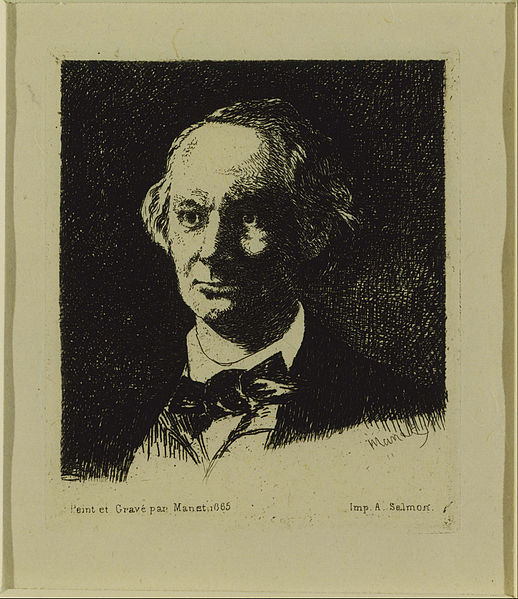
I own a small Edouard Manet. It is a tiny print, a re-strike, of Charles Baudelaire that I bought at a print sale in 1966. It hangs in my kitchen above a desk and under a book shelf. Most visitors miss it and many of my friends, who are not artists, if they do see it, don’t give it a second thought. It is easy to miss although it is quite a famous image. It is likely of little value as I paid very little for it being a graduate student at the time I bought it and even if it was to prove a valuable print, I wouldn’t sell it as it is part of who I am.

Edouard_Manet_-_Baudelaire_-_Google_Art_Project

Looking at it makes me happy as it is a direct link both to Manet and Baudelaire who are personal heroes for any number of reasons and I own a piece of both of them. Perhaps Manet did not physically ink this print, but he sure as hell drew the image and made the plate and the drawing on the plate was of his friend Baudelaire. I wonder what they were talking about during the sitting if there was one? I hope it was profound. Maybe it was about the weather or what they had for lunch or, perhaps, a turning point in the history of modern art. I would like to think it was the latter. Baudelaire was, in the minds of many, mine included, the first modern art critic and Manet was one hell of a modern artist. I certainly would have liked to have been in the room during the sitting sipping a glass of wine and smoking a cigar. Perhaps I could have shared a bon mot and changed the history of art.

Mind you, Manet could have been working from a photograph for this image of Baudelaire, but that is a whole other issue and I am not going there. It is a fact that the two were good friends and this was at the very beginnings of Impressionism. What artists should have not wanted to be in Paris at this time. The print dates from 1865 and Baudelaire died in 1867. Writers, painters and composers were all in the mix and in all in the cafes and salons that were so central to this start of what was going to become Modernism. It is my firm belief that these artists talked to one another at these places rather than blogging as I am here sitting in my basement office or tweeting on their smart phones. Perhaps something came from these conversations, but that is only my opinion.

In daydreams I often place myself in the role of an artist of the past. Looking at a painting I can feel every brush stroke as if I made them myself; I feel the pressure of the brush against the canvas and the smell of paint. I see the subject, if there is one, as if were in front of me. It is a type of magic that is only available if you studied traditional studio painting and have a good sense of imagination. It does make looking at art more fun than Post-Modern analysis, and or deconstruction theory, that often leads to boring art criticism. Art, paintings in museums, was made by real people, men and women, who stood in front of a canvas doing their thing.

The visual arts do have the power to transport us to other places that are mostly in our minds as does music and literature. It doesn’t take much, at least for me, for this to happen as is the case with this little Manet print. A print or a painting is a point in time and we live in time that keeps moving forward; a process we have little control of, but art works give us the chance to stop time if only for a moment. Baudelaire lives timelessly in my kitchen and he will continue to live, as long as the print exists, long after I am gone.

© Virgil Hammock, Sackville NB Canada, Sunday, 12 May, 2013.

h1

The Education of the Artist

May 8, 2013

There comes a time for reflection on one’s own past and that time is now. Slipping as I am into a well earned obscurity, I think about my own education in the arts and how that would not happen the same way now. I don’t want to get into old chestnut that in my day I walked to school through snow up hill both ways. Quite the opposite, it was a golden time and, here is the key, my education was cheap or perhaps, more aptly, not expensive. Kids today pay a small fortune for fine arts education that is often third rate. My undergraduate degree at the San Francisco Art Institute, the California School of Fine Arts when I started, cost me a few hundred dollars a year in tuition–a sum I could raise working part time around the school. Today’s tuition is around $37,000 plus fees a year. My graduate degree from Indiana University was pretty much free plus I got some dough as a teaching assistant. I walked away from my education a free man. Don’t give me that crap about inflation. You cannot earn the money to go SFAI today working part time and summers and there is the small matter of materials, eating and a place to live. Tuition has out stripped inflation many, many time over. Even at my own provincial or state university, Mount Allison, where I taught for twenty-nine years, tuition is around $7000 plus a whole lot of fees, however, this does sound like a bargain compared to good American art schools.

What does this all mean? Well, it changes the very nature of art and who makes it. Working class students are mostly out as those who do go to university are looking for degrees that will in their minds, and it is mainly in their minds, led to a well paying job. Men are largely out as they, when they go to university at all, are too practical for their own good. What’s left upper and upper middle class, women. I have nothing against women artists. The more the merrier. Again, in my undergraduate days (1959-1965), art schools were filled with wildly romantic males wanting to be heroic abstract expressionist, and at SFAI sloppy figurative, artists. Not a bad role to play at local watering holes after a hard day throwing paint around in your studio or class room. Many of the people, men and women, I went to school with came from working class backgrounds whose parents had never gone to university. They were not worrying about what they were going to do for a living when they graduated. Perhaps they should have as it was still a bitch to make a living as an artist then as it is today. The idea then, and I hope a little bit today, was to change the world to a better place through art. It didn’t work then and it’s not working now, but let’s give everybody an A for trying.

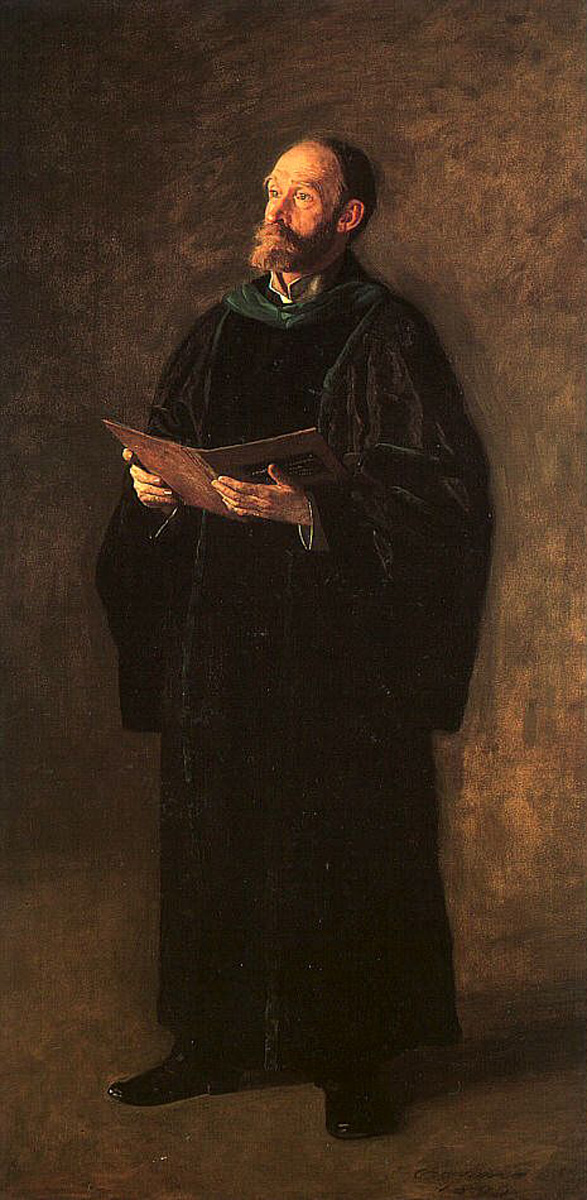
Eakins_Dean's_Roll_Call_1899_wikimediaIt has been argued that a degree, fine arts or otherwise, does not buy as much as it used to, but the playing field has changed. In the 1950s and 60s a far smaller percentage of the population went to university. Graduates were an elite and hence in demand. Today perhaps five times as many people, as a percentage, go on to some form of post secondary education. Do the math. A degree is worth far less than it was fifty years ago. Before the 1950s, Mount Allison was the only university in Canada giving a BFA degree and their programme only started in 1938. When I came to Canada to teach in 1967 there were no universities offering a MFA degree. Today there many schools cranking out both degrees in Canada. (Should be said, however, that some of these schools are dropping or thinking of dropping their BFA and other humanities programmes in favour of more practical studies that are in line with the job market.) Hello, Mars to Earth, is it any wonder that there is a painter behind every expresso machine? Don’t despair as the second person behind the machine is likely to be recent B.Com or IT graduate.

Am I in favour of limiting the number of people going to art schools and universities? You bet, but then I am an elitist. Was I lucky to go through the system at a better time? Yes, but it was all my father and mother’s fault who conceived me in the late 1930s. Younger colleagues of mine are still pissed off that a no talent laggard like myself was able to waltz my way to an early full professorship while they have to toll many years in the mines of academia. Them’s the breaks. On the plus side most of them will still be alive when I am safely dead and things have got to get better, don’t they?

Back to limits and elitism. I am not in favour of how this works now; both are controlled by money rather than talent. Post secondary education should be free. Talented people should be paid to go to school. Society would benefit were its best people get the education and training they need to make a country a better place for everyone. While it appear that I might be smoking something that I shouldn’t, but let me assure that I am not inhaling and such things do happen in some countries other Canada and the United States–try Finland or Denmark for starters.

Two answers. One: Massive Open Online Courses or MOOCs. Free is good, but I don’t think painting and drawing courses work very well in this kind of format. Two: Declare that everybody is already an artist. Vast numbers of people own a camera and know that the lens is on the front and you can buy a pencil or a brush without a permit. Who need a fine arts degree when we are all artists?

© Virgil Hammock, Sackville NB Canada, Saturday, 4 May, 2013.

h1

The Value of Priceless

May 1, 2013

There is much talk about the value in dollars of art works these days. It is hardly a new subject, but now in this age of recession if not outright depression art seems to be moving in the market for truly outrageous sums. This would not be a bad thing if living artist made big money off the secondary market, but generally this is not the case. True there are a few artists like Damien Hirst that do well, but often it is the work of dead, often long dead, artists that do the best at auction and even if the heirs of an artists do well, which sometimes happens, being dead cuts into your fun of being a successful artist.

The real question is changing taste in a changing market. Is the value of half a shark in a tank of formaldehyde (The Physical Impossibility of Death in the Mind of Someone Living), Hirst again, or an off-register photo silk screen, any of many Andy Warhols, worth more than an old master? Currently the answer is yes, but there was a hot market for tulip bulbs in 17th century Holland until some bright person figured out that they were flowers. The results were not pretty and many good folks were left holding a bouquet and little else. Generally the art market is victimless crime: fools and their money parting. We suffer in this inflated market as good art is pulled from the public view and sequestered into private collections and, worse, into vaults where the works are seen by no one. Of course, public institutions have a hard time competing in this hyper-inflated market.

OK, what’s to be done? Actually, nothing. We are screwed. Money talks and the market listens. Art has always been the game of the rich and privileged. Their is more than a little irony in that artists often work on the cheap for the ultimate benefit of the rich. I salute the rare artists, good and bad, who make a fortune during their lifetimes. Rare and beautiful objects, whatever they are, will always have a high market value and owning them gives status to the collectors. It can buy them into the upper reaches of ‘polite’ society. At onetime the newly rich would, at least, buy art and give it to public collections and gain entrance into society and, possibly, if they were lucky and pious, Heaven as did Enrico Scrovegni, an early Italian banker, around 1305 when he commissioned Gitto to paint the walls of his chapel in Padua. Hope it worked. Nice pictures in any case. Today buyers are often buying art as a hedge against inflation and even, in some cases, as a method to laundry money from drug deals.

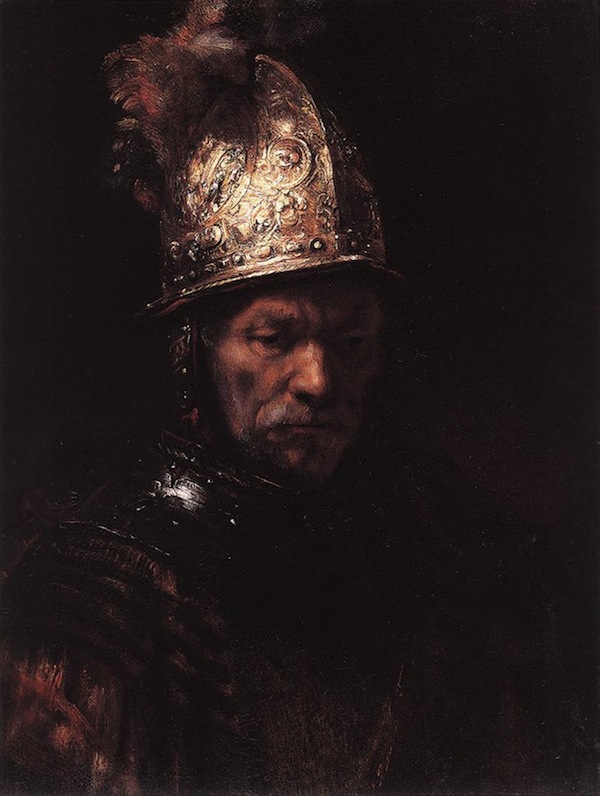
The_Man_with_the_Golden_Helmet_(Rembrandt)_wikimediaMost people are more impressed with the money value of an art work than the work itself. If a painting is worth many millions of dollars then it must be good as the market is always right. What is interesting that when a painting looses value such as was the case when a work is deemed not to be by a master, but by another as happened with the Rembrandt Project when a painting like The Man in a Golden Helmet was said not to be him, but by an unnamed student. The value dropped like a rock, yet the painting did not change one iota. Hell, I even went To Berlin to see that painting when it was still a Rembrandt and I thought it was worth the trip. School of Rembrandt is worth a fraction of the value of a real Rembrandt. Indeed under the project some paintings became non-Rembrandts then they changed their minds and became Rembrandts again (The Polish Rider). What’s the poor public to do much less collectors who have real money invested?Rembrandt_-_The_Polish_Rider-wikimedia

There is a school of thought that thinks maybe we should take the names of artists off of all art works and let the chip fall where they may, but that might confuse the market and who would want to do that? The signing of art works by artists is fairly recent, mostly post 1400’s, and yet we realise some earlier unsigned art works are ‘better’ than others and we do so by looking at the works and making judgements. I carry a small polished rock in my pocket that is quite the beautiful object. I have no idea what type of rock it is, although the person who sold it to me at a rock shop for a couple bucks told me, and I don’t care, but I cherish it and I have with me all the time. It may not be art, but I like it and that is enough.

Granted great art works are not polished stones and I wanted them valued and saved and, what is most important, be able to see them. Even that is getting difficult when ‘block buster’ exhibitions in North America charge twenty-five bucks and up to get your foot in door. When I was a child growing up in San Francisco in the 1940’s and early 50’s, my grandfather used to take me to the city’s art museums all of which were free as they were went I later went to the San Francisco Art Institute. I would like to think that might have had something to do with me taking up a life in art. Today it cost real money to go the fine arts museums of San Francisco not to mention the Institute. This has changed the nature of art both in its making and seeing and I would say not for the better.

Expensive art education and its problems are another subject. One of the last hold out of quality tuition free fine arts eduction, Cooper Union, appears to be going down the tubes. I will save this debate for another time.

© Virgil Hammock, Sackville NB, Canada, Saturday, 27 April, 2013.

h1

Art Treasures of New Brunswick

April 24, 2013

Art Treasures of New Brunswick
Beaverbrook Art Gallery
Fredericton, New Brunswick
21 February–26 May 2013

When the director of the Beaverbrook Art Gallery. Terry Graff, asked last year if I would be interested in putting on an exhibition of five art works from each of five public collections in New Brunswick for a total of twenty-five pieces, I jumped at the chance. It was an opportunity to put my money where my mouth was, as an art critic I am always judging the efforts of curators and their exhibitions. Now it was put up or shut up. I decided that there would be no theme other than the fact that I liked what I picked. No matter what choices you make people will find fault with your selections. Everyone should trust their own taste and if there was disagreement, so be it, but it would, in my case, a change of that old chestnut from: “I don’t know much about art, but I know what I like.” to “I know a whole lot about art and I do know what I like.”.

The five collections were the Beaverbrook Art Gallery and the University of New Brunswick Art Centre, both in Fredericton; the New Brunswick Museum, in Saint John; the University of Moncton’s Galerie d’art Louise et Ruben-Cohen and Mount Allison University’s Owens Art Gallery in Sackville. My choice was enormous as there were thousands of art works in the collections of the Beaverbrook, the Owens, and UNB; in the hundreds at UdeM and, in the case, of the NB Museum, which is an archive and museum rather an art gallery, over 100,000 items. Surely this was a recipe for disaster.

It is not that I won’t make a case on why I picked a work from a collection for the exhibition. I have a good reasons for every piece in the show. The reason that is common to all of them is that they all caught my eye. An art work that I am not interested in looking at is a non-starter. Here is where I claim expert art ‘looker’ status. I have spent well over half a century looking at art professionally, and believe it not, forty years writing about in it in this magazine. I would not foist my taste on anyone, however, how does a painting catch my eye? The answer is beauty. Beauty is big subject in the study of art. It is said that beauty is in the eye of the beholder. I do not agree. I think that beauty is a very real thing that can be defined. I have written a lot on this subject and taught a course on the philosophy of beauty for over thirty years. I believe that every work in this exhibition is in one way or another beautiful.

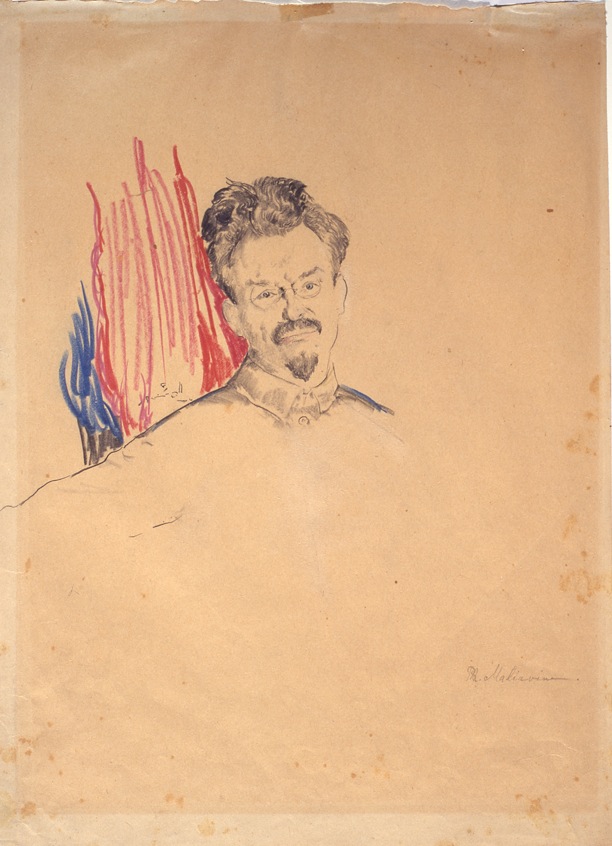
leon trotsky by philipp maliavanHowever, beauty was only one aspect of my thinking about this exhibition. I wanted viewers to perhaps see works that had not seen the light of day for a very long time. Works that for one reason or another have lingered unseen in a vault. In vast collections works, particularly works on paper stored in boxes, can get lost. Case in point the small drawing of Leon Trotsky by the Russian artist Philipp Maliavin which came into the Beaverbrook Art Gallery as part of the original collection of Lord Beaverbrook in 1959, as far as I can see from the gallery’s records, has never been exhibited. There are many questions about this drawing such as why would Lord Beaverbrook buy a drawing of Trotsky by a little known Russian artist who died in France in 1940? There are many drawings by Graham Sutherland of Churchill in the Beaverbrook collection that makes sense because of Lord Beaverbrook’s connections with both the artist and the subject, but I am hard pressed to think of Lord Beaverbrook as a fan of Trotsky. Nonetheless, it is a very nice little drawing, typical of the artist, that deserves to be seen.

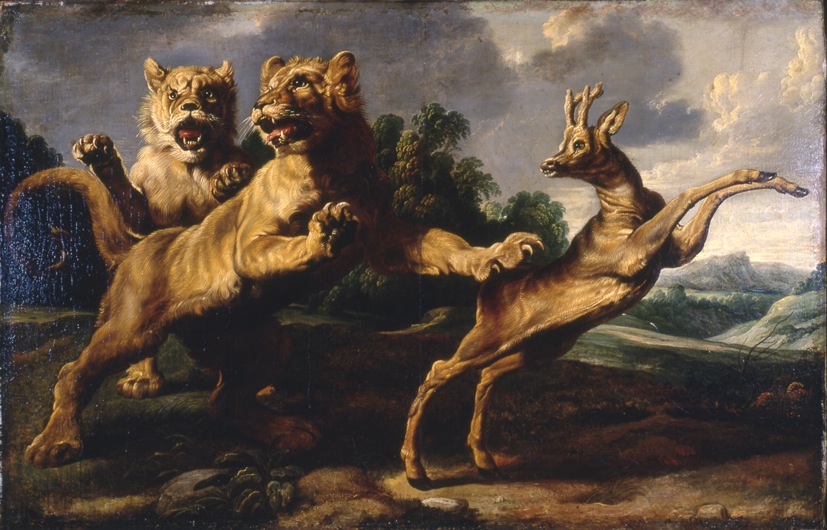
An example of pure conventional beauty, also from the Beaverbrook collection, that I included in the exhibition is a painting by the 17th. century Flemish master Frans Synders, Two Lionesses Attacking a Young Stag; it is pure painterly virtuosity that takes one breath away, but a humble late 19th century New Brunswick quilt by Ruth Bateman from the New Brunswick Museum, also in the exhibition is, in its own way, equally as beautiful. Both are a feast for the eye. two lionesses by frans synders

There are other personal choices by contemporary New Brunswick artists like Molly Bobak, Stephen May, Stephen Scott, Jennifer Belanger, Yvon Gallant and Romeo Savoie that run the gambit from realism to abstraction, but all share a commitment to what I find as the beautiful. The artworks in this exhibition are my treasures another person picking from the same stock would likely come up with a different selection. Indeed, perhaps on an other day my choices might have been different. Art does give me satisfaction. I want people who look at this exhibition to share my satisfaction. After all it is the artists who are the real treasures without them making the art there would be nothing to look at. The unnamed person who made tiny Easter Island totemic sculpture; the woman who crafted the quilt; the well known and the not so well known traditional artists whose works are in this exhibition can transform the world into a better place if only we take the time to pay attention to their efforts.

© Virgil Hammock, Sackville, NB Canada, Sunday, 10 February, 2013.

h1

Manet: The Opera or What you get is not what you see

April 19, 2013

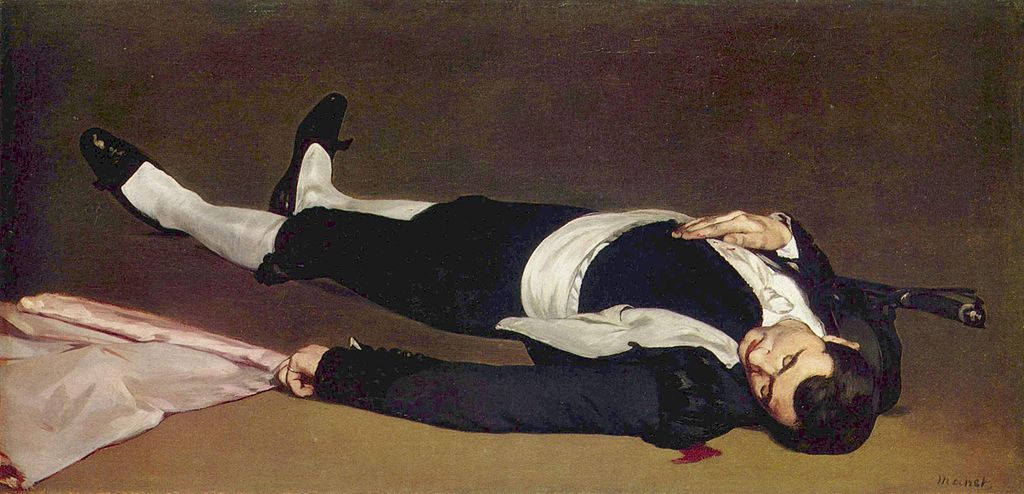
Following in the footsteps of the Met’s direct broadcast of opera to a movie house near by you, Cineplex is offering us ‘Great Art on Screen’ starting with Manet this month and following with Munch in the summer and Vermeer in the fall. Good thing this: art for the masses, at least those with seventeen bucks in their pocket. Movies and television of great art have a long tradition that goes back to the beginnings of those media. Folks can’t get to the art so we might as well bring it to them, complete with commentary from art experts on what it is all about and what we should think about it. There in lies the rub. Looking at visual art is a personal thing and we bring our personal opinions to this venture however wrong they might be.

Back to Manet and the matter at hand. We are offered a tour of the exhibition Manet: Portraying Life that is currently at London’s Royal Academy of Arts hosted by Tim Marlow, a good fellow, I am sure. All will be beautifully photographed; the music first rate; and the experts will all be experts. All very good you might say, and as I am an expert myself, what would could possibly be wrong with this picture? Well, it is actually about looking and all that entails.

Edouard_Manet_Toter_Torero_wikimedia

Opera is an event in time, looking at paintings is not, it has a start, an overture, an end, the fat lady sings–in short, it is theatre and that works as a film. I might rather be at the Met, but it’s not too bad at my local cineplex. Theatre, opera, is group event, you enjoy it in a crowd, if somebody sings something well everybody applauds and might even cheer and they even do this at the movie theatre where the opera is being shown, at least they have when I have gone. When was the last time you ever saw a group of people standing in front of a painting applauding?

Why? Because looking at a painting is a singular event between the viewer and the art work, even if the viewer is within a crowd at the time. I have seen Vermeer’s Girl with a Pearl Earring many times, often in a crowd, yet each time my viewing has been a unique experience. How does one ‘look‘ at a painting? The usual drill is first you see it as a whole and then scan the painting, most often from left to right and from up to down. Bright colours jump out at you and duller colours receed. In the Vermeer you look for the pearl earring and, no surprise, it is in the right place–the centre of interest. This painting is all about composition, Vermeer has got it right, but that is another whole subject that I used to spend an entire year teaching undergraduate art students. Manet gets his pictures right as well and that’s what makes him a great artist.

Johannes_Vermeer__The_Girl_With_The_Pearl_Earring_wikimedia

The problem with the camera doing the looking at parts (or details) of paintings, be they Vermeer’s or Manet’s, is that the camera is not you and will take a route that is not yours. A real difference between an opera and a painting is that a painting is a single unique object and an opera exists as a score that comes to life in many different guises. A performance of Carmen in San Francisco will be very different from one in Paris. You can even enjoy an opera on the radio or a recording. Hard to imagine listening to a painting on radio. You can talk about a painting on radio, but it leaves much to be imagined.

Surface and colour in a painting cannot be captured in film. Pigment colour is very different from film colour and there is no way that film can show the surface texture of an art work. There is also the issue of scale. A smallish painting like the Vermeer is a very different experience than a wall sized Jackson Pollack. The camera cannot overcome this problem, no matter how hard a director works at it. There is no way that a film can replace a real person in a real space looking at an original art work.

Well, where does that leave us? I, for one, will levy up my seventeen bucks, no, make that fifteen, I am a senior, and go to the movie and enjoy myself. I know to get the most out of Manet, I will have to go where the art works are and hope that some of audience will do the same thing. I know that some of them will never have the money to travel to see the art work and they are better informed by seeing the film. Alas, we live in a far from perfect world.

© Virgil Hammock, Sackville NB Canada, Sunday, 14 April, 2013.

h1

Twittering Machine: Paul Klee 1922

April 14, 2013

I was only fourteen or so living in England when I became aware of the Swiss artist Paul Klee and his work. I was given a tiny book of his watercolours and paintings in 1954 by a woman who thought I should be an artist. She was right and I still have that book.

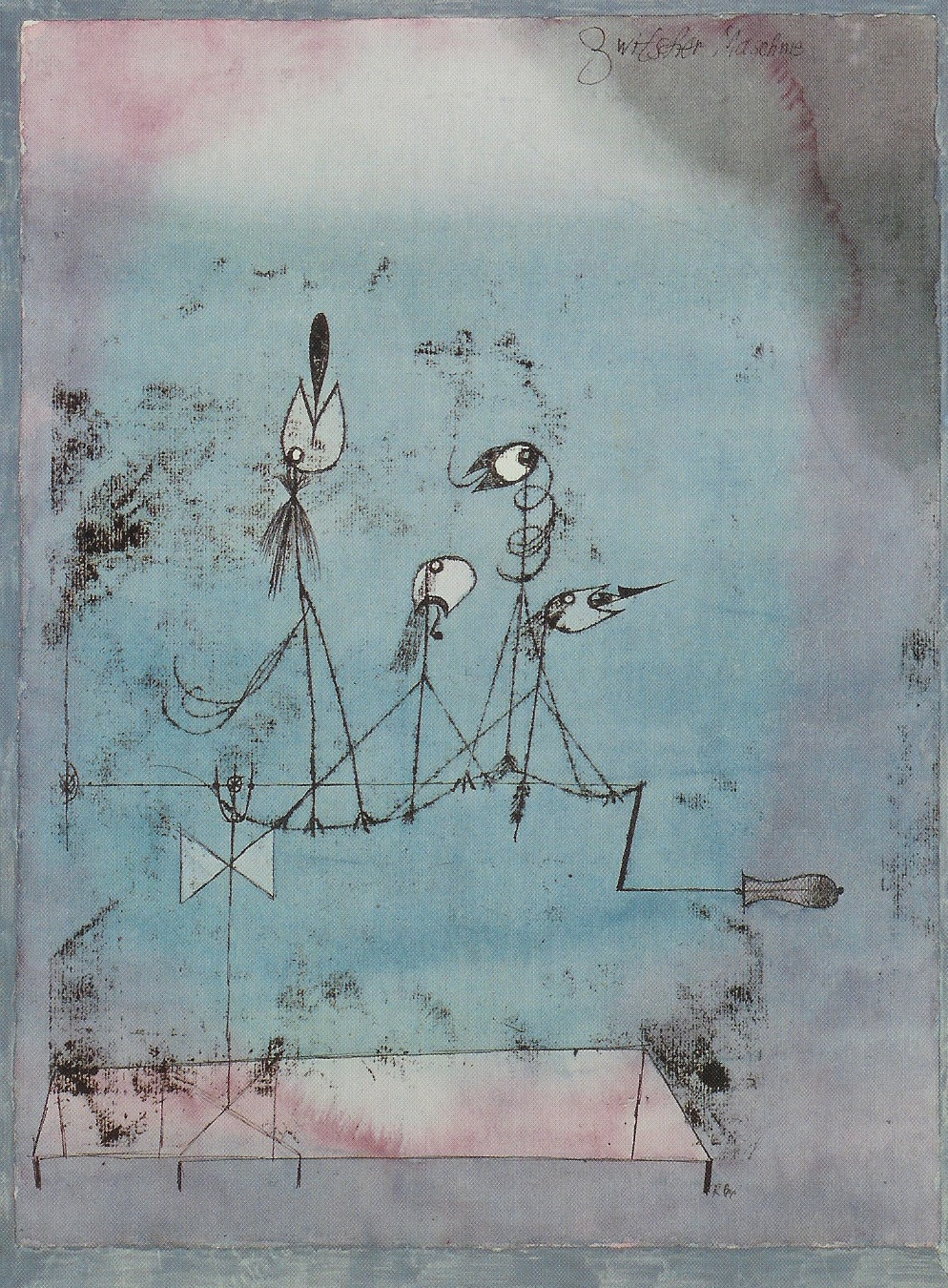
Two years later I was in the American army in New York City on leave, waiting to be shipped to Korea as a combat photographer, and I found myself in the Museum of Modern Art; that’s where I first laid eyes on Klee’s small 1922 watercolour: Twittering Machine. Love at first sight. What a wonderful picture and what a wonderful artist. I have seen the painting many times since that first view, but I have never gotten over the wow factor of that first time.

Die_Zwitscher-Maschine_(Twittering_Machine)

Now over half a century later this little painting comes back to haunt me because of all the fuss over Twitter as a social medium. Was Klee an early seer of the future like Marshall McLuhan’s global village or was his title just a happy coincidence? Actually, it doesn’t matter.  What matters is that Klee’s image is a perfect simile or metaphor for Twitter. Here we have a bunch of birds all tweeting on a line that is attached to a hand crank waiting to be turned. Perfect. How like us, and I mean us as I am just as likely to tweet as the next person, and hope that somebody hears my call. Yo, anybody home and look at my feathers!

Much has been written about this painting and I am not the first to compare Twittering Machine to Twitter, the old chestnut holds that there is nothing new under the sun, but I would like to think that my bird song is not only the prettiest, but the most profound. A whole lot of art writing draws conclusions about art works that are at best dubious. A quick look on the web for this painting will bring thousands of results. Good luck at finding truth in such a forest of stuff.

Let me tell you this for sure, Twittering Machine is a really pretty, little, blue hued, watercolour that, besides being funny, does a good job of showing the sorry state of the early part of the 20th century just before the ‘you know what’ hit the fan. Klee knew and that’s why he fled Germany and the Nazis and died in his native Switzerland in 1940.

h1

The Landscape as metaphor in Canadian Art

January 24, 2013

Canada is the second largest country in the world and at the same time it is one of the most sparsely populated countries in the world. Moose still vastly outnumber people in Canada’s North. We are also, if you discount the aboriginal population, a very young country. We date the founding of our country to 1867. Of course, there were settlements prior to that date by both the French and English who consider themselves the founding peoples of modern day Canada. This conveniently overlooks the fact that Canada was already populated by aboriginal people who where promptly misnamed by the colonists, Indians. The colonists were continuing the mistake of early Spanish explorers who, in finding the Americas for the first time, thought that they were in India. What early Canadian white explorers really found was a vast and overpowering landscape. It was a country that was, to a large measure, cold and cruel to the newcomers, but it offered them riches if they could tame the land. These early Europeans never really conquered the land, but some of them did try to capture its magnificence on canvas.

Why is the landscape a powerful metaphor for the Canadian psyche? Are Canadians victims of their own self-proclaimed myth of a unity with nature? Myth has always been a strong force in the way that a country envisions itself. It has certainly been a help to the Americans who see in the myth of their `Old West’ an allegory of what they hold to be sacred American values, and to the French who enshrine the myth that France is the centre of the cultural universe. There are times when a myth that a nation believes about itself, such as Nazi Germany’s belief in Aryan supremacy, can lead to catastrophe. Canada’s myth pales beside these three examples probably because we, as a nation, do not have the political power to export our mythology to other countries. Canada has not been, and very likely will never be, a colonialist power; indeed, our history is one of being a colony. It is interesting that in the major myths of the United State, France and Nazi Germany it is the people who act on, and control, `nature’ and in the case of Canada’s dominant myth, it is nature that controls the people. These contrasting myths are a perfect metaphor for colonialists and the colonized. Canadian art is in awe of nature, not its conqueror.

To this day, many Canadians are overpowered by the physical immensity of our country; there are still vast regions of Canada that remain either not populated or underpopulated. It is not surprising, then, that our national identity is tied to our image of the landscape, in spite of the fact that a vast majority of Canadians today live in very large urban centres such as Montreal and Toronto. Many of us live as close as we can to the American boarder in an attempt to get as far South as possible to avoid the realities of winter and still remain Canadian. Like all stereotypes there are some truths and some falsehoods in our self image. In truth, most foreigners’ image of Canada and Canadians is closer to the stereotype than to the reality. They see Canada as a land that is vast and cold–it is–and populated by Eskimos, Mounties, French Canadian Trappers, and Indians all travelling by dog sled to their respective igloos–it isn’t.

Many Canadians do love the land. It is likely that a larger percentage of Canadians retreat to summer country cottages than do the citizens in any other society even if it means living in a sub-standard hut, with little or no modern plumbing, and being eaten alive by the world’s largest mosquitoes and black flies–a holiday for the truly masochistic–but it does give us a chance to commune with nature, and nature is never very far away in Canada. The `country’ is always close at hand, even to the centres of our largest cities. The forces of nature can, in the Canadian context, be overpowering. People tend to get lost in such a setting and that is why you will find few people portrayed in early Canadian art, dominated as it was by landscape.

The earliest European artists in Canada were artists by advocation rather than vocation. They were Catholic priests and missionaries sent from France to `save’ the natives; they were British military officers who were trained in watercolour for its practical uses in topography; they were British civil servants who were surveyors first and artists second; and they were the wives of British officials who had in trained in art as part of their `finishing’. Up to, and through, the 18th century there were very few professional artists in Canada. It was, after all, a hard inhospitable place to live with the possible exceptions of the garrison towns of Halifax and Quebec City which were the only centres of `civilization’ in a remote land. There were very few other towns and even fewer collectors and patrons of art in early Canada. This doesn’t mean that there were not remarkable images done by these early artists. It was not good art by international standards of the day, but it is the best picture we have of not only what early Canada looked like, but what people thought about it.

We have records of at least fifty British officers who served in Canada in the 18th and early 19th century who did watercolours and topographical drawings. Officers in the British Army considered themselves `gentlemen’ and upper class in a class-bound society. When stationed in a remote corner of the Empire, which Canada certainly was during this period, these officers had very few official duties to occupy their time. This gave them ample opportunity for a leisurely garrison life which included time for painting.

Lieutenant-General Thomas Davies (c.1737-1812), who did wonderful watercolours of Niagara Falls, is a typical example of an early Canadian artist. He attended the Royal Military Academy at Woolrich where he studied watercolour. He had several tours in Canada between 1757 and 1790, served in both the French and Indian Wars and in the American Revolution, and each time he was in Canada, he painted. His pictures of Canada were widely shown in Britain, including the Royal Academy, and they were published and sold as engravings. His large watercolours, while not great art, are very competent and are a remarkable record of early Canada.

By the mid-19th century, the early colonial period was over. The British garrisons were closed. The age of gentlemen officer artists was over; however, a new group of indigenous Canadian artists was emerging. These artists were either born in Canada or they had immigrated with the intention of staying. All of them viewed Canada has their native land rather than as an exotic place to visit. This is the beginnings of real Canadian art. These Canadian artists were no less in awe of the landscape than their expatiated predecessors. They began to look westward to the Rockies, and beyond, all the way to the Pacific, and comprehend the enormity of Canada. This was also the time for the organization of a Canadian art establishment via the founding of the Royal Canadian Academy in 1880 and with it, the beginnings of the National Gallery of Canada.

Today the National Gallery is filled with the landscapes of the last half of the 19th century by Canadian artists like Lucius O’Brien, John Fraser, William Cresswell, William Brymner and many others. John Fraser (1838-1898) was the first to paint the western mountains in all their splendour, but he was preceded to the West by a much more interesting artist, Paul Kane (1810-1871), who was never really part of the Canadian art establishment and who at mid-century travelled across the country painting a record of the native people. His is the best chronicle we have of their life before it was changed forever by the advance of so-called civilization. Unfortunately the vast majority of his epic work now resides in a museum in Texas forever lost to us because we failed to understand its value and allowed the work to leave Canada for a foreign home.

While late 19th and early 20th century Canadian artists attempted to come to grips with the grandeur of their native landscape, they did so in an European manner. Many of our better artists received their training in Europe, in particular France, or in Canada from artists who were trained in Europe. We may have had a unique subject matter in our landscape, but we lacked a native style. Our artists who went to Europe during this period, with the exception of James Morrice, studied with all the wrong people. They went to the Academies to learn classical methods and somehow managed to miss major events like the Impressionist and Post-Impressionist movements. Late 19th century Canadian landscape painting was more akin to 17th century Dutch landscape art than it was to anything modern. This was to change in the first twenty years of the 20th century.

A group of artists living in Toronto at the beginning of the century was searching for a way to paint Canada in a uniquely Canadian way. They would emerge in 1920 as the Group of Seven named after the artists who were the founders of the group: Lawren S. Harris, J.E.H. MacDonald, Arthur Lismer, A.Y. Jackson, Frederick Varley, Franz Johnson and Franklin Carmichael. Together with colleague Tom Thomson, who died in 1917, before the `Group” was official named, these artists were key players both in Canadian landscape painting and in the history of Canadian art. The Group, along with Thomson, are Canadian cultural icons known to every school child in the country. Some of their images like Thomson’s The Jack Pine and The West Wind, and Harris’ Lake Superior, have passed from icon to cliche. However, there is no doubt that these artists really loved Canada and that they wanted to find a unique way of expressing it which would appeal to all Canadians. Though both their successes and failures they left a mark on Canadian art from which our culture will never escape.

The method the Group used was really a rehash of Post-Impressionism many years after the style had passed its peak in Europe. Post-Impressionism would not have seemed radical in Europe in 1915, but in Canada it certainly was. The Group’s direct approach to nature was different. They painted what they saw on location with an impressionist palette. The results were, to some viewers who were used to more `polished’ works, both bizarre and unsettling. But these artists were unapologetic. They thought themselves to be the champions of a new Canadian vision. It was a vision that reinforced a stereotype of Canada–plaid-checked lumberjacks cutting their way through the primeval forest. Their own writings reflected this idea of Canada. Sometimes they appeared to be more like a group of boy scouts than a group of painters some of who had been trained in Belgium, France, Germany and England. However, they looked to themselves and their country, rather than to Europe, as a model for their art; this continued especially in English Canadian art, for the next thirty years.

These artists who had won an artistic revolution over the entrenched forces of the Royal Canadian Academy, like so many revolutionaries before them, both artistic and political, soon turned reactionary. The very thing that they fought for, artistic freedom, they tried to deny to those artists who came after them. In particular, they fought a very successful battle against the forces of abstraction; so successful, in fact, that it was not until the early 1950’s that abstraction was freely shown in English Canada. In the place of artistic innovation, the `wild nature’ theme of the Group was replayed over and over again, this time by the Canadian Group of Painters formed on the ashes of The Group of Seven which was disbanded in 1930 because the Group had become so larged that the use of the number seven was really a misnomer.

There were a number of good, and a few outstanding, artists who either worked with, or against, the Canadian Group of Painters. One outstanding artist was Emily Carr (1871-1945) who was a contemporary of the Seven and was actively encouraged by them, was a member of the Canadian Group of Painters. She was a better painter than any of the Seven with the possible exception of Harris and Varley. She was unusual for a number of reasons: the primary one, of course, was her gender–art in Canada, at that time, was pretty much a mens’ club; second, she was from, and worked most of her life in, British Columbia, a cultural backwater if there ever was one; and third, she had a very good art education in both the United States and France. Carr had an affinity for the place of her birth which shows over and over again in her work. Like Harris and Varley, who had both moved to British Columbia during the 1930’s, Carr had a mystical relationship to nature. Her paintings ring true which is something that can not be said for the work of very many painters of her generation.

David Milne (1882-1953) was another outstanding artist who was a contemporary of both the Group of Seven and the Canadian Group of Painters. He was never a member of any group nor did he want to be. Although, he was an artistic loner, he was much closer to Modernism than were other Canadian artists of the period. He was educated and lived in New York during most of the period from 1904 through 1928. It was in New York City that he saw, and learned from, important European and American modern art. He was the only Canadian artist to exhibit in the important 1913 Armory Show in New York. His work is unlike that of other Canadian artists of his generation; while he, like other Canadian artists, had a love of nature and the outdoors, his approach to landscape was filtered through early Modernism. Milne was shunned for much of his life by the Canadian art establishment. It was only through the generosity of one or two collectors who supported his work, that he was able eke out a livelihood as an artist.

Once the stranglehold of the Canadian Group of painters was broken, Canadian art began to follow the dictates of international Modernism. In short, for better or for worse, our art began to look like everybody elses art. In many cases this new art was better than the tired recapitulations of Group of Seven motifs. Even so, the romance of landscape has not been lost on succeeding generations of Canadian artists, although it is only one in a variety of stylistic choices contemporary Canadian artists have now have.

There are important Canadian realist artists who paint landscape as part of their efforts such as Alex Colville, Tom Forrestall and Chris Pratt. These three very different artists work in a highly finished style that has been mis-labelled Magic Realism. What they share is a common educational background. Colville taught the other two artists at a school that he had also attended and they share some common concerns. Their landscapes are, in general, particular to the region in which they all live, Atlantic Canada. Their style which is in isolation from main-line Canadian art, matches the region which is physically and mentally apart from the rest of the country. What is important is that they strongly identify with Atlantic Canada and see it as a place that is different and, to their minds, better than the rest of Canada.

An important abstract artist who has used landscape particularly well is Patterson Ewen. His large carved and painted plywood panels give a new perspective to the Canadian landscape. His personality, which has often been troubled, is reflected by his use of landscape to make a personal statement. Ewen’s paintings are more of a map of his mind than they are of the landscape.
There are countless other contemporary Canadian artists using the landscape as a motif in their art; however, their methods are as varied as there are styles in today’s Pluralism. In addition to the more traditional media of painting, sculpture and photography there are landscape artists who are working in performance, video and mixed media.

Why does nature continue to exert such a powerful force on the Canadian psyche and on Canadian Art? Our neighbours to the south, the Americans, have not been immune to nature’s call; in particular, during the 19th century, when their own population was small and they were extending themselves ever westward, their relationship to nature was not unlike ours. One only has to look to the writings of Thoreau to understand something of this feeling in 19th century America. Much has changed in the United States since then. Canada has changed too, but, perhaps, not as much as the United States. We have one tenth of its population, in a country that is larger in land area. Admittedly, much of our land is not as usable as theirs, but that only adds to the romance: the frozen cruel north, the barren tundra and the impassable mountains, all present a forceful pictorial image that is Canada, metaphorically and literally.

Originally published: 12 May 1991
Professor Virgil Hammock, Sackville, N.B. Canada

h1

The Cult of Beauty Review

June 25, 2012

The Cult of Beauty:
The Victorian Avant-Garde, 1860-1900
Legion of Honor
Fine Arts Museums of San Francisco
34th Ave & Clement St.
San Francisco, California
18 February—17 June, 2012

While Vie des Arts generally concerns itself with issues about contemporary art it is important occasionally to look at art that form the foundations of modern art. This exhibition that takes a critical look at the British Aesthetic Movement is a case in point. Although it might seem strange to us to mix the words Victorian and avant-garde into an art movement it was, in fact, very much the case in the last half of the 19th century in Britain where some of the artists who were at the core of the Aesthetic Movement were met with outright hostility by the important critics of the day. Witness the remark by the famous art critic John Ruskin on the paintings of James McNeill Whistler: “ I have seen and heard much cockney impudence before now; but never expected to hear a coxcomb ask two hundred guineas for flinging a pot of paint in the public face.” The two guinea painting in question The Falling Rocket is now worth millions—so much for critics and criticism.

The important point that is well illustrated by works in The Cult of Beauty exhibition is that the Aesthetic Movement was able to combine the traditional fine or high arts, painting, sculpture, architecture with the crafts, furniture, interior design, jewellery and fashion. The movement was one of the bases for the Arts and Crafts Movement and Art Nouveau. The artists in the Aesthetic Movement were of the opinion that art’s purpose is to be beautiful on its own on formal terms; art for art’s sake—L’art pour l’art. This was in opposition to the existing Victorian ideal for art as a moral educator. Nor were the sensual qualities of much of the movement’s products appreciated by a society that put skirts on table legs to protect modesty. The outrage that surrounded Whistler’s breathtakingly beautiful painting Symphony in White No.1: The White Girl, 1862, which is central to this exhibition, was the fact that the teenage girl in the painting was the artist’s mistress rather than its modernism and the fact that it was shown in the famous Paris Salon des Refusés in 1863.

The British Aesthetic Movement is more about a social revolution than an artistic style. Its art varied widely from Neo-Romantic to Decadence, but what the movement had in common is distaste for Victorian orthodoxies. Whistler is book-ended in the movement by Aubrey Beardsley. In the roughly forty years that span the movement Britain was going through a social revolution. Western Europe was being transformed by the Industrial Revolution craftsmen were being replaced by factory workers and people were moving to the cities. The response of artists of the Aesthetic Movement was the Pre-Raphaelite Brotherhood and the Arts and Crafts Movement. While the artists might be considered reactionary in regard to the machine age they were revolutionary in their disregard for social norms. Theirs was the bohemianism of Oscar Wilde and the decadence of Aubrey Beardsley.
It was the stuff other than painting, sculpture and lurid prose where the Aesthetic Movement was to have its biggest influence on the British public such as the wallpaper designs of William Morris, the cloth designs of Liberty’s of London, the home furnishing of Thomas Jeckyell and the architecture of Philip Webb. There are examples of all of these peoples’ work, among others, that is evident in the exhibition. A central idea of the movement was unity in all things or as William Morris stated in 1880: “ If you want a golden rule that will fit everybody, this is it: have nothing in your homes that you do not know to be useful or believe to be beautiful.” In a nutshell all things that surround us should be both beautiful and useful.

It is unfortunate that San Francisco was the only venue for the The Cult of Beauty. The exhibition was also seen in the Victoria and Albert Museum in London and Paris’ Musée d’Orsay who along with the Legion of Honor organized the exhibition. However, the Victoria and Albert did publish an excellent catalogue edited by Lynn Federle Orr and Stephen Calloway that accompanied the show that is well worth reading in lieu of actually seeing the exhibition. It is important that we sometimes look at a different route in the development of Modernism to have a better understanding of where art is today. The Aesthetic Movement was one of those routes and their products, if nothing else, were beautiful. That aside, just to have a chance to see James McNeill Whistler’s, painting from the Tate Gallery, Harmony in Grey and Green: Miss Cicely Alexander (1872-74) was well worth the price of admission.

© Virgil Hammock, Sackville NB, Canada, 21 May 2012.

h1

Welcome

August 30, 2009

I have just started this blog about beauty and art. Looking forward to your comments.