Archive for the ‘Virgil’s Thoughts’ Category

h1

We are all Charlie or in my Case: I am Mike

January 14, 2015

I was trained by the US Army to be a combat photographer. It was considered to be a very dangerous job. I volunteered. I was seventeen at the time and none too bright. Fortunately, the only time I spent in a combat zone was for sixteen months in Korea in 1957 and 1958. The real war had ended in 1953. I subsequently spent nearly forty years of my life teaching art at university and, in particular, teaching drawing. I was following my post army credo, make love not war with an emphasis on the love. I thought that art would not be a dangerous job for me or my students. The recent events in Paris have proven me wrong.

A former student of mine, Michael de Adder, is one of Canada’s best known political artists. In fact, I’m in the process of organizing a major retrospective of his work at the Beaverbrook Art Gallery in Fredericton, New Brunswick for next year. We had spoken, before the shooting in Paris, about cartoons he had drawn that proved too hot to be published and others that when published that got him and his publishers in trouble for being too provocative. These were, of course, the kind of materials that I wanted to include in the exhibition.
Political cartoonists work within a very short time line. They need to know what is going on and what’s going to be of interest to the paper’s readers. They need to be provocative. Who wants boring cartoons. They need to have an opinion. Nothing should be sacred; yet if it’s too far off the wall, then the paper won’t likely publish it. Mike does everything a good political cartoonist ought to do. The one thing he should not have to worry about is getting killed in the process.

by Micheal de Adder (used with permission)

by Micheal de Adder (used with permission)

There’s been a lot of ink spilt in the last little while over the Charlie Hebdo shootings some of it very good and some, too much, lamentable. Salman Rushdie, who does have some real experience with extremism, vented his frustration, during a TV interview, over what he calls the buts. These are the people who say, yes, the events in Paris were terrible, an attack on free speech, blab, blab, but if Hebdo had been more sensitive to people’s feelings, none of this would have happened. This begs the point of what Charlie Hebdo was, and is, a slightly off-kilter, satire magazine. The old Mad magazine or the National Lampoon on steroids. Charlie Hebdo is not in the business of being sensitive. Rushdie said that you are either against an outright attack on freedom or you’re not; there is no middle ground. He is right.

I’m able to avoid what Mike must confront. I’ve told the magazine, that I’m still writing for, that I’m going to only write about exhibitions and subjects that I like. I figure that there’s a lot of bad art and why, at my advanced age, should I get my knickers in a knot venting about stuff I don’t care about. I guess I’m back to my make love stand of the 1960s. Mike, on the other hand, has to deal, on a day to day basis, with a lot of awful stuff and be funny at the same time. People do get offended and write letters to the editor. If they didn’t, Mike would likely be looking for another job. I do know that he believes in what he draws and is passionate about his work.

The danger of an event like the Hebdo shootings is that cartoonists, consciously or sub-consciously, will self censor themselves or be censored by their publishers. It’s easy to understand why. Getting yourself killed over your art is an option to be avoided. The main problem that faces most North American cartoonists is running afoul of the politically correct. This is a quagmire that I am all too aware of after a lifetime in academia. Seldom does a day pass that there isn’t a letter to the editor in the newspapers that I read where someone is offended by an editorial cartoon. Fortunately objections normally stop there and the next day all is forgotten.

Political cartoonists are like the court jesters of old. The jester had the difficult job of telling the king the truth and had to be skillful to keep his head. One assumes that even temperamental kings had a sense of humour or they would have had a hard time finding jesters. The people who murdered the staff at Charlie Hebdo had no sense of humour. Truth often needs humour to make us see the absurdity that surrounds us.

These are dangerous times and we need windows to truth more than ever. I doubt that if I were living in Paris today, that I would have been a regular reader of Charlie Hebdo, and I did briefly live in Paris, but I sure as hell would be buying a copy now. I’m proud that Mike was my student. I might have helped him learn to draw, but his talent, and bravery, are his own. So, I am Mike as well as Je suis Charlie.

© Virgil Hammock, Sackville NB, Canada, Monday, January 12, 2015.

h1

The Circle Completed

February 19, 2014

This essay was originally published in the book:
Redeemed: Restoring the Lost Fred Ross Mural
UNB Art Centre, University of New Brunswick, 2013.

The recent reanimation of the Fred Ross mural, Destruction of War & Rebuilding the World Through Education, in Fredericton by a group of apprentices and artists, under the supervision of the artist, is not only a homage to the youthful work of Ross, but a reminder of the history of mural painting in Canadian art history. The original mural, now lost, was commissioned in 1946 by the student council of Fredericton High School as a memorial to fellow students who lost their lives in World War II. It took Ross nearly two years to complete the mural which was finally unveiled in May 1948. This was the very young artist’s second mural, he was born in 1927; the first was Annual School Picnic completed in 1946 at the Saint John Vocational School when he was still a student.

If there was ever a child prodigy in Canadian art it would be Fred Ross whose talents were recognised early on by the Saint John art community, in particular by Ted Campbell who was to become his teacher at the Vocational School, his mentor and lifelong friend. Other important influences were, of course, Miller Brittain and Jack Humphrey. The City of Saint John plays a pivotal role in the story of the Fredericton High School mural and the other four major murals that Ross completed between 1946 and 1954.

During the first half of the twentieth century, Saint John, and the rest of the Maritimes, sat in splendid isolation from the history of Modern Art, indeed; most of Canada was out of pace of what was going on in Europe. I would go venture to say that the art in the Maritimes was even far removed from the rest of Canada. This isolation was perhaps not a bad thing, unless you were an artist trying to make a living here, as it made us unique. There were at the time two places to study art in New Brunswick: Mount Allison University, whose degree programme did not start until 1938, but had been teaching art in one form or another since the mid 1800s, and Saint John Vocational School which started in the 1920s. The Owens Art Gallery at Mount Allison showed art, their mixed bag collection, and there was a small collection of art at the New Brunswick Museum, but there was no opportunity to see major art works; this was the world that Fred Ross, with all his natural talents, was born into.

The big elephant in the room when Ross was coming of age was the Depression. This was to affect the very nature of art in Canada and its history of mural painting. New Brunswick had always been, and remains, a difficult place to live. The Depression made it worse. Certainly New Brunswick felt the Depression in a large way and its artists were no exception. Canada had no WPA (Works Project Administration) with its New Deal Art Projects programmes for its artists which was the case with their American counterparts. Frankklin D. Rossevelt spent his way out of the Depression and that included spending money on the arts to promote his vision of a ‘New Deal’ for Americans. That did not happen in Canada where both Prime Minsters Mackenzie King and R.B. Bennett and their respective governments preferred a course of austerity. The enviable results for the arts was that they flourished in the United States as they never did before and possibly never repeated, while in Canada the arts languished along with the rest of the economy. What pulled this country out of the Depression was the war, but even that did little for the arts.

Saint John artists like Brittain, Humphrey and Campbell did, however, mirror their American counterparts with their subject matter of the despair of the Depression’s working class people. This was a time of class warfare–left versus right. Many artists, in both countries, embraced far left, anti-Fascist politics that included in some cases becoming Communists. Visual artists wanted to find a way to use their art to fight Fascism and Capitalism and this led them to murals as a public forum to educate society. Where they found models was Mexico where murals had become the chief source of a new strong public art under the leadership of artists Diego Rivera, Jose Clemente Orozco and David Alfaro Siqueiros.

Screen Shot 2014-02-17 at 20.11.57Diego Rivera was particularly important as he was invited to the USA to both teach and paint a number of murals. As well, a number of American and Canadian artists travelled to Mexico to study mural painting. Indeed, Fred Ross went twice to Mexico to study, but that was just after Destruction of War & Rebuilding the World Through Education was completed. Ross, and his teacher Ted Campbell, were certainly well aware of what was going on in Mexico at the time of the Fredericton High School commission. The golden age of American WPA mural (1933-1943) was over, but there were many books and reproductions of Mexican and American mural art that the young artist could, and did, see during the mid 1940s. These and his teacher’s urgings were to serve as his model for the mural Fredericton High School.

There are many antecedents for Destruction of War & Rebuilding the World Through Education, but this mural was a powerful accomplishment by a young artist with so little under his belt at the time. Murals, or in a broader context, wall painting, go back to the very beginnings of art. The paintings on the wall of caves in Altamira and Lascaux are as early as you can get; Egyptian tomb art; Roman wall painting and, most important to Ross, European religious frescoes from the Middle ages through the Renaissance in particular those from Italy like Giotto, Cimabue, Cavallini, Duccio and Masaccio. The mission of all of this art, as it was with the Mexican murals, was to tell a story generally to a broad, and sometimes illiterate, audience. Much of these works were large in scale as their stories were large and meant to impress.

Ross’s audience was, of course, not illiterate, but the work was intended as a memorial to the fallen and as an example what was possible, because of their sacrifice, of a new world made possible through education. These goals were a tall order for a young inexperienced artist. The model he uses is a diptych of contrasting themes, in his case war and peace. The result is a secular version of what would have at one time been a religious work. The models I have in mind are from religious art like Rogier van der Weyden’s Last Judgement were of Heaven and Hell. Ross’s follows the general pattern of early church iconography with Hell, war, on the left panel and Heaven, peace, on the right panel. Besides the idea that left usually stands for bad and right for good such a placement also makes visual sense as well as we normally scan works of art from left to right. As well, it does make sense to look at the left panel first and then go on to the right–from what is bad to what is better. The images in the two panel viewed as pair form a triangle or pyramid that leads our eyes upward which again follows religious conventions–upwards towards the Godhead and, in any case, the top half of a composition is a stronger area. In their original placement the paintings were high on a wall which also forced the viewer to look upward.

The images on the panels mirror one another which is a strong visual device. The figures are drawn with very strong outlines which are more linear than painterly and strongly relate to the cartoons for the murals. The full scale cartoons survive and are in the collection of the National Gallery of Canada. There are also smaller scale surviving drawings all which were a great help in the recreation of the murals. While I have written about the early religious models for Destruction of War & Rebuilding the World Through Education the most obvious precedences are the Mexican murals of the Rivera school. The Mexican murals, and those Rivera did in the US, were meant to impress and impress they did not only in their scale, but in the boldness of their subject matter and political content. While some of today’s postmodern art does reflect social concerns they are often presented in ways, and places, that are remote from the general public’s understanding and gaze. The mural art of the thirties and forties, and in Ross’s case, the early fifties was meant to be in your face and clearly understood by all who saw it–in short, a populist art. There is a long social history of art that was meant to be art in the service of the people. As an art student in the fifties and early sixties, I was an avid reader of Arnold Hauser’s epic multi-volume The Social History of Art and firmly believed that art could, and should, be a tool of social revolution. The muralists certainly thought this and I am sure that the youthful Ross did so as well, but alas both of us are older now and far away from the bloom of young ideals.

Oddly, the uniting factor between Ross’s two panels is the mushroom cloud of an atomic explosion that appears in the top facing corners. On the right panel is the bomb that was the result of world war and, on the left panel, it is the threat to world peace. The atomic age rested heavy on the public psyche of the late 1940s. Death it appeared was just the push of a doomsday button away, but in Ross’s vision perhaps this could be avoided by the lessons of education. Panels in the Gothic period promised eternal damnation on Judgement Day unless one had lead a good Christian life. Ross’s mural, like the Gothic models, is a moral lesson that if ignored promise a bad end.

Not all murals of the American WPA period and those of Ross were left wing polemics. Ross’s first mural from 1946, Annual School Picnic, was an innocent image of a happy event. A seminal figure in the development of mural painting in Canada was the American regionalist painter Thomas Hart Benton, a teacher of Jackson Pollock and certainly not a left wing figure. He gave a keynote address at the 1941 Kingston Conference on the arts where he spoke of the importance of murals and their role in public education. Several Saint John artists, including Ted Campbell, were at the meeting where Benton’s message was enthusiastically received. Public art was seen by many artists at the time as a method of bringing art directly to the people in a way that was available to everyone.

There is the question of when public art becomes propaganda, but that all depends on one’s viewpoint just as myth can be viewed as someone else’s religion, propaganda can be seen someone else’s politics. In the best of worlds, public art mirrors the artist’s personal beliefs rather than those of the state or who was paying for the funding of the work. It should be noted that some of the very best religious mural art of the past was done by artists on direct commissions from the church and we know very little of the artists’s personal ideas. For instance, we know little of what an artist like Jan van Eyck thought about religion, but The Ghent Altarpiece (1432) is a masterpiece of the first rank on the subject. So quality art is possible in spite of what an artist believes.

Another factor, and this is the case with Ross’s Destruction of War & Rebuilding the World Through Education, is that artists as they mature can change both their minds and direction. This mural is a youthful work of the artist who was very much under the direction of his teacher and symbolic of the time when it was painted. Ross’s mature works are more classical in nature, more painterly and limited to traditional easel painting. Those things aside, I believe that this lost work, now reanimated, is very important in an understanding the artist’s development. Clearly Ross has always followed his own vision wherever it has taken him. He has avoided the trends of contemporary art be they abstraction or post modernism. He has stuck to realism and craftsmanship through thick and thin. He has remained in Saint John when the centre of Canada’s art universes are elsewhere.

Has the world been rebuilt through education since 1945 and the end of World War II? One would like to think so, but looking around us some nearly seventy years on there are serious reasons to doubt such a rosy conclusion. One thing is certain: the destruction of war is still with us. Fred Ross’s 1948 mural Destruction of War & Rebuilding the World Through Education in its new manifestation is a symbol of hope and a reminder that art, and artists, have something to say and, in this case, a way of doing it. It was a unique project, to my knowledge of a type not, to my knowledge, done before where a living senior artist witnessed and supervised a reanimation of one of his youthful works.

There is hope that the reanimated Destruction of War & Rebuilding the World Through Education in its new home in the Richard Currie Centre at the University of New Brunswick in Fredericton will serve the same purpose the original did at Fredericton High School and which is to remind students, and, indeed, all of us, that while the world is a messy place, that there is hope through both sacrifice and education.

© Virgil Hammock, Sackville NB Canada, Tuesday, 20 August, 2013.

h1

Across the River and Into the Trees

February 12, 2014

Landscape and Northern Myth
[This is the text of a talk that I gave, and was published, in Finland in 1998.]

“This task demands a new type of artist; one who divests himself of the velvet coat and flowing tie of his caste, puts on the outfit of the bushwhacker and prospector; closes with his environment; paddles, portages and makes camp; sleeps in the out-of-doors under the stars; climbs mountains within his sketch box on his back.” – Fred Housser

Northern countries such as Canada, Finland and other Scandinavian countries share something besides long cold winters. We rely on our image of the landscape as one way to define us as nations. In Canada, a vast majority of the population is urban and the contact of the people, if any, with the wilderness is limited to vacations and time in their ‘cottages’. Yet, the idée fixe remains in the minds of many Canadians of a constant battle against the savage elements for survival. The late Northrop Fry, Canada’s best known literary and cultural critic, spoke of “…the vast hinterland of the north, with its sense of mystery and of fear of the unknown, and the curious guilt feelings that its uninhabited loneliness seems to inspire in this exploiting age.” Throughout its history Canada’s artists have explored and amplified our uneasy relationship with nature with their portrayal of the landscape and help shape our identity as a people.

Eight years ago I gave a lecture titled The Landscape as Metaphor in Canadian Art in several European cities. In the interim I have thought more about this subject of landscape and its impact on who and what we are. This kind invitation to Finland has given me the opportunity to focus my thoughts. Besides our common bond as northern people we, Canadians and Finns, share the idea that our national identities can be witnessed through how we see our respective landscapes reflected by the work of some of our most respected artists. I am speaking particularly of our artists of the late 19th and early 20th centuries when cultural nationalism was a very important issue in both of our countries.

I cannot speak with authority if national identity is still a burning issue in Finland. This I hope to learn during my visit. I know that nationalism was an issue while you were under the thumb of Russia and before that Sweden. I can assure you that national identity is still an issue in my country although there many artists in present day Canada who see themselves as internationalists and would view using art as a weapon of cultural identity with suspicion. There is one advantage that you have and that is your unique language. The English language that we in English Canada share with the rest of the world, and in particular with the United States, is a large part of our problem of sustaining a unique identity and the French of French Canada is little better off except that their language gives them a sense of difference within North America.

We started our history as a nation as the physical colony of both Great Britain and France and, in some ways, today we are both the economic and cultural colony of the United States. The most powerful nation in the world with ten times our population is our nearest neighbor. We share, at least in English Canada, a common language. We are totally engulfed by their media–in print, in film and in television. Yet there are those, and I count myself among them, who would like to separate ourselves from the American juggernaut.

This takes some explaining as I am a dual citizen of the two countries–American by birth and Canadian by choice. I moved to Canada over thirty years ago because I thought there was a difference. What Canadians want from their country it is a sense of law, order and good government. This is very different from the American idea of rugged individualism, expansionism and Manifest Dynasty. The province of Canada where I live, New Brunswick, was chiefly settled by people who were called Loyalists. These were people who fled the United States during its revolution because they remained loyal to the Crown; obviously not revolutionaries, they were staunch conservatives. Conservatism is not in itself a bad thing assuming that there is something to conserve. For the Loyalists it was King and Country.

The American Revolution, like any war, tends to be seen through the eyes of the victor, the revolutionaries, rather than with the losers, the loyalists. This is even the way that it is seen today by many Canadians through American media where their revolution is continually portrayed in American television on our screens as a righteous struggle against the tyranny of monarchy. What I find interesting is that, to my mind, Canada, in spite of its royalists roots, is a more socialist and caring country than the United States. This is because Canada is, and was, a more paternalistic country. I am using paternalism here in a positive way. It simply means that government sees that it has an obligation to care for all its citizens. One example, although there are others, will suffice. Canada has universal medical care supported through its tax system. The United States does not. In truth, our system of a caring government is eroding , as are similar social democratic governments, in a head long rush into the so-called global economy. This is why this question of identity is so important. Either we find and protect who we are or we run the danger of becoming like everyone else whatever that may be.

Why is the landscape a powerful metaphor for the Canadian psyche? Are Canadians victims of their own myth of their understanding of the power of nature? British born, American historian, Simon Schama, says, and he is correct, that: “Landscapes are culture before they are nature; constructs of the imagination projected onto wood and water and rock” Myth has always been a strong force in the way that a country envisions itself. It has certainly been a help to the Americans who see in the myth of their ‘Old West’ an allegory of what they hold to be sacred American values, and to the French who enshrine the myth that France is the centre of the cultural universe. There are times when a myth that a nation believes about itself, such as Nazi Germany’s belief in Aryan supremacy, can lead to catastrophe. Canada’s myths pales beside these three examples probably because we, as a nation, do not have the political power to export our mythology to other countries. Canada has not been, and very likely will never be, a colonialist power; indeed, our history is one of being a colony. It is interesting that in the major myths of the United State, France and Nazi Germany it is the people who act on, and control, ‘nature’ and in the case of Canada’s dominant myth, it is nature that controls the people. These contrasting myths are a perfect metaphor for colonialists and the colonised. Canadian art is in awe of nature, not its conqueror.

What is it to feel Canadian? Frye says it: “…was to feel part of no-man’s land with huge rivers, lakes, and islands that few Canadians had ever seen.” And “In the Canadas (Upper and Lower), even in the Maritimes, the frontier was all around one, a part and a condition of one’s whole imaginative being.” This description of early Canadians was true at the time and in some ways is still true. One does not have to go far outside of Canada’s largest cities to find wilderness. Vast areas of our country are sparsely populated or even totally unpopulated. Yet, it is not an easy landscape and besides its obvious beauty it can kill you. But our landscape expresses what we are, or think we are, even if we live in large cities such as Montreal or Toronto.

For the purposes of this paper I will limit myself to the first thirty years of this century and to the work of the Group of Seven. The artists in the Group of Seven are synonymous with the issue of Canadian nationalism and there is a direct connection with Scandinavia art from the late 19th and early 20th century. The Seven were Franklin H. Carmichael, Lawren S. Harris, A. Y. Jackson, Fraz Johnson, Arthur Lismer, J.E.H. MacDonald and Frederick Varley. By all rights the Seven should have been the Eight, but Tom Thomson, who was the prototype of the heroic Canadian landscape painter died in 1917 three years before the Group was officially founded in 1920. Actually before the time the Group disbanded in 1930, and became, three years later, the Canadian Group of Painters, they had already added A.J. Casson, L.L. FitzGerald and Edwin Holgate to their number. It wasn’t that members of the Group could not count, but that the very name Group of Seven had come to mean Canadian nationalism; it was already iconic and any change of name would have been unthinkable.

Forest Undergrowth by Tom Thomson 1915-1916

Forest Undergrowth by Tom Thomson 1915-1916

The artists of the Seven were certainly not the first artists to notice and paint the grandeur of the Canada landscape. 19th century artists William Brymner, William Cresswell, John Fraser and Lucius O’Brien to name just four did a credible and workman like job of painting Canada, however, they did so in a European manner. This was not surprising as our early artists were either trained in Europe or by artists who were trained there. The only difference in their pictures from that of European landscape paintings was their exotic location. The Rockies rather than the Alps. The landscape painting done in the second half of the 19th century in Canada were almost without exception very conservative. Movements such as Impressionism and Post-Impressionism went without notice in Canada even if some of our artists had trained in Paris while these movements were in vogue. Our artists stuck to places like the Académie Julian when perhaps they would have been better off hanging out with Toulouse-Lautrec at the Moulin Rouge.

The membership of the original Group of Seven was neither homogeneous in training or country of birth. Leaving aside, the Canadian born, and largely self-taught Thomson, three, Lismer, MacDonald and Varley were born in England and the others in Canada. Lismer and Varley studied at the Sheffield School of Art in England and later at the Antwerp Academy of Art. Carmichael, who studied in Canada, also ended up at the Antwerp Academy. Jackson studied in Canada, the United States and France, Johnson in Canada and the United States. Harris in Munich and Berlin. MacDonald, although born in England, did all his studying in Canada. What they did have in common was a love of nature as a subject for their art. Several of them worked prior to World War One, by necessity, at the same Toronto commercial art firm, Grip Studios. The exception was the independently wealthy Lawren Harris who became identified as a leader and spokesman for the Group. He also, with non-artist Dr. James MacCallum, a Toronto ophthalmologist, bankrolled the early development of the Group.

Canada prior to 1914 was regarded as an far off outpost of the British Empire. Our Governors General, the Head of the Canadian State, were all British born and our laws ratified by the British parliament, but there were plenty of Canadians, including the band of artists who were to become the Group of Seven, who were anxious to see a country that they could call their own. Harris returned from Germany to Canada in 1910 and shortly thereafter, in 1911, saw an exhibition of work by J.E.H. MacDonald and was immediately drawn to the older artist’s images of rural Ontario. The two started working together and MacDonald introduced Harris to his colleagues at the ‘Grip’. This was the informal genesis of the Group of Seven.

From their very beginnings the Group of Seven saw themselves as populists and not as an avant-garde. Art historian Dennis Reid, who curated the 50th anniversary exhibition of the Group states: ” They saw their role as more fundamental, and at the same time more general, one of a profound aesthetic involvement of a large number of people.” He continues: ” …What was needed, they felt, was a direct and unaffected mode of painting derived from an experience of the Canadian land that all Canadians, if they would only look about themselves, would have to acknowledge as being true and worthwhile.” It is very important to understand these facts in order to place the Group not only in art history, but in the cultural history of Canada as well; the latter is far more important than the former because their efforts to forge a unique Canadian identity far outweigh their contributions to the history of art.

The Group needed a model for their nationalistic art and they found it in an exhibition in January of 1913 as Harris recalled in 1954: “MacDonald and I had discussed the possibility of an art expression which would embody the varied moods, character and spirit of this country (Canada). We heard there was an exhibition of modern Scandinavian paintings at the Albright (Knox) Gallery in Buffalo–and took the train to Buffalo to see it. This turned out to be one of the most exciting and rewarding experiences either of us had. Here was a large number of paintings that corroborated our ideas. Here were paintings of Northern lands created in the spirit of those lands and through the hearts and minds of those who knew and loved them. Here was an art bold, vigorous and uncompromising, embodying direct first hand experience of the great North, and our conviction was reinforced…From that time on we knew we were at the beginnings of a great adventure.”

Another thing that appealed to Harris and MacDonald was, as recalled by MacDonald in 1931, that the Scandinavian art in the exhibition was not fashionable or ‘Parisian’ and an art that could be “…understood and enjoyed without metaphysics”. This certainly can be seen as a reaction against modern art, but the Group wanted to create, and maintain, an art accessible to all Canadians and they believed that avant-garde art was not able to do that. It was also widely believed as late as the 1930s by the Group, and their supporters, that “…abstraction is not a natural form of art expression in Canada”. It is interesting to note, in spite of these strong statements, that Lawren Harris went on to become an excellent abstract painter.

Cathedral Mountain by J.E.H. MacDonald , 1927

Cathedral Mountain by J.E.H. MacDonald , 1927

There are pluses and minuses to the whole question of nationalism and art. On one level nationalistic art is propaganda , pure and simple, however, it can also echo the legitimate feelings of a society for their nation. The question is how do we navigate between theses two poles? The Nazis put a nasty twist on Nordic nationalism and art with their motto of Blut und Boden (Blood and Soil) which was equated with racial purity. What was good and true about the German character, according to the Nazis, came from the myths of the German woodlands and mountains. Nature was powerful and so were the German people. Hitler had his Eagle’s Nest, Göring was the great hunter. Nazi painters’ landscapes were settings for German heroes. Simon Schama points out in Landscape and Memory that , strangely, German Green politics, now firmly to the Left, have their roots in the Nazi period. Nazis practised what Schama calls ‘deep ecology’ setting aside vast areas of forest as nature reserves. They maintained these reserves all through World War Two even if it took manpower from the war effort.

The Finns, however, envisioned their forests and mountains in a different way. Their artists used these motifs as part of the path to the independence of their country. The rallying cry of many Finns in the 19th century was: “We are no longer Swedes, and we don’t want to be Russians–so let us be Finns.” However, when Harris and MacDonald saw the exhibition of Scandinavian art in Buffalo in 1913, Finnish art was excluded as Finland was still part of Russia. Full independence did not come until 1917. Nevertheless, Akseli Gallen-Kallela and Pekka Halonen were two Finnish artists who did influence the Group of Seven through both reproductions of their work and the influence these two artists had on other Scandinavian artists that were in the exhibition.

I should emphasise that only Harris and MacDonald actually saw works by Scandinavian artists and this raises the question of the direct influence of Scandinavian art on the Group. There is no question that Harris was the moving force of the Group not only financially, but spiritually as well. MacDonald was also a powerful voice within the group. Nor is there any doubt that these two artists viewed the 1913 exhibition as a seminal event in the formation of the mind set of the Group as witnessed by their public statements throughout their lives. Harris and MacDonald forcefully brought back the message of the exhibition to their colleagues in Toronto. The message was simply that Scandinavian artists, and their concerns, had many things in common with what the Canadian artists were already thinking about. Harris and MacDonald ‘shuffled off to Buffalo’ with a mission in mind. They already knew what they might find. They wanted to confirm with their own eyes what they already knew which was that Canada had a cultural kinship with Scandinavia.

The artists of the Group were not working in a vacuum–many had trained in Europe, they read art magazines, in particular, the British publication the Studio which regularly published photographs of recent European art including that from Scandinavian and Finland and, most important, they talked to each other about what they were trying to do as a collective. Nasgaard writes, in his essay in The Mystic North, about a belated synchrony between what happened in Canada, with the Group, and what had happened in Northern Europe a couple of decades earlier. The situation in Scandinavia, and in Finland in particular and to a lesser degree in Sweden, was similar to that in Canada. Groups of artists each country wanted to use their art as part of the process of establishing a national identity. The American thinker, Morse Peckham, uses the interesting term cultural convergence to explain phenomenon of this sort that where there are similar problems it is not unusual for people to find similar solutions. In this case we have cultures that are all trying to find an identity and share a similar environment or landscape. Artists in Scandinavia and Canada saw what they thought made their societies unique in their common rugged northern landscapes.

The Group, and their Northern European counterparts, were, by and large, Neo-Romantics in an age that had seen Romanticism already dead in much of the rest of the world. It is important to understand that the artists in the Group did not believe in art for art’s sake, but were trying to produce an art for the lay public. Through their art they hoped to bring a sense of nationalistic pride to all Canadians. Their timing was impeccable. Canada, many believe, came of age as an independent country in a single defining event of fifteen minutes duration on the 9th of April 1917 during World War One when Canadian troops, under Canadian command took Vimy Ridge. We would no longer simply be a colony of Great Britain, but country of our own traditions and our own future. The Group wanted to be part of that future.

Northrop Frye said of Lawren Harris, that the artist was: “…the bridge between the artist and his society. He is missionary as well as explorer: not a missionary who wants to destroy all faith that differs from his own, but a missionary who wants to make his own faith real to others.” Bridging is a good simile for what the entire Group was trying to do with their art. The foreword to a catalogue to a 1914 of second annual exhibition of small pictures by the Group stated: “What made it succeed (the first exhibition of small pictures in 1913) was that it fulfilled just what was promised, viz., to provide an opportunity for Canadian people to see Canadian pictures suitable for their home.”

From fairly early on the Group was successful both critically and financially. They built their own myth, however, that they were not well received by the critics and the elite of society, but this does not hold up to the light of truth as Dennis Reid has conclusively proven in his text for the 1970 exhibition at the National Gallery of Canada of the Group’s. They were championed long before 1920 by the then director of the National Gallery, Eric Brown, who regularly bought their pictures for the national collection; their first exhibition as the Group of Seven was at the Art Gallery of Toronto (now the Art Gallery of Ontario); the Province of Ontario was a regular purchaser of their works; they were generally received quite well by the press; their work was collected by the cream of Toronto society if for no other reason the social connections that Harris maintained. It does make a better story if the Group portray themselves as fighting the establishment. In truth, they did take on the Royal Canadian Academy (of which many of them were members) and soundly defeated it and , by 1930, the Group had become the artistic establishment.

This is where the waters become muddy. Today’s revolutionaries are often tomorrow’s reactionaries. This has been a repeated theme throughout history. However, the Group of Seven needs to be viewed in a somewhat different light. Much depends on how one regards the idea of progress in art and what one believes to be the mission of art is in society. If you believe that there is a linear progress in the history of art then the Group fails on nearly all counts. The Group was not from its outset avant-garde–it was solidly Neo-Romantic with roots in Symbolism and Theosophy all of which were old hat by the time they were taken up by them. If you believe that art has a social role defining the broad society then the Group was a success.

Here is where I admit my own ambiguous feeling towards the Group of Seven. As a young artist and writer I thought them to be totally reactionary and an enemy to all that I held dear. Art had to be on the cutting edge which clearly the Group was not. The cutting edge of what was another question and my ideas were really not as clear cut as I would have liked because, as a young man, I also believed that art had a social role to play. Art was going to bring socialism to the masses, but, on the other hand, I believed that art had to aim high and it was up to the public to figure it out. It took me a while, but eventually I figured out that avant-garde art and the general public were mutually exclusive. I came to the conclusion that art was an elitist activity done by generally poor artists for the rich. I still believe this and it is not even a very original idea as artists have been serving the elite for centuries. I have come to terms with this conclusion and I doubt that anything much can be done to change it.

The Group of Seven thought that they could make a peoples’ art and for that I give them full marks. What is important is they believed, at least at the beginning, in what they were doing. I found the remarks, which I quote at the beginning of this paper, by Group biographer, Fred Housser, about bushwhacking, mountain climbing artists with a backpack on their backs slightly Monty Python like, but if you look at the photographs of the Group of Seven artists in situ the description was apt. Canadian museum director and curator, Joan Murray, in her book the Best of the Group of Seven calls them: “…a grown up boys’ club”, and as for their search for sites for subject matter, “…less like Monet’s constant quest for motif than like the Hardy boys’ adventures.” And this is from someone who likes their work.

There are good reasons why the Group of Seven is not better known outside of Canada. The most obvious reason is that almost all Canada visual art is unknown outside the country because we are out of the mainstream of art history, but you can say the same thing about Finnish art and Finland. A better reason is that viewed in world terms the Group’s paintings are not very original or even what is considered to be by many as being very ‘good’. I have placed the word good in quotation marks because it is a relative term. What is good in art depends on what it is compared with. There were certainly better Post Impressionist, Symbolist, and Neo-Romantic painters than those in the Group and they did their work years before Group did theirs. There is much stock placed in originality–doing something first–in the visual arts and often this is seen as the same thing as being ‘good’. However, they are not the same things, and I believe that the Group produced any number of paintings that I would consider good and a few that were outstanding, in particular, some of the work by Harris and Varley.

A good painting to me means one that is well painted and interesting. The qualities that make a great painting are much harder to define, but good, in a less than perfect world, is good enough to make a difference to me. The terms well painted and interesting are inevitably tied together. I was trained as a painter and by well painted I meant how the artist applied the paint to the canvas. You have to actual see a painting to make this judgement. Reproductions are not sufficient. My appreciation of the painterly qualities in a work of art is generally technical while for a lay person it would be visceral, but none the less valid. The interesting part of a painting is its content or subject matter. I seldom get as far as the content of a painting if I am not first drawn to it by its painterly qualities. Judging a painting from a reproduction is not unlike judging sex from reading about it; satisfying only if you haven’t experienced the real thing.

It must be obvious by now to see that I don’t believe in a linear progress in the history of art. I don’t believe in linear progress in any history nor do I believe in a common history for all of humankind. Such epochs as the Dark Ages do not fit nicely in a linear theory of progress in history. The history of art in the early 20th century ground on at a slower pace in Canada than in Europe in spite of some of our artists knowing what was going on in Europe. Artists in the Group thought that the work of European avant-garde artists was alien from the everyday experiences of common people and they were right, but they were only able to fight a holding action and did not achieve a lasting victory.

The death of Romanticism spelt the end of popular style art. It was replaced by a modern art whose very ethos was to be unpopular if not anti-popular where the romantic artist saw his or her role as the salvation of humankind–a hero–modern artists, on the other hand, more likely sees themselves apart from the concerns of the common people.

The artists of the Group of Seven were Neo-Romantics and they could no more stop modernism’s victory than they could stop the world from spinning. In the end their destiny was not to become art heroes, but to be regarded as curmudgeons and reactionaries who stood in the way of modernism in Canada. This misses the point. They were never part of the mainstream history of art. They were the eyes of a nation who wanted to be unique, who wanted to be Canadians and here they are heroes, Canadian heroes.

23 September 1998 (c) Virgil Hammock, Sackville, NB, Canada, E4L 1G6

h1

Blue Train on a Red Track

February 5, 2014

This is part one of a two part article on Soviet art that was originally published in 1991 and 1992.

I was looking forward to my second trip to the USSR in less than two years. So in mid-May of 1991, I took a flight from Valencia, Spain to Frankfurt and onward to Moscow. I had just completed several lectures on Canadian art and architecture at the University of Valencia and was looking forward to repeating them in the USSR; as well, I planned to visit artists and critics, see exhibitions, and look into art education in Soviet art schools. I had no idea what had been planned for me prior to my arrival in Moscow. I had been sending letters and telegrams to the Artists’ Union, my hosts, for months trying to work out details, but communication to and from the Soviet Union is difficult at best and usually impossible. All I knew was that I had a visa and that they were expecting me.

As anyone who has been there knows, arriving at Moscow’s Sheremetyevo Airport is always a treat that is only surpassed when leaving the country from the same airport. Passport control features a Frontier Guard–part of the Army–who looks alternately at you and your passport photo for approximately five minutes–I am sure that he has a timer in his booth that tells him when time’s up–hoping to break the clever disguises of the multitude of spies who fly in every day on commercial flights from the West. I am clever enough to pass this tough inspection by giving the guard my Canadian Flag lapel pin which gains me immediate entry into the, now ex, Evil Empire. I hope that the CIA knew this ploy. The next barrier are the entry Duty Free shops where you could top up your goodies such as cigarettes which are a handy substitute for the local currency. This is particularly useful if you ever expect to take a cab in Moscow. Russian cab drivers draw a blank when presented with Lenin-festooned rubles by foreigners; however, they immediately recognize a pack of Winstons and they seem to have a fond place in their hearts for George Washington and Abe Lincoln whose visages they collect with fervour. Next stop is the luggage carousel. It appears that each piece of luggage is lovingly carried from the aircraft to the carousel by a single Russian luggage handler and in a mere hour or so you have your bag. You can get a cart for your luggage, but here is the rub, there’s a guy there wanting one ruble for its use; seeing as it is illegal to bring rubles into the country, there is a problem–shades of Toronto’s new Terminal Three, with its carts for Loonies, but, what the hell, I am happy to see the Russians practising Capitalism and all is not lost: the obliging cart guard will let you have the cart for an American dollar which is only thirty times what one ruble is worth. Last stop is customs. I am lucky enough to be in line behind two returning natives who had several large boxes filled with bolts of cloth and assorted computer hardware. The customs official gleefully unpacks each heavily tied and taped box throwing cloth and other goodies from the West in all directions. When it becomes apparent that this could take a long time, I attempt a successful end run around the custom’s desk. Those involved seem to be having so much fun that they don’t notice my illegal entry.

Soviet_deco_art_metalworkmen

At last, I am in the country! The person sent to meet me at the airport, my translator and guide, Anna Kononow, has no trouble spotting me. We art critics stand out in a crowd at Russian airports–I was the only male westerner on the Frankfurt flight who was not dressed in the official German business uniform of blue blazer, grey slacks, white shirt and tie. Anna and I lug my bags to a waiting cab–it is pouring rain and cold, weather which will continue throughout most of my visit–and we are off to the hotel, the Budapest, a very depressing place. Like many Soviet hotels more than half the light bulbs were out, the hallways were dark, the rooms were dirty and most of the ‘features’ in them don’t work. There is usually a radio with from one to three stations that will either not turn on, or if it is on, you can’t turn it off. Russian television sets have the distressing habit of self-immolation–bursting into flames–whether they are on or off. In February of 1991, a turned off T.V. exploded in a Leningrad hotel and the resulting fire did in a number of tourists. So I always unplug the set in my room when I am not actually using it, but as some large Soviet hotels have hundreds of rooms all with these time bombs installed, I am not sure that my safety precautions really count for much. Each of the two built-in beds in my room at the Budapest tilted downward at an approximately thirty degree angle from level, which meant that I had to figure a way to hold on while I slept if I didn’t want to roll out every time I fell asleep. Fortunately, for me, my room had an extra feature, a very large refrigerator that came on with a loud bang every thirty minutes throughout the night. This saved me from falling out of the bed, but I didn’t get much sleep. The next morning I found a way to unplug the fridge; however, I was only at the Budapest one night.

On our way in from the airport, Anna had told me the plans for my visit. I had thought that I might repeat my last visit and go to the same places: Moscow, Leningrad and Tbilisi as this was the plan that I had discussed with my Soviet friends when they were in Canada in the summer of 1990. However, by the time I arrived in the USSR for the second time, I had misgivings about going to Tbilisi, the capital of Georgia. Things were already heating up there by the spring of 1991 and I didn’t want to find myself in the middle of a civil war hundreds of miles from Moscow. My hosts seemed to have had the same thought. They now had plans for me to go directly to Leningrad, spend some time there, and then go to Novgorod–which, in Russian means ‘new city’ which is strange, as it turned out to be one of the oldest cities in Russia dating back to the ninth century–and then to Kiev, Ukraine and from there back to Moscow. It seemed like a good way to spend three weeks.

The first day was to be in Moscow and that evening Anna and I were to take the train to Leningrad, The Blue Train. The first thing we had to do, was to change my visa. I had a business visa because I was travelling on my own and not in the usual tourist group. Getting the visa in Canada, in the first place, was difficult enough. One must have an official invitation and one must list each city one plans to visit. It took months to complete the details and I had listed only Moscow, Leningrad and Tbilisi. One must have one’s visa stamped at every place one visits in the USSR; even Soviets must carry internal passports. I should make it clear that bureaucracy such as this, as well as the airport entry and exit antics, were designed as much to limit the Soviet citizens free travel as they were to frustrate tourists. It is still a police state or at least it was in May and June of 1991. So we were off to some government office where Anna did her thing, the first of many, to make my trip a success. Anna knew how to do things and we soon had Kiev and Novgorod added to my visa. If one doesn’t speak Russian one’s chance of getting anything officially done in the USSR is nil; even if one speaks perfect Russian one must know how to do things and have some pull.

One evening in Leningrad, Anna and I had dinner at the Architects’ Union restaurant. A Press Card was needed to get in. We had vodka, some very good Soviet champagne, caviar, two kinds of smoked fish, salad, pork cutlets, dessert and coffee. The total cost in rubles, at the official tourist rate, was well under four Canadian dollars. This, by the way, was one of the more expensive meals I had during my visit. Later, in the same city, we stopped in at a ‘hard’ currency bar, I had a couple of beers, Anna had tea, and we both had a very light snack and it cost me over forty Canadian dollars. This is the difference between being a regular tourist and having some way to deal yourself into the local economy.

Anna was unusual in other ways. She refused to let me spend my dollars to get things ‘done’. She wanted nothing to do with what she, and others, called crime people. This does make things difficult because there is a flourishing black market in the USSR and if you don’t, or can’t, use it, it is not very easy to do anything, in particular, to get a cab if you are a European or North American. All the cabs in front of tourist hotel will only take dollars or cigarettes; it’s all very illegal, but the country is coming apart and everyone, including the police, are on the make for dollars. Graft and corruption is rampant. I had a feeling that I was in the company of a very rapidly decreasing minority–a completely honest person. So, we walked a lot, and took the bus, the trams and the metro. This turned out to be a blessing in disguise because it gave me a chance to see how real Soviets get around. Public transport is cheap in large Soviet cities, but not as cheap as it was a couple years ago. The fare for all public transport in Moscow, for instance, is 15 kopecks ( 100 kopecks equal one ruble, during the time I was there, approximately twenty-five rubles–at the official tourist rate–equaled one Canadian dollar. The rate is even higher now.); however, for fifty, yes fifty, years before Perestroika, the metro fare was a constant 5 kopecks. To put it in context the average Soviet wage when I was there was between 200 to 350 rubles a month. All prices were fixed in the USSR before Perestroika. Now some prices are fixed and others aren’t, but it doesn’t matter much as you can not buy very much of anything in rubles unless it is with a whole lot of them. A pair of decent shoes can cost 600 rubles, or two months’ wages, on the black market if you can find them at all. It doesn’t do you much good if cigarettes officially cost 80 kopecks if they are nowhere to be found. If anything, the Soviet Union reminded me of South Korea in the mid 50’s, right after the war. I was stationed there as a photographer in the American Army. The local currency, the Won, was worthless and the whole economy moved on US dollars and cigarettes. This made us G.I.’s rich, but the Koreans were wretchedly poor. They, like today’s Soviets, lived in a country where their own currency played second fiddle to the almighty dollar. If you can find a way to live on rubles as a visitor, as I did, in the Soviet Union, a hundred dollars worth, at the official tourist rate, goes a long way. You might not get the standards that you are used to in Western Europe or North America; however, it does give you a clearer picture of how things really are in the Soviet Union than the usual package tours that most tourists endure.

Паровоз_ИС_на_маркеSoviet express trains are one area where no apologies are necessary. The long train rides I took were from Moscow to Leningrad, Leningrad to Kiev, and Kiev to Moscow. They are much better than the poor excuse we have for long distance trains in this country. They are on time, clean, offer good services, have good equipment and are cheap. This might all go down the tubes very quickly with the collapse of the central control by the USSR. I just hope that they don’t get a helping hand from VIA to find a new system for their trains.

The train is the best way to travel from Moscow to Leningrad. It is overnight and is painless. Soviet train stations are another matter. They are dirty, crowded and confusing even if you know what you are doing as my guide did. Don’t even try to buy a ticket on your own. It is hard enough to discover on what track,or at what time, your train leaves. After an uneventful ride, we arrived in time for rush hour in Leningrad. Anna looked in vain for a taxi that would take rubles and finding none, we took the very crowded metro and a trolley bus to our hotel. It appeared to me that nearly every time I got on a bus in the in the Soviet Union the good citizens were trying to break the Guinness Book of Records for the number of people who could fit into a bus. This was particularly fun if you were carrying a month’s worth of baggage as I was.

The hotel, the Helen, where we stayed in Leningrad was the best of my entire trip. This was because it was not a Russian hotel at all, but part of a Finnish chain. Only the Finns would call a hotel Helen. Everything in this hotel worked and it was clean. The bar, however, was filled, as were all hotel ‘hard currency’ bars–there are no ‘soft currency’ bars–, with the before-mentioned `crime people’ and various Western business wheelers and dealers. It was a toss up which group was the most obnoxious, but these bars were the only place to get a cold beer or a stiff drink. I usually needed the cold beer to cool off after a hard day and the stiff drink after a day of minor and major frustrations.
In Leningrad, in addition to meeting artists and seeing art schools, I wanted another chance to see the Hermitage. On my last visit I had very little time to visit this vast museum. I did manage this time to have several hours of intense looking; however, you can spend several lifetimes at this great museum and not absorb everything. The Rembrandts, Titians and their great collection of Impressionism and Post Impressionism alone are worth any inconvenience that a trip to the USSR entails. Unfortunately, most foreign tourists are hustled through the Hermitage in thirty minutes flat. I am worried that with the enormous problems facing Russia, and the rest of what was the USSR, that this great museum will fall on hard times and will not be able to care for its magnificent collection properly. The care of museum collections is not the only problem facing Soviet art. I am disturbed with what has been happening to public sculpture since the failed coup and the total collapse of Communist authority. The iconoclastic fury of the mobs intent on destroying the images of their deservedly hated past is understandable, but they risk destroying legitimate relics of their history in the process. To paraphrase Santayana, people need to be reminded of the lessons of their history if they are going to avoid repeating its mistakes. Stalin wasn’t able to tear down anywhere near all of his country’s churches. Now these buildings are coming alive once again with renewed voices and songs of the Orthodox Church. In Moscow, Leningrad and Kiev there were major exhibitions in state museums on the Soviet avant-garde of the 1920’s and 30’s. The works in these exhibitions had been kept unnoticed in the vaults of the galleries. The people who saved these works are the real ‘heros’ of Soviet Art. Because these works were not ‘deaccessioned’ or worse, today’s Soviets have the opportunity to see these works from their very exciting past. I hope that future generations of Soviets will have the same opportunities to see the art of their Communist past. It will help them to understand what went wrong with the dreams of the Revolution. Much of the past official Socialist Realism, like Nazi Fascist Art, was, despite some technical competence, truly awful, but that is the point and people, all people, not just Soviets, need to be reminded of this fact. It is already too late for much of the public sculpture, but I hope that it is not for the Socialist Realist works that are in public collections.

In Leningrad I saw the annual exhibition of the local Artists’ Union. It was installed in the Blue Gallery of their headquarters that is in a wonderful old Victorian building near the Hermitage. The exhibition, however, was pretty bad by Western art standards, but what do you say in such a situation? I wanted to be constructive because Soviet art needs encouragement rather than smart-assed comparisons to what it is not, but in a show like this one it was difficult to be positive without stretching reality. The quality of much of the work reminded me of the kind of thing that you might see in exhibitions of local amateur art associations in Canada. Most of these Leningrad artists appeared to have either been cut off from recent art history outside of their country or to have been so thoroughly indoctrinated by Marxist-Leninist art dogma that they can’t find their way out. This is not to say that they are not trying and that many of them know that something is dreadfully wrong with their art. Of course, the art in this particular exhibition was not necessarily on the cutting edge of Leningrad art; there is ‘good’ art in Leningrad, but it wasn’t much in evidence at this show.

Most of the work was for sale, but it wasn’t moving. In the new free market Soviet Union, people are not buying art. It is not because they are not interested–there were many people looking at the show–but the average educated `middle’ class Soviet has little disposable income for art or other luxuries. The ‘crime people’ and their ilk aren’t into collecting art either. They prefer to put their hard earned cash into symbols of western culture like high cut basketball shoes, and big league team sports jackets with matching baseball caps; however, these born-again capitalists of the black market and prostitution certainly cut fine figures at all the best eating and watering holes in the major Soviet cities. These are hard times for the vast majority of all Soviet artists and it is going to get a whole lot worse before it gets better.

In the remaining time I had in Leningrad, I visited the Repin Art Institute, which is the Leningrad Academy of Fine Arts, and the studios of a few senior artists. Art education in the Soviet Union is too complex an issue to cover in this article. Suffice it to say that all education in the Soviet Union is undergoing a painful transition and art education is no exception. Most artists I spoke to thought that the likelihood of real changes in the art education system are about as possible as the veritable leopard changing its spots as long as the existing faculty and administrations stay in place, which presently is the case.

Leningrad senior sculptor, Anatoly Kisselev, was typical of many of the older artists I met who were truly confused by the events that had overtaken them. He had been working for well over thirty years as a successful artist when everything he took for granted changed. He was a fine craftsman who had worked his way up through the system. His chief, and for all intents, only, customer was the state. The State took care of his needs and he supplied its needs. His work is placed in villages and cities throughout the Soviet Union. Anatoly was no party hack; his work, for what it is, is very good. Like many Soviet artists, he had become slightly schizoid with his work, doing, as he said: “One for myself and one for something to eat.” I saw photos, and a large maquette, of a very interesting, and unusual for the time, 18 metre high abstract sculpture commission that he completed in 1972 for a war memorial at a site near the Black Sea. Now, however, there is no work for monumental sculptors, like Anatoly, whatever their talent. Perhaps, if Russia, and the rest of what was the USSR, ever gets back on its feet, public sculptors will be put back to work replacing with Capitalist sculpture all of the Communist sculpture that has been torn down by the people, but I doubt it. Capitalism and sculpture have never been such good friends as Communism and sculpture. Until the unlikely event of a rebirth of public art, sculptors, like Anatoly, will have to sit it out or find some other line of work.

The evening train from Leningrad to Novgorod was not in the same class as the other trains I took. It was a local; the trip took three hours, and the rolling stock had seen better days, but it got you from point a to b. We were met at the station, in the rain, by Alexey Komarov, the young curator of art at the Novgorod Museum. He took us to our hotel and met us the next morning, with his wife Yulia, who was also a curator at the museum. We spent three days in this Halifax-sized ancient Russian city which is filled with many churches and a historic kremlin. Kremlin, by the way, is the Russian word for walled city or fortress and there are many in Russia besides the one in Moscow. The Novgorod Museum, which is both a historical and art museum, is located within the city’s kremlin. It was a very interesting museum due in no small measure to the work of Alexey and Yulia. It was clean, well lit and the displays were well planned. This was certainly not the case in many of the art galleries and museums I visited. Novgorod’s collection of historic art was nothing to write home about, but the care in which it was shown made it much more interesting than other displays of much `better’ art at other more famous museums I visited in Russia and Ukraine.

The more contemporary art of Novgorod was interesting as well because it gave me a chance to see art of a more regional nature than that of Moscow, Leningrad and Kiev. As might be expected, Novgorod’s contemporary art is generally even more out of step from current trends in the West than the larger centres in the USSR, but it was here that I found paintings by one of the most interesting artists that I have seen in my Soviet travels. Vladimir Ryabov, who was born in the region in 1932 and is largely self-taught as a painter, is a very good artist by any measure you would care to use. His thickly painted still-lifes and portraits had a life and originality that was lacking in most art that I have seen in the USSR. The sad part of this discovery is that Ryabov is very ill with diabetes. He, like most other Soviets, can not get proper medication. He has lost the use of his legs, he can not afford to get a wheel chair, and he can no longer paint. His friends, the museum, all try to help, but to little avail. Ryabov’s tragedy, like so many similar stories, makes me question if the total collapse of the USSR is as wonderful as many in the West think it is. Harsh economic medicine might sound good to the Michael Wilsons of this world, but one wonders if the suffering it brings to real people, like Ryabov, is worth the cost.

It is difficult not to try and make comparisons between the ‘deconstruction’ of the Soviet Union and the attempts to do the same that are currently going on in Canada. The glue that held the USSR together was the power of the Communist Party. Not too long ago, you would have been labelled a fool, or worse, if you had predicted the events that have come to pass in the Soviet Union. Those of us who have had a window into the East over the years, thought that Communism was an idea, however bad, that was going to be around for a long time. How wrong we were. Communism is gone, but it has left a vacuum–a void–into which something far worse could end up in its place. There is no history of democracy in Russia. The line between extreme left wing demagoguery and that of the extreme right wing is very narrow. I am not optimistic about the possibilities of the USSR becoming a mirror image of a western, market driven, democracy. What is happening in the Soviet Union should provide lessons for us in Canada, but I fear that we are too concerned with our own problems to look abroad. There is a kind of Humpty Dumpty effect with the breakdown of nations like the Soviet Union, and, God forbid, Canada; once the egg breaks, it is hard to put it together again. What remains, at best, is a kind of bad omelette.

I will continue my Soviet journey in the next issue with my visits to Kiev and Moscow.

10 November 1991 © VIRGIL HAMMOCK
Sackville, N.B., Canada

h1

The Alex Colville Gift to Mount Allison University

January 29, 2014

The Owens Art Gallery
Mount Allison University
Sackville, New Brunswick
(2 November 2013 – 16 March 2014)
This article was originally published in
Vie des Arts #233, Winter 2013-2014

Mount Allison University”s Owens Art Gallery recently received a magnificent gift from the late Alex Colville, a complete set of the artist’s serigraph (silkscreen) prints. Colville made the gift to the university in March of this year shortly before his own death in memory of wife, Rhoda, who had died in the Fall of 2012. To the gallery’s and the artist family’s knowledge this is the only complete set of Colville prints in a public or private collection, which makes the Owens Art Gallery, more than ever, the centre for the study of the artist’s work as they already own several of his paintings and a large collection of his drawings. Mount Allison is also home to the Colville House which was the artist’s former home and studio in Sackville, New Brunswick and is now a museum and archive.

The thirty-five prints in the collection, that date from 1955 to 2002, will be on view at the Owens Art Gallery until mid-March of 2014 and it is unlikely that they will be exhibited as a complete collection again for a long time. This is a rare opportunity to see an important artist’s lifetime body of work in a particular medium.

I first met Alex in the mid-1970’s when I moved to the Maritimes to become Head of Mount Allison’s Fine Arts Department; at that time I wrote a long article in this magazine on his work that appeared in the Fall 1976 issue. I said, at the time, that there had not been enough study of his prints and I still believe that to be true. He completed many prints since that article and what they all demonstrate was a continued growth both in the medium and artistic vision.

When Alex studied art at Mount Allison (1938-1942) and later taught there (1946-1963) the department did not teach printmaking. He wanted a method of making multiple images and he thought that silkscreen would be an easy solution. However, it presented him with a whole set of problems as it is difficult with silkscreen process to get the kind of detail that was common to his painting with egg tempera and, since 1963, acrylic, but true to his meticulous nature, he found a way to make the medium his own. I try to make it a habit, if possible, to observe artists that I write about working in their studios and I was fortunate to be able to do this with Alex on more than one occasion. Unlike many painters who work with master printmakers in print shops to make prints of their work, Alex did the whole process by himself in his home studio. He cut each screen by hand, one for each colour, that could number up to seven or eight screens. Then, after very careful registration, printed each colour on each sheet of paper of the edition. The editions, from 1968 on, were limited to seventy copies. Tedious, exacting, time consuming; yes, but the results are stunning.

It’s difficult to pick favourites from this body of Alex’s work as they vary greatly in subject and size ( from 11.4cm x 11.4cm to 43cm x 70cm), but there are some common themes and the most common of all is animals. A nice bookend to his animal print works are his second print, Cat on Fence, 1956, and his penultimate print, forty years later, Black Cat, 1996. He has always brought sensitivity and nobility to his images of animals and these cat images are no exception. I remember him telling me that animals, in particular, cats and dogs, have noble qualities that humans often lack.

Sleeper

Courtesy of The Owens Art Gallery

Another common subject in his work was his use of himself and Rhoda as models, but almost always anomalously. To my eye, every woman in this set of prints is based on Rhoda even if she is identified in a 1978 print titled as, Hotel Maid. With few exceptions every man in his print was based on himself. The obvious are Cat and Artist, 1979; Artist and Blue Jay, 1993; and, the before mentioned, Black Cat, 1996. There are prints where they appear as a couple like Sleeper, 1975, although all you see in this print is the artist’s foot, and Morning, 1981. Morning, a circular print, 54.5 cm in diameter, is a favourite of mine, it shows a nude couple sitting on a bed with a front view of the female figure and the back of the male. The woman is holding an antique mirror which blocks her face. The mirror image was borrowed from the collection of the Royal Ontario Museum, as I remember Alex telling me, and if you look at wall in front of the male figure you see a fragment of the Cat on Face print which places the location of the image squarely in Alex’s and Rhoda’s bedroom. The artist, through his imagery, lets you into his personal life, but only if you know code.

Cat and Artist

Courtesy of The Owens Art Gallery

Thirty-five print editions is not a lot over a career that spans over sixty years and Alex’s painting production, as well, was not large. This was because he always chose quality over quantity. One of my best memories of him was sitting in his immaculate studio and watching him paint dressed in a cashmere sweater, grey flannel slacks and beautiful polished shoes. Compare that to photographs of Francis Bacon working in this studio, where the artist was knee deep in trash. Mind you, I like Bacon’s work as well, but their ways of working couldn’t be more different. I ended my 1976 Vie des Arts article on Colville with the words: “In short, Alex Colville is a gentleman.” with the exception of changing is to was, I have no reason to change my ending.

© Virgil Hammock, Sackville NB Canada, Thursday, November 14, 2013.

h1

A Taste for Modernism

January 22, 2014

The William S. Paley Collection:
A Taste for Modernism
Portland Museum of Art
Portland, Maine (May 2-September 8,2013)
Musee national des beaux-arts du Quebec
(October 10,2013 – January 5,2014)
Crystal Bridges Museum of American Art
Bentonville, Arkansas (February-April 2014)

This article was originally published in Vie des Arts #232, Fall 2013, pgs. 48-49.

There has been a long standing confusing between the terms modern and contemporary art. This exhibition provides a textbook explanation of Modernism and modern art and its fit in the history of art. All art at the time it is being done is contemporary for its time, thus when modern art was being produced it was contemporary art, however, the art of today is not modern art. It may be Postmodern or something else, but it is not modern or modernist. Confused? In classical art history terms, modern means from the end of the 18th Century (Jacques Louis David) to around 1965 or so. To most art critics, we mean from about 1863, the first Salon du Refuse, to about 1965, the end of Abstract Expressionism. The art in the Paley collection fits quite nicely into these later dates.

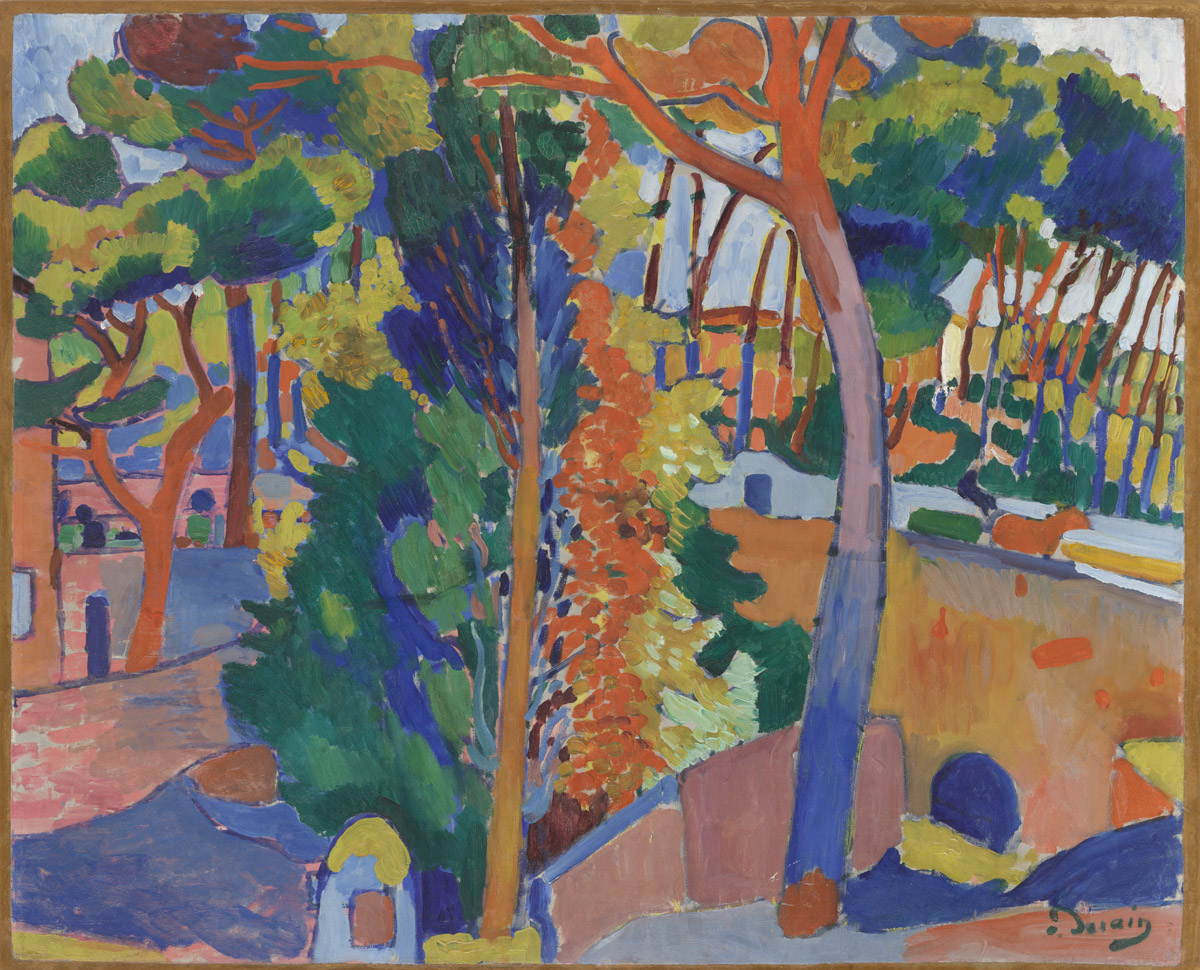
Bridge Over Riou

André Derain (France, 1880–1954), “Bridge over the Riou,” 1906, oil on canvas, 32 1/2 x 40 inches. The Museum of Modern Art, New York. The William S. Paley Collection.
© The Museum of Modern Art, New York. The William S. Paley Collection

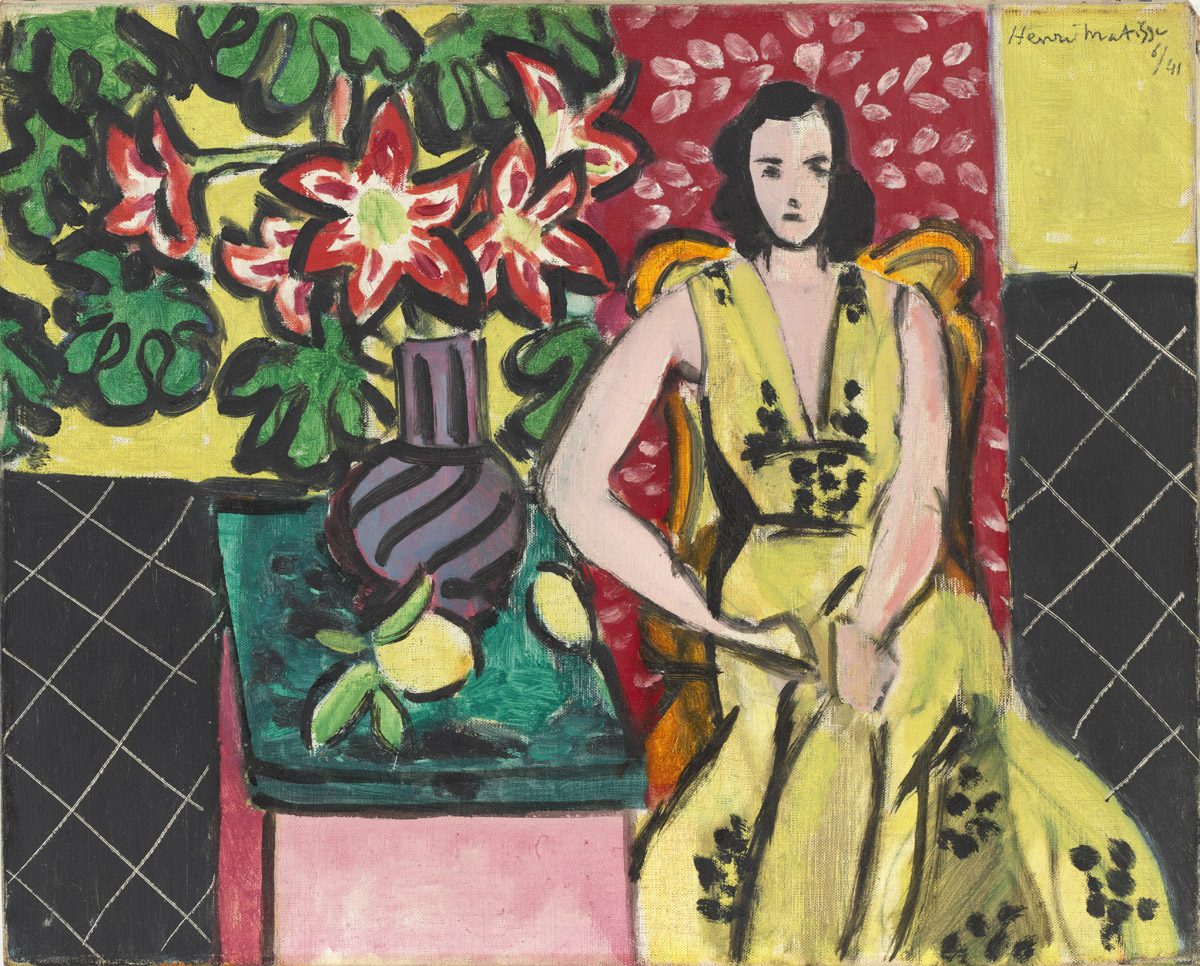
Most, but not all, of the works in this exhibition from the Paley Collection are French and they are virtual alphabet of the gold standard of French Modernist artists of the late 19th. Century to the mid 20th. Century: Bonnard, Bourdelle, Braque, Cezanne, Dega, Derain, Gauguin, Giacometti, Gris, Lachaise, Moillol, Manet, Matisse, Picasso, Redon, Renoir, Rouault, Rousseau, Toulouse-Lautrec and Vuillard. Add to that these mostly small scale works are first-rate examples by these artists and this gives a very good reason for my Quebec and Ontario readers to plan a trip the Musee national des beaux-arts du Quebec to see the exhibition at its only Canadian venue. Even if you were to visit the Museum of Modern Art in New York, once this exhibition has completed its tour, you would not see so much of Paley Collection at one time as they only show parts of the collection on a rotating basis.

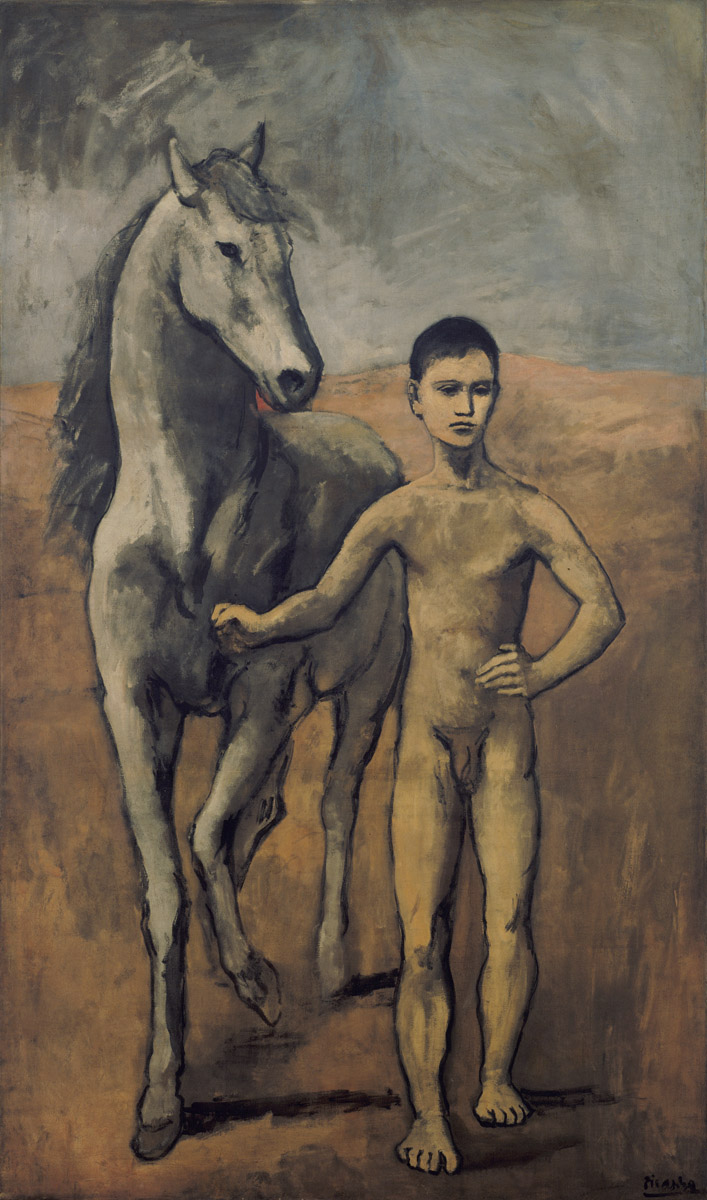
Boy Leading a Horse

Pablo Picasso (Spain, 1881–1973), “Boy Leading a Horse,” 1905-1906, oil on canvas, 7 feet, 2 7/8 inches x 51 5/8 inches. The Museum of Modern Art, New York. The William S. Paley Collection.
© The Museum of Modern Art, New York. The William S. Paley Collection.

Several of these artists are presented in depth in the exhibition like Cezanne, Matisse, Picasso and Roualt. It is difficult to pick individual works from so many masterpieces, but I might start with Picasso’s iconic, Rose Period, work, Boy Leading a Horse, from 1905-1906. One of the largest paintings in the exhibition at over two metres in hight, it is an image that is familiar in the history of art and an early work by the Spanish born artist. The Rose Period, 1905-1906, was a transition for the artist from Symbolist motifs drawn from other artists like Puvis de Chavannes to the art of his own invention such as Cubism which was to follow in less than ten years. I have seen this painting a number of times and it always stops me in my tracks as I am dumbfounded by Picasso’s youthful genius. He had no right to be so good so early and go to so many, even better, things over a long life.

On the subject of Cubism, one of Picasso’s great works, The Architect’s Table (1912), from this period is included in the exhibition. It is hard to understand that this painting is from the same artist who painted Boy Leading a Horse and that is the magic of the artist as because every time he reaches a high point in his career he changes direction and it’s sometimes one hundred and eighty degrees. While other artist will find a niche and stay there profitably their whole life, Picasso was like a bull, and a bull is an apt metaphor for the artist, in a china shop, breaking things, mainly the history of modern art, and coming up with new forms to confuse the public. Cubism was certainly something that not only confused the public, but angered them as well. Cubism is now over a hundred years old and many people still are befuddled and, hence, unhappy with paintings like The Architect’s Table.

Cezanne’s small still life, 53cm x 61cm, from 1979-80, Milk Can and Apples, stands out and is an excellent example of why this artist was so important in the development of Modernism. What shows through in this small work is the sheer act of painting rather than an attempt at traditional realism. The struggle to create a new form of artistic expression is self-evident and it easy to see why so many artists at the beginning of the 20th. Century looked to Cezanne for inspiration. There are just so many paintings in the Paley Collection that are outstanding that it would take a book to do the exhibition justice and, indeed, there is one, a catalogue of the collection from the Museum of Modern Art written in 1992, which is still in print, and on sale at the exhibition that is worth reading.

I like Modernism because it is what I think art, mainly painting and sculpture, should look like and perform in society and by that, I mean provide a backdrop of a civilized culture. I assume William S. Paley shared my view, but he had the money to pursue his passion. All the works in this exhibition were from his personal collection and ended up as a gift to the Museum of Modern Art in New York where he served as a longtime board chairman (1937-1990). What a gift, what a collection, I doubt that it could be repeated very easily today as it was not just money he spent, it reflected his taste and a half of a century of collecting.

Seated Woman with a Vase

Henri Matisse (France, 1869–1954), “Seated Woman with a Vase of Narcissus,” 1941, oil on canvas, 13 x 16 1/8 inches. The Museum of Modern Art, New York. The William S. Paley Collection.
© The Museum of Modern Art, New York. The William S. Paley Collection.

© Virgil Hammock, Sackville NB Canada, Wednesday, 7 August, 2013.

h1

Around about seventy-five

January 15, 2014

Funny thing about life, you really don’t recognize its worth until you’ve used most of it up. Take me. I have just passed seventy-five and I am only now beginning to figure it out. All of my life I have had this interest in art, no, it really is an interest in beauty, and art, good art, that is, and there is precious little of that. Art is a window, a glance, into the nature of beauty. I have spent my entire life in pursuit of beauty. It has been a perpetual carousel ride always reaching for the brass ring and never quite grasping it. Not that I am sorry. It has been interesting and there have been highs as well as lows. I should go back to the beginning. My life, like most, has not been exceptional. I was born in southern California, but spent most of my youth around San Francisco and the Bay Area. My first two years of high school, however, were spent in England where my father was working for an American company that was doing an engineering project for a British oil company. Certainly those two years changed my life and are responsible for what I am or am not today. Now this is a story about art and not about me, but it is hard to do one without the other.

I should mention one other thing. My sight. I was about as nearsighted as you can be. Before my cataract operation a few years ago, I would, without my glasses, walk into walls. I have always had a morbid fear of going blind. Indeed, years ago I suffered a detached retina in my then ‘good’ eye and came within hours of totally losing sight in that eye were it not an emergency operation by an exceptionally skilled eye surgeon. As it was I lost thirty percent of my vision in that eye. So I have always thought that I had better see things while I could. I viewed myself as a sort of collector. A collector of visions that I could store just in case I needed them at some later date. Early on I saw art as magic. It appeared to me as a child as a method of living vicariously off the talents of others. How wonderful it was for a nearsighted little boy with thick glasses to look at reproductions of paintings in books. When I looked into the eyes of a sitter in a portrait they looked back at me and told me, silently, their story. Landscapes opened wide vistas of places that I had never been and could perhaps never go. In my world of imagination I was never laughed at, as I was in real life, I was part of the picture; I was in the picture. If this sounds like escapism—it was, but what better place to be? Did I say that I was left-handed? This further added to my feeling of being different. Not only couldn’t I see, I wrote, awkwardly with the wrong hand, nor could I spell very well. The words just didn’t seem to want to stand still for me. Dyslectic? Probably, but they didn’t use the word much in the early 40’s when I started school. Two things that I could do well as a child, I could draw and I could talk. Boy, I could talk a blue streak and big words too, only I couldn’t spell them.

Then into my little world came Europe and a chance to see those pictures for real and to see some of those places that I had so firmly fixed in my mind. I would like to say that I was disappointed, but, to my great joy, the real thing was, well, the real thing. In reality the only two places that I saw then were London and Paris. We lived just outside of London, in Surrey, and we visited Paris twice, but that was quite enough to change my life forever. Those pictures in books turned out to be painted by real people who lived, loved, and died. They, the paintings that is, were much nicer in person than in books. You could touch them (only when the guards weren’t looking) and the colour was certainly different from the books. Some of the paintings were big, real big, and, others were much smaller than I had imagined, but big, it turned out, wasn’t necessarily better. These revelations happened to me between 1952 and 1954 and, the beauty of it was, that this was before art galleries and museums were so damn popular that you can’t see the pictures for the people, nor were there ‘blockbuster’ exhibitions that turned staid museums into carnival sites so I could have my pleasures in relative solitude. My elitism came at an early age. I never saw painting as for everyman, not to mention every woman, I knew from the start that the appreciation of painting was very different than real life. I saw it as a secret language from artist to viewer. You need not be rich to be this type of elite, only responsive to the language. I was thankful that the rich generally made it possible for the artists to do their work and thankful that the state somehow got hold of the work and put in it to places where I could see it for free. It is a pity that today most galleries and museums are no longer free and a kid of today would have a hard and expensive time spending as much time looking at pictures.

It is a good idea to start young if you are going to love art. Look how easily children pick up a language. In no time a all a young child placed in new country speaks the language as well as a native speaker and without a trace of accent while an adult, in the same situation, if they can learn the language at all, invariability ends up with an awful accent. The language of art is no different. The problem is that society, at least ours, is generally blind to this language. This is a world of words. One person’s dog is another’s chien or hund. These animals look remarkably alike in paintings regardless of where they were painted. I am not convinced, however, that art is a universal language. Dutch painting is Dutch painting as is French painting French, regardless of canine content, but it is possible to have a pretty good understanding of both Dutch and French painting without understanding their written languages because painting the world over does have much in common.

Let’s go back to me as a boy coming into contact for the first time with great art. Here I go being an elitist again because, by great art, I mean art in the Western European tradition. After all it was 1952 and Post Modernism was some years off and I was thirteen or fourteen at the time. So, here I was in the National Gallery in London. It was quiet, dusty, and I was quite alone. On top of all of this I really didn’t know a hell of a lot about art except that I was keen to learn, but I was in the candy store with a nickel in my pocket. Where do you start? There are thousands of pictures in the gallery most by people I have never heard of. A good place to start is to find pictures you like. It really doesn’t matter if you are nine years old or ninety years old or if you are an expert or someone in the gallery for the first time—view with your eyes and feel with your heart. My taste at this time was rather saccharine, but it was mine and probably more honest than it is now after two degrees and thirty-seven odd years teaching the subject.

MadonnaThe choice at the National Gallery ranges from Fra Angelico to Francisco de Zurbaran. While they have a particularly rich collection of Italian Renaissance paintings many of which are from what I call the Bambino School. I found it difficult, even at fourteen years old, to take the subject matter of these paintings seriously. Raphael’s (1483—1520) very small Madonna and Child with the Infant Baptist is good illustration of the problem. While he has never been a favourite of mine, Raphael was certainly a fine painter. Typically, in this sort of painting, the Christ child (and in this example, the Baptist as a child as well) is presented as a miniature adult and the Virgin in a plastic Barbie Doll fashion. The subject is a means to an end. Artists painted pictures to order, be they religious pictures or portraits of notable citizens. This is not to suggest that Raphael, or any other Italian artist of the period, did this picture with tongue in cheek and laughed all the way to the bank. I am certain that there were artists who had firm and conventional religious beliefs as I am equally sure that there were artists who could care less if they painted a nude or the Virgin Mary as long as they were painting and getting paid. We tend to forget that while genius was recognized in a few artists during the Renaissance, painting was a trade, even a union job. You paid your dues by completing a long apprenticeship with an established artist, or master, eventually painting your own ‘masterpiece’ and were admitted to the guild as a master craftsman.

I did spend a lot of time in front of this Raphael, and other paintings of his in the collection because he is one of the best known artists in history and I figured there had to be good reasons. Many people know the name Raphael even if they have never seen one of his works. To understand why he is a great artist I needed to look no further than his painting of Pope Julius II. Here was quality, not that I counted myself as a connoisseur at the time. In this remarkable picture the sitter, a very old man, does not look at us, but appears to be lost in thought as if contemplating his own mortality. Corny take? I don’t think so. Julius II was the warrior pope, the pope who commissioned Michelangelo to do the frescoes for the Sistine Chapel. He was a man whom I am quite sure did not take thoughts of his own mortality very easily. It well may be a mug’s game to second guess what was in the mind of an artist or his sitter especially those dead for hundreds of years. It’s not very fashionable these days to talk about meaning in pictures in the way that I describe Raphael’s painting of Julius II. One should properly do a post-modern take or formal analysis. My description echoes Victorian sentimentality–looking for noble meaning in noble pictures. I guess that I am guilty, but there are greater sins.Pope_Julius_II

What makes one painting better than another? Why is Raphael a better painter than a host of other artists of the same period? Two qualities stand out that he shares with other great artists. One, there is generally some bit of originality in the work and, second, a great painter is almost always just technically a better artist. I am very guarded here because it is dangerous to say that anything is always true. There are great artists who are not very original and others who are not technically great, however, you can be sure that any great artist will be outstanding in one of these areas. Let me get this off my chest at the start. I do not believe that taste in art is totally subjective and that one person’s opinion is as good as another’s. A majority of the qualities that make a work of art great are objective and can be categorized. You would not ask your butcher’s opinion on whether or not you were ill nor would you want him to perform major surgery on your person based on his opinion. You would be happy, however, to ask him about various cuts of meat and how to lard a roast. Ill informed opinion on art is just that, ill informed, and it is likely, at last analysis, to be wrong. I can temper all of this by stating that in the Middle Ages the barber and the surgeon were likely to be the same person, but one can assume that a hair cut was a lot safer than surgery.

There are large measures of both qualities, originality and technical competence, that separate great art from the commonplace to be seen in Raphael’s portrait of Julius II. I knew it intuitively as a child when I first saw the work that it was something special and my intuition has been reinforced by what I now know as an adult. I have already commented on the unusual composition. The sitter is placed diagonally to the picture frame rather than perpendicular to it which is the more usual practice. The sitter looks not at the viewer, but at someplace over the viewer’s right shoulder. There is a powerful psychological content. All of these qualities can be called originality. Technically Raphael was a boy wonder doing absolutely amazing paintings by the age of twenty such as the portrait of Angelo Doni (Florence). His use of colour is quite outstanding as is his brushwork; both of these qualities are self-evident in the Julius II portrait.

I have gone on at some length about Raphael and he is a painter that I really don’t like that much, however, he is certainly a great artist of the first rank. My liking him or not liking him has little do to with it. There is always the possibility of recognizing a great art work without liking it. The liking of a work of art is the subjective part while the greatness is objective part of the equation. I never apologize for my taste, however, I should temper this with the fact that my taste is forever changing. At any given point in my life, my taste is my taste and I am stuck with it. To look at art is to learn and I have learned something from every work that I have seen be when I was fourteen or fifty.

I have come to the conclusion that I am firmly mired in the past. This does not make me a reactionary but it does reflect on my doubts about the inevitability of progress in art or, for that matter, anything else. The mantra that every day, in every way, we are getting better and better does not stand up to the lessons of history. The ups and downs of human progress are well documented—golden ages followed by dark ones, civilization replaced by barbarism, the banquet years of the belle époque followed by the horrors of the First World War and the list goes on. It is not possible to go back, bridges have already been burnt. We march towards our own decline like every other civilization has in the past, convinced somehow that we can avoid the mistakes that other societies made. If all of this sounds rather grim let me assure you that it is. I have used art, in particular painting and drawing, as an escape from reality. In art one can see the genius of the human condition. Through art I can see the things that people can make with no more than their hands and that, most wonderful of all things, is human imagination. Escape is not a bad thing as long as I recognize what it is I am escaping from and my reasons for my flight.

© Virgil Hammock, Sackville NB Canada, Thursday, January 9, 2014.

h1

Se Camoufler à l’ére de

January 8, 2014

Jeffrey Poirier
Se Camoufler à l’ére de
Centre des arts et de la culture Dieppe
331 avenue Acadie
Dieppe NB E1A 1G9
(29 November 2013 – 28 February 2014)
This article was originally published in
The Saint John New Brunswick Telegraph Journal Salon Section
on Saturday, December 28th. 2014.

se camoufler largeWhen I walked into the gallery space at the Dieppe Arts and Culture Centre and saw Jeffrey Poirier’s installation, Se Camoufler à l’ére de, my first thought was that it was made of plastic and was some sort homage to Lego, but, as I got closer to the work, I realized that it was something quite different and much more interesting. Rather than plastic blocks, the work was constructed of folded cardboard and coloured tape; more a homage to origami than to Danish toy blocks. I am not generally a big fan of installation works which I often find boring and, more often than not, sloppy in their execution. This work is strikingly beautiful both in its construction and installation and it is certainly not boring. The gallery is, first, a very handsome space for this type of art: a glass fronted box which allows the viewer to see the work from outside the gallery. As well, the space provides for dramatic lighting that is done very well in this exhibition. I think that this is the nicest small exhibition space that I have seen in the greater Moncton area.

Poirier is a French born, young Quebec artist with a recent MFA, 2012, from Laval with a rather impressive record of installation works in Quebec and, as far as I can tell, this is his first exhibition in outside the province. Se camouflager à l’ére de is, to its credit, labour intensive and, I am told by Luc Gaudet, the director of Dieppe Culture Centre, is a cooperative effort by the artist and his friends, with Poirer’s ideas being realized by a joint effort in its execution. A rough translation of work’s title, a sentence fragment, is: ‘to hide or camouflage oneself in the age of’ which certainly speaks of ambiguity and that is the installation’s primary quality; what you think you see is not actually what is there. The term trompe l’œil comes to mind which is a fancy term, generally about painting, but works here as well, to fool the eye. I don’t mind being fooled when the result is enjoyment.

An element of this installation that works in its favour is its scale. Large is not necessarily better, but here the size is just right. Poirier says, in his online artist’s statement, that he enjoys constructing his sculpture is situ or on site to fit where they are made. He needs to think about how can he use the exhibition space to maximize the effectiveness of the work, tailor it to space. This is very different from hanging paintings on a wall or placing sculptures in a fixed gallery space. Lighting, as I said earlier, is certainly an important part of this exhibition. Here the light isolates the work within the darkened gallery giving it a sense of drama that would be lacking in a uniformly lit space.

There is a playful qualise camoufler detailty to the work as well that illustrates the artist’s sense of humour, as I looked closely at it, I came across an adhesive price tag still stuck to the folded cardboard material used in its construction for $3.99. If you take your time with this work you well be rewarded. Another element, I found interesting, which links back to its ambiguity, is the material wrapped around the installation’s right side. I cannot tell if is supposed to wrap around the back of work and appear, like a piece of tape, in the cut out window of the white wall or the opposite, the leftover from the stuff in the window, trailing off and falling on the floor. Either way, it is an interesting coda that completes the work.

In the end, Se camouflager à l’ére reminds me of a modern take on Piet Mondrian and Constructivism if nothing more than both artists use of coloured tape and little more than primary colours in Poirier’s case yellow, blue, red and green. As well, Poirier shares both simplicity and clarity with the Dutch master. Of course, Poirier is a young artist just starting out on his career and it might be unfair to saddle him with a comparison with Mondrian, but it is good to come across a young artist with a fresh vision who is not afraid of hard work.
I certainly look forward to seeing more exhibitions at the Dieppe Arts and Culture Centre and I recommend that people in the greater Moncton area take the opportunity to see this exhibition. It is worth it.

© Virgil Hammock, Sackville NB Canada, Sunday, December 22, 2013.

h1

So let us be Finns

August 28, 2013

“We are no longer Swedes, and we don’t want to be Russians—so let us be Finns.”- 19th century Finnish saying.

(This article was originally published in Artsatlantic #64, Summer/Fall 1999, pgs. 45-48)

Any country with an identity crisis should be of interest to Canadians as much of our history has been a search for our own identity. So when a Finnish friend of mine, art critic and artist Antero Kare, invited me to Finland last fall to give some lectures on Canadian art I jumped at chance to learn something more about this Nordic nation and, in particular, what role art plays in Finnish identity.

Late October in Finland is not tourist season. Daylight hours are already short and, at least while I was there, the sun never shone. But then Canada isn’t famous for its weather either and while the skies might have been grey while I was in Finland, the hospitality was anything but. I had told Antero that I was interested in finding out all I could about Finnish artists, art galleries and art education. I wasn’t disappointed. I had a full schedule during the two weeks that I was there, visiting many different places and meeting the key players of the Finnish art scene.

It had been arranged for me to give lectures at the Helsinki Academy of Fine Arts and at the Satakunnan ammattikorkeakoulo in Kankaamnpää—the latter being a new art school in a town about four hours by bus from Helsinki. One thing that I have noticed over the years is that art students everywhere are very similar and those in Finland are no exception—they dress the same, most of their work looks very similar (right out of current art magazines), and they think that their teachers are ‘old hat’.

However, there is one major difference from Canada. Post secondary education in Finland, while highly selective, is free. Not only does the state pay tuition, it provides students with a stipend to cover some of their expenses. The results of this policy are that the student population more closely mirrors that of the general population than it does in Canada and that students can finish their education free of debt. Further, more students choose to study subjects such as fine arts rather than those which might be seen as directly related to the job market.

Finland, like other Scandinavian countries, spends quite a bit of money on culture.

This is because culture is taken very seriously not only by the government, but also by the people on the street. There is considerable support by all levels of government right down to the municipalities. Cities and towns give their own artists grants, supply studios, and have active contemporary galleries and sculpture parks. Certainly there is more active support for the arts from the middle class and above, but as well there is an appreciation of culture from all levels of Finnish society.

Finland has been an independent country since only 1917 after centuries of rule by Sweden and Russia. One factor that has saved their culture over a thousand years of foreign domination has been their unique language. Words such as the before mentioned Satakunnan ammattikorkeakoulo and Kankaamnpää do not easily roll off the tongues of non-native speakers of Finnish.

Their epic saga, the Kalevla, has also reinforced a national identity. Late in the 19th century Finnish artists, in particular Akseli Gallen-Kallela and Pekka Halonen, used landscape painting as an symbol of nationalism. The artists in the Group of Seven are synonymous with the issue of Canadian nationalism and there is a direct connection with Scandinavia art from the late 19th and early 20th century. The Group needed a model for their nationalistic art and they found it in an exhibition in January of 1913 as Lawren Harris recalled in 1954: “ (J.E.H.) MacDonald and I had discussed the possibility of an art expression which would embody the varied moods, character and sprit of this country (Canada). We heard there was an exhibition of modern Scandinavian paintings at the Albright (Knox) Gallery in Buffalo—and took the train to Buffalo to see it. This turned out to be one of the most exciting and rewarding experiences either of us had. Here was a large number of paintings that corroborated our ideas. Here were paintings of Northern lands created in the spirit of those lands and through the hearts and minds of those who knew and loved them. Here was an art bold, vigorous and uncompromising, embodying direct first hand experience of the great North, and our conviction was reinforced…From that time on we knew we were at the beginnings of a great adventure.”

I was not sure that national identity was still a problem in Finland but, as I found out, there are new worries on the subject now that the country is becoming a full member in the European Union. There very well might be, in some peoples minds, a loss of a measure of their uniqueness. The EU demands uniformity in many regulations. One example that was repeated to me more than once, was that in Finland there is something called the rule of first sale which means that when an artist makes the first sale of an art work, be it through a dealer or a private sale, there are no taxes on the sale. No small thing in a country whose version of HST is 22 ½%. Europe wants this rule changed, but so far, in a fight led by the Artists’ Association of Finland, the rule remains.

One of the first places that I visited was the Artists’ Association of Finland office in downtown Helsinki which is located in a handsome block square 19th century building called House of the Art just kitty-corner from The Academy of Fine Arts.

I spoke with president Kari Jylhä and acting secretary general Liisa Murto. The association is an umbrella organization for the visual arts in Finland and has over 1500 members. The membership is divided into separate groups: the Finnish Painters Union, the Association of Finnish Sculptors, the Society of Finnish Graphic Artists, the Society of Artist Photographers, and Union of Finnish Art Associations. The Artists Association was founded in 1864.
Kari told me that the Association is a strong voice for the visual arts in Finland and that nearly all professional artists in the country are members. Individual membership in the various sections of the Association is by election. Artists must have a certain number of professional level exhibitions before they are qualified for membership. The number of exhibitions varies from union to union, but the emphasis is on professionalism. Certainly artists can operate outside of the Association, but very few do as opposition to unions is rare unlike it is among North American artists who generally see themselves as rugged individualists.

The Artists’ Association of Finland championed ideas such as the tax free government grants that are given to artists for one, two or three years. The current grant is worth 70,000 FIM (about $22,000C) per year. They also administer copyright laws that apply to the visual arts. These laws give Finnish artists far better protection than do our copyright laws in Canada. Finnish laws provide compensation for the reproduction of art works, artist fees for exhibitions, fees for works shown on other media, and a droit de suite law that gives artists 5% of the resale price when one of their works is resold in Finland. Further, the copyright protection continues for seventy years after the death of an artist.

The following day I visited Kiasma, the brand new contemporary art gallery in Helsinki. This new five storey building was designed by the American architect Steven Holl. I spoke with director Tuula Arkio who told me that the gallery’s mandate is Finnish and international art from 1960 on and that the collection was formerly housed in the Ateneum, the Finnish National Gallery. The gallery opened its doors in May of 1998 with a major exhibition called This Side of the Ocean which was concerned with the question of identity in Finnish art. What I found strange was that when I visited the gallery in October of 1998 that Finnish art was notably absent from all of the gallery’s walls and the major exhibition was of the work of the American artist Bruce Nauman. I was not sure if this was due to the gallery’s desire to encompass internationalism or if it showed a lack of confidence in contemporary Finnish art. I was assured by the director that what I saw that day in the gallery was an anomaly and that the permanent collection had yet to be installed. Nevertheless, this left me in the position of seeing very little contemporary Finnish art in an institutional setting in Helsinki.

The new building itself, like so much new museum architecture—such as Frank Gehry’s new Guggenheim Museum in Bilboa, Spain—is more an architectural statement than a functional building. Kiasma looks more like a giant outdoor sculpture than an art gallery. This is rather the opposite of the old modernist adage of form following function, but these are post-modern times and I wouldn’t want to get into the way of an architect’s ego. Nevertheless, I found the interior layout of Kiasma to be very confusing. Just getting from point A to point B proved to be quite a task. However, there is no denying that the metal clad building stands out in its setting amidst the more traditional architecture of its downtown neighbors.

During my first weekend in Finland I took a train to the city of Lahti to meet the sculptor Olavi Launi. He is one of the best known senior artist in Finland. Now in his early seventies he represented Finland at the Venice Biennial in 1978 and his work is in many collections in Scandinavia and elsewhere. What I wanted to see was Launi Park. It is a sculpture park in Lahti that is dedicated to the work of the artist. Here some twelve large sculptures wind around a wooded hillside at the edge of the city. The works were completed between 1989 and 1995. To say that he is highly regarded in Lahti is an understatement. While walking through the park with the artist and his wife Tarja—who is a painter and acted as a translator to the non-English speaking Olavi, we were approached by a young Finnish woman and her American boy friend because they had heard us speaking English. Lahti, it appears, is not a place where you find many tourist at least in late October. When she found out that I was interviewing Olavi Launi, she said, in her excellent accent free English, that it was “awesome” to meet the famous artist and insisted that she have her picture taken with him so she could show it to all of her friends. It would be difficult to imagine such an event taking place in North America where most people would be hard pressed to come up with the name of a sculptor much less hold an artist in the high regard as this young woman obliviously did Launi.

During the next week I met more artists, museum directors, curators, art critics and editors. I travelled to Tempere and visited the city museum of art; the Sara Heldén Art Museum of Contemporary Art; the Lenin Museum (this museum shows contemporary art, but is the place where much of the planning for the Russian revolution took place and where Lenin first met Stalin); and Museokeskus Vapriikki where there was an outstanding exhibition on Arctic shamanism.
I spoke with Kimmo Sarja, a Helsinki artist of a younger generation than Olavi Launi, whose work was included in Kiasma’s exhibition This Side of the Ocean. Kimmo had studied in New York in the Whitney Museum Independent Study Program, but he also has a degree in Political Science from the University of Helsinki. He is currently completing a Ph.D. at University in Aesthetics. I was interested in his ideas about the issue of Finnishness in contemporary Finnish art. His work in This Side of the Ocean, which was done with film-maker Kimmo Koskela, was a video of interviews with senior Finnish intellectuals on the subject of what it means to be a Finn. Those interviewed included writers, artists, composers, philosophers, psychiatrists and art historians. The youngest of this group was sixty-five years old and the oldest had died in 1997 at the age of ninety-seven.

Kimmo was concerned that the voice, and the image, of these people be preserved for future generations. These people such as artist Aleksanteri Ahola-Valo and philosopher Sven Krohn were, in Kimmo’s opinion, the foundation of Finnish culture. His fear is that their voices and ideas might be lost in Europe’s headlong rush into gobalisation and in tandem, some of what it means to be a Finn. Kimmo also believes that the voice of the old, along with their experiences, are often over-looked in a world obsessed with youth and technology. His video is a testament to the belief that we are results of our collective histories and that without a shared past we face a doubtful future.

My host, artist Antero Kare, like Kimmo Sarja, studied at the University of Helsinki rather than at an art school. Kare combines science, principally archaeology and microbiology, with painting and sculpture with interesting results. His ‘living’ paintings, which are works that are painted with live, and I might add harmless, microbes, have been exhibited in both Europe and the United States. These paintings are quite literally about life and death. The large abstract paintings change in colour as the microbes go through their short life cycle. The colour only becomes stable with the death of the microbes.

Antero’s most recent work are installations that combine video images, sound and sculpture. An installation in an exhibition in Austria last fall was of a carved moose head within a closed glass environment. The moose head was coated with microbes which grew during the course of the week long exhibition. The piece, complete with video images and sound, was about the wilderness and the place of nature in a northern country. I thought that this piece was a perfect demonstration of the similarity between Canada and Finland. We may not be world powers nor are our artists world famous, but we do have moose in some abundance.

On my last day in Finland I had an interview with Soili Sinisalo the director of the Finnish National Gallery, the Ateneum, in Helsinki. This gallery is responsible for Finnish art prior to 1960. Sinisalo is an art historian who not only knows historical Finnish art, but is very aware of the contemporary scene as well. I was interested in what had influenced Finnish art over the last century. She told me that the major influences were from Russia, through St. Petersburg and Paris. I could see the French influence in much of the art, but was less aware of that coming from Russia; it made sense as St. Petersburg is very close and Finland was controlled by Russia until 1917.

Sinisalo also knew of the Scandinavian influence on the Group of Seven as her museum lent works to the Art Gallery of Ontario’s 1984 exhibition, The Mystic North. This exhibition, curated by Roald Nasgaard, showed the similarity late 19th and early 20th century of Scandinavian and Canadian landscape painting. I came away from the interview with Sinisalo with the strong conviction that Finland was a country with a short history as an independent nation, but with a long history as a people because they have a sense of themselves through their culture and art.

The high regard that average Finns have for all their artists is because of their excellent education in the arts and the subsequent importance that culture takes on in their day to day lives. Would that it were the same in North American, but I am afraid that what culture means to most Canadians is, at worst, the latest American television situation comedy or, at best, Masterpiece Theatre on PBS. Both of these examples, one low brow and the other, middle brow, are imported and reflect our reoccurring belief that if it is from someplace else, it must be better than anything that could be done here. I have often thought that if we had our own unique language—and I don’t mean French which is fraught with its own problems—and a currency that was called something other than a dollar, then we would have a much stronger culture than we have now. At least it would be ours, just as Finland’s is theirs and something that they take pride in.

© Virgil Hammock, Sackville, NB Canada, 11 January 1999.

h1

Surely, You Jest, Professor Hammock?

August 7, 2013

Recently I received a link from a friend. The video gave me pause and clearly my friend, a professional sixty-one year old artist, was upset over the absurdity of it. The child in question, Kieron Williamson, while not untalented, is no genius. The paintings are B flat landscapes which were they done by an adult would, if they sold at all, go for a fraction, very small fraction, of what Williamson received. I am happy for him and his parents. I can see by the video of him playing football with his chums that he is just a normal boy who in his spare time flogs paintings for ₤50,000 a pop. His lifetime earnings, all five years of it, far outstrip that of most famous Canadian artists that come to mind.

Of course, if I were one of his parents, I would take the money and run and hope that kid keeps turning them out. I would set up a trust fund in his name, which I am sure has been done as ₤1,500,000 is a lot of money, but that begs the question that something is really wrong with the art market. The old adage of a fool and his money or victimless crime spring to mind. If somebody is stupid enough to pay that kind of money for mediocre art who am I to stop them and Williamson’s paintings seem to be a bargain compared to the idiot who paid eleven and a half million quid for British artist Peter Doig’s maybe canoe painting. What’s with these Brits like Doig and Hurst, leaving wunderkind Williamson aside, who make so much with so little talent? I am fully prepared to be proven wrong by history. If fifty years from now these artists and their works are deemed masterpieces by masters, you may use my name as an example of a narrow minded twit who didn’t know genius when it was in front of him. Of course, I will be dead for at least thirty years by then and sticks and stones may my hurt my bones, but names will never hurt me.

Durer-self-portrait-at-the-age-of-thirteenI am not against child genius artists, Albrecht Durer turned out a pretty wicked silverpoint self-portrait at the age of thirteen and Mozart was knocking them dead at seven. I would like to think that they were exceptional, but I have been assured by many parents that I know, particularly university colleagues, that their children are all exceptional as well and destined for great things.Wolfgang-amadeus-mozart_2 A golden age will surely emerge and we will live in a bright new world. It’s too bad we couldn’t have all had exceptional children a few generations ago and the world would not be in the mess that it is in now. We should leave things to progress (Capitalism), leave old ideas and old people behind, as the future is always going to be better. I, like everyone else, can hardly wait for the iPhone6. Although, my iPhone4S is already smarter than I am, but it is not about using it, but owning it

Detroit, in case you have been living under a rock and missed it, has filed for bankruptcy. There is talk of having to sell off all its assets which included the collection at the Detroit Institute of Arts. If there was ever a dumb idea this one would have to top the list. The Institute is (or was) one of North America’s greatest art museums with a collection to match its reputation. Yes, the collection is worth billions, but not nearly enough billions to get the city out hock. Once sold, they could never be bought back at a price the museum could afford, in fact the real masterpieces of the collection, if sold at auction, would not be affordable to other major institutions. The works would end up in the private collections of the same sort of morons who pay eleven million plus pounds for canoe paintings and, very likely, stored in vaults in Switzerland never to be seen again.

I understand that if I were relying on a pension from the city of Detroit and had the choice between continuing to get my pension or viewing masterpieces that I would opt for my pension and that is the way this issue is being played in the media. Would that it were it that simple. Money collected from the sale of assets in this sort of bankruptcy go first to the needy like the banks and bondholders with the pensioners far down the list. All in and all, not a happy picture and likely to end badly for all concerned. Perhaps, the best thing is not to think about any of the issues that I have raised and hope that they will go away. We have, after all, the world we deserve as we, in North American, at least, have elected the successive governments that have created this mess, our mess.

© Virgil Hammock, Sackville NB Canada, Sunday, 4 August, 2013.